

Imagine you have a brilliant idea for a new piece of software. You could hire a team of developers and tell them what to build, but that’s a bit like handing a construction crew a napkin sketch and expecting a skyscraper. A software development consulting firm is the master architect you bring in first.
They don’t just ask what you want to build; they start by asking why. They’re strategic partners who dig deep into your business to design and build the right solution—the one that actually moves the needle.
What Exactly Is a Software Consulting Firm?

It’s easy to mix up software consultants with coders-for-hire, but they play a fundamentally different game. A standard development agency is your tactical expert. Give them a finished blueprint, and they’ll execute it flawlessly, much like a construction crew. Their focus is on the build.
A software consulting firm, on the other hand, is both the architect and the general contractor. They start by helping you draw up that blueprint, making sure every feature, technology choice, and workflow is directly tied to a business goal. This dual role closes the all-too-common gap between a good idea and a genuinely successful product.
The Strategic Blueprint Before the Build
The real magic of a consulting firm happens long before anyone writes a single line of code. They immerse themselves in your world—your operational headaches, your place in the market, your five-year plan.
This upfront strategic work is what prevents those expensive, soul-crushing mistakes, like sinking a fortune into a feature nobody wants or picking a tech stack that crumbles under pressure. To get a better sense of how they operate, it helps to understand the different software development outsourcing models. That context shows just how they can tailor their approach to what your business actually needs.
Ultimately, their job isn’t just to deliver software. It’s to deliver a measurable business outcome, whether that’s:
- Boosting operational efficiency
- Opening up a new revenue stream
- Dramatically improving customer engagement
- Slashing long-term technical debt
Beyond Code: The Advisory Role
What truly sets these firms apart is their role as advisors. They don’t just build what you ask for; they challenge your assumptions, refine your ideas, and offer a perspective you might have missed.
For example, a logistics company might come to them asking for a simple fleet management app. A true consulting partner would first analyze the entire supply chain, uncover deeper bottlenecks, and maybe recommend a full-blown platform that not only tracks trucks but also optimizes routes, predicts vehicle maintenance, and plugs directly into warehouse inventory.
A consultant’s job is to steer development toward solving the real business problem, not just to tick off a list of technical tasks. This strategic oversight is what ensures the final product delivers maximum impact and a solid return on your investment.
This advisory function becomes even more powerful when you work with a firm that understands your market inside and out. They bring more than just technical skill; they offer crucial insights into local regulations, customer expectations, and competitive pressures. A USA-based partner, for instance, provides the immense benefit of a shared cultural and business context, which makes for a smoother partnership and a product that feels perfectly built for its audience. The proof is in the numbers: the global software consulting market was valued at USD 344.69 billion in 2024 and is expected to hit USD 960.47 billion by 2033, showing just how critical this strategic approach has become.
Core Services That Drive Business Growth

It’s a common misconception that software development consulting firms are just advisors. The reality is they are hands-on builders, the kind of partners who roll up their sleeves and solve complex business problems with well-crafted technology. The services they offer are the tools they use to give you a competitive edge, make your operations run smoother, and find new ways for you to grow.
This work goes way beyond just writing code. A good firm brings a whole toolkit to the table, covering everything from core system architecture and security to advanced data analytics. Understanding what they can do helps you figure out exactly where they can add the most value to your business.
Custom Software Development
Have you ever tried to make off-the-shelf software fit your business perfectly? It often feels like forcing a square peg into a round hole. It might work, but it’s rarely efficient. Custom software development is all about building a solution from the ground up that is designed for your specific workflows, your unique challenges, and your long-term goals.
Imagine a logistics company wrestling with a generic routing app. A consulting firm could step in and build a custom platform that does more than just map routes. It could pull in real-time traffic data, accurately predict delivery windows, and even automate driver assignments. This isn’t just a tool; it’s a competitive weapon that slashes fuel costs and makes customers happier. The best partners in this space provide comprehensive full-stack development services, ensuring a polished, high-quality product from the user’s first click to the database behind the scenes.
The real goal of custom software isn’t just to automate a task. It’s to create a core asset for your business—a system that drives efficiency and opens up new avenues for growth that generic software simply can’t.
Cloud and DevOps Consulting
Today, the cloud is the backbone of almost every scalable and reliable application. But just “moving to the cloud” isn’t a strategy. Cloud and DevOps consulting is about architecting an infrastructure that’s not only powerful but also secure, cost-effective, and highly automated.
A skilled consultant is your guide through this complicated landscape. For instance, they could help an e-commerce company transition from a clunky on-premise server to a modern, cloud-native system. This isn’t a simple lift-and-shift; it involves:
- Optimizing Cloud Spend: Carefully selecting the right services so you aren’t bleeding money on resources you don’t need.
- Automating Deployments: Setting up CI/CD pipelines to push out new features and fixes faster and with fewer mistakes.
- Enhancing Scalability: Designing systems that can effortlessly handle massive traffic spikes during your busiest sales seasons.
This strategic approach turns your infrastructure from a potential bottleneck into a powerful engine for growth.
AI and Machine Learning Integration
Artificial intelligence and machine learning have moved from science fiction to the real world of business. They are practical tools you can use today to solve real problems. Consulting firms with deep AI expertise help companies use their own data to automate tasks, predict what’s coming next, and build smarter products.
Take a financial services firm trying to get ahead of fraud. An AI consultant could build a machine learning model that sifts through transaction patterns in real time, flagging suspicious activity with a level of accuracy that a team of humans could never match. The market shows just how critical this is: AI consulting is expected to be a USD 90.99 billion industry by 2035, while cloud consulting is on track to hit USD 500 billion by 2033.
Cybersecurity Strategy
In a world where everything is connected, protecting your digital turf is non-negotiable. A consulting firm with a serious cybersecurity practice acts as your strategic defender, safeguarding your systems, your customer data, and your hard-earned reputation.
Their job is much bigger than just setting up a firewall. They conduct deep security audits to find weak spots, create solid plans for what to do if a breach occurs, and make sure your software meets strict regulations like GDPR or HIPAA. For a healthcare startup, that means building a patient portal that isn’t just easy to use but is also locked down tight, protecting sensitive data and earning the trust of its users.
The Strategic Advantage of a USA-Based Partner

Choosing someone to build your software isn’t just about hiring a team of coders. It’s about finding a genuine partner who gets your vision and can translate it into a real product. When you work with software development consulting firms right here in the USA, you gain a home-field advantage that goes well beyond the code itself, directly influencing your project’s timeline, quality, and overall success.
This isn’t just a matter of geography; it’s about aligning with a business culture that prizes speed, security, and innovation. A domestic partner is already living and breathing the same market you are, which cuts down on misunderstandings and boosts efficiency at every turn. This shared context is a huge reason the sector is booming.
The U.S. market for software consulting was valued at USD 80.75 billion in 2024 and is expected to more than triple to USD 270.02 billion by 2034. That kind of growth shows just how much American companies rely on local experts for their most important tech projects. You can dig into more data on the U.S. software consulting market size and share.
Seamless Real-Time Collaboration
Let’s be honest: time zone headaches are a project killer. One of the most immediate and tangible benefits of a US-based firm is that everyone is awake at the same time. No more late-night calls or waiting a full day for an answer to a simple question.
This real-time communication is everything in an agile development world, where daily check-ins and quick feedback are the lifeblood of a project. If a developer hits a snag or has a question, they can get it sorted out in minutes, not the next day. This keeps the momentum going and your launch date from slipping.
Think of it this way: a domestic partner turns your project from a stop-and-start relay race into a smooth, continuous sprint. That constant alignment is the secret to getting better software out the door, faster.
Superior Intellectual Property Protection
Your code, your unique algorithms, your data—these are the crown jewels of your business. Protecting your intellectual property (IP) isn’t just a legal checkbox; it’s critical to your company’s future. Partnering with a firm in the USA offers the strongest possible shield for these assets.
US-based firms operate under some of the most robust and well-enforced IP laws on the planet. Your contracts are governed by a legal system you already know, making it simple to enforce non-disclosure agreements (NDAs) and protect your trade secrets. This provides a level of security that’s hard to match elsewhere.
You automatically benefit from key legal safeguards, including:
- Strong Copyright and Patent Laws: Giving you clear ownership and protection for your software from day one.
- Enforceable Contracts: US courts provide a reliable and predictable path for resolving any potential disputes.
- Strict Data Privacy Regulations: Ensuring your sensitive business and customer information is handled with the highest standard of care.
Deep Domestic Market Understanding
A USA-based firm doesn’t just know technology; they know the American market. They have a firsthand, intuitive grasp of the business culture, consumer behaviors, and complex regulations you navigate every day. This insight is baked into the project from the very beginning.
For instance, a team building a healthcare app will already have a deep, working knowledge of HIPAA regulations, ensuring compliance is built in, not bolted on. Likewise, a firm developing an e-commerce site for a California business will be experts on the nuances of the California Consumer Privacy Act (CCPA).
This built-in expertise saves you the time and money you’d otherwise spend teaching an offshore team the basics of your market. They can anticipate challenges and build solutions that are not only technically solid but also commercially smart and legally sound in the US.
How to Select the Right Consulting Firm
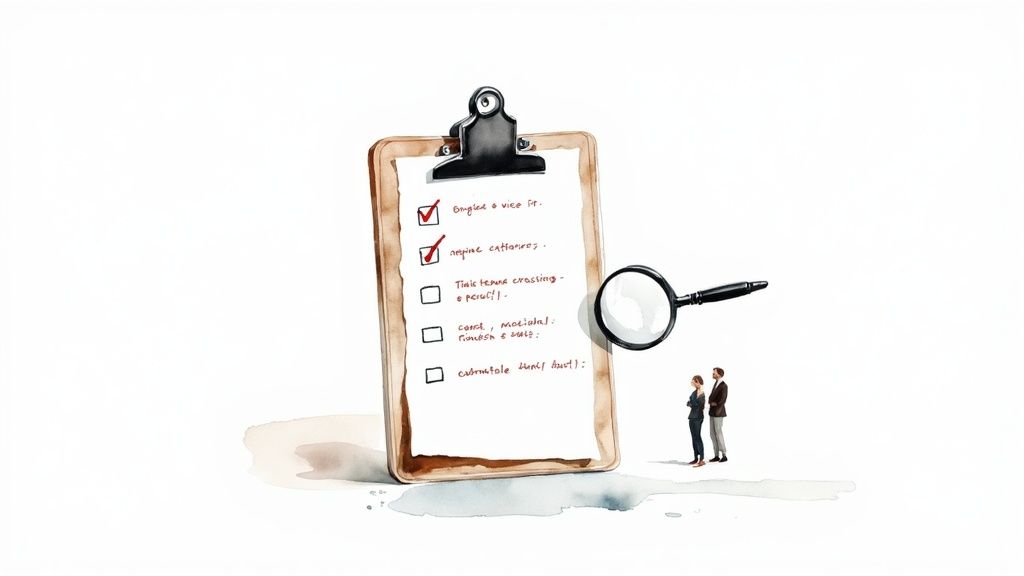
Choosing a technology partner is one of the most consequential decisions you’ll make for your business. This isn’t a time for gut feelings; it calls for a structured, deliberate approach. Get it right, and you can accelerate your growth for years. Get it wrong, and you’re looking at costly delays, wasted funds, and a lot of frustration.
The goal isn’t just to find the cheapest quote. It’s about finding the firm that delivers the most value because they genuinely understand your vision. By using a clear evaluation framework, you can move forward with confidence, knowing you’ve picked a team that’s truly equipped to help you win.
Define Your Project Scope And Goals First
Before you even start Googling software development consulting firms, you have to look inward. A successful project starts with absolute clarity on your side of the table. You need to know exactly what “done” looks like in concrete business terms.
Start by hammering out the answers to these core questions:
- What’s the core business problem we’re trying to solve? (e.g., “Our manual inventory process is causing a 15% error rate and killing our margins.”)
- What specific, measurable outcomes do we need? (e.g., “We must reduce inventory errors to under 2% and cut processing time by 40%.”)
- Who is this for, and what do they actually need? (e.g., “Warehouse staff need a dead-simple mobile app for real-time stock updates.”)
Having a well-defined scope document is like giving your potential partners a detailed map. Without it, you’re just asking them to navigate in the dark—a recipe for inaccurate proposals and misaligned expectations right from the start.
This initial homework is non-negotiable. It puts you in the driver’s seat during conversations and ensures every firm is bidding on the exact same, well-understood project. This is especially vital when comparing proposals; a USA-based firm will use your detailed scope to give you a much more realistic quote, factoring in their understanding of market-specific requirements from day one.
Assess True Technical Expertise And Industry Fit
With clear goals in hand, it’s time to vet potential partners on their technical chops and real-world experience. A slick website and a confident sales pitch mean nothing if the team can’t deliver. You need to dig for tangible proof.
A firm’s portfolio and case studies are your first stop. Don’t just skim them—interrogate them. Did their past projects solve business problems similar to yours? Do they showcase deep expertise in the specific technology stack your project demands?
Look beyond their curated success stories. Do their senior developers contribute to open-source projects? Do they publish insightful technical articles or speak at industry events? This demonstrates a passion for their craft that goes far beyond just billing hours. For a deeper dive, a technical guide to selecting a DevOps consulting firm can give you specialized questions for vetting infrastructure and automation skills.
Industry experience is just as crucial. A firm that has already built solutions in your sector—be it healthcare, finance, or logistics—already speaks your language. They get your unique regulatory hurdles, competitive pressures, and operational workflows, which radically shortens the learning curve and de-risks the entire project. This is a major differentiator for top-tier firms, especially those offering specialized software development outsourcing services, which often have teams dedicated to specific industry verticals.
Scrutinize Their Development Process And Communication Style
How a firm works is just as important as what they build. A mismatch in process or communication can quickly turn a dream project into a nightmare. You’re looking for a partner, not just a hired gun, so that cultural fit is everything.
During your initial calls, ask pointed questions about their project management methodology. Do they live and breathe an Agile approach like Scrum or Kanban? How often will you connect for check-ins and progress reviews? A transparent, iterative process with a steady feedback loop is the hallmark of a modern, effective development team.
Pay very close attention to how they communicate. Are they clear, direct, and proactive? Do they ask thoughtful questions that challenge your assumptions, or do they just nod and agree with everything you say? A real consulting partner will act as a strategic advisor, steering you toward the best solution, even if it’s different from your original idea. That collaborative spirit is what separates a product that just works from one that truly excels.
Finding the right questions to ask is half the battle. This table summarizes some of the most critical questions you should be asking during interviews or in your Request for Proposal (RFP) to properly vet a potential partner.
Key Questions to Ask Potential Consulting Partners
| Category | Sample Question |
|---|---|
| Technical Expertise | Can you walk me through a past project that used a similar tech stack to what we need? What were the biggest technical hurdles you overcame? |
| Project Management | Describe your typical project workflow from kickoff to launch. How do you handle scope changes or unexpected roadblocks? |
| Communication & Culture | Who would be my primary point of contact? How frequently can I expect updates, and what format do they take (e.g., daily stand-ups, weekly reports)? |
| Industry Experience | What experience do you have in the [Your Industry] sector? What unique challenges or regulations are you familiar with? |
| Team Composition | Can we meet the senior developers or project lead who would be assigned to our account? What is your team’s structure and turnover rate? |
| Post-Launch Support | What do your maintenance and support agreements look like after the project goes live? What is your process for handling urgent bug fixes? |
These questions are designed to move beyond the sales pitch and get to the heart of how the firm operates. A great partner will welcome this level of scrutiny and provide detailed, confident answers.
What to Expect: A Look at Project Timelines and Deliverables
A great partnership with a software development consulting firm hinges on everyone being on the same page. Without a clear roadmap, even the best ideas can get lost in translation. Understanding the typical project lifecycle—from that first conversation to the final launch—is the key to keeping your project moving forward, on schedule, and within your budget.
This structure isn’t just about ticking boxes; it’s about building transparency. Each phase is designed to produce tangible results, or deliverables. Think of these as signposts along the way, confirming that you and your consulting partner are seeing the same destination. This constant alignment is a huge advantage when working with a USA-based firm; communication is in real-time, meaning you can solve problems together instantly, not wait a day for a reply.
Phase 1: Laying the Foundation with Discovery and Strategy
A project never starts with a line of code. It starts with a conversation—a lot of them, actually. This initial discovery phase is arguably the most critical part of the entire process. Your consulting team will dive deep into your business to understand the “why” behind what you want to build. They’ll talk to your key people, map out your current processes, and get a feel for the market you operate in.
The entire goal here is to define the problem so precisely that the solution starts to feel obvious. It’s all about preventing expensive missteps down the road by making sure everyone is aiming at the right target from the very beginning.
Deliverables you’ll typically see from this phase include:
- A Detailed Project Scope: A clear document outlining the business challenge, project goals, core features, and how you’ll measure success.
- Product Roadmap: A high-level visual plan that shows where the project is headed over the next few months or even years.
- Technical Specification Document: An early blueprint that sketches out the technology stack, system architecture, and other technical requirements.
Phase 2: Bringing the Vision to Life with Design and Prototyping
Once the strategy is locked in, the focus pivots to the user. In the design and prototyping phase, the consulting team begins to translate all those requirements into something you can see and interact with. This is about more than just aesthetics; it’s about crafting an experience that feels intuitive, efficient, and maybe even a little delightful for the people who will use it every day.
This part of the process is intensely collaborative. The firm will build out wireframes (simple screen blueprints) and then move on to interactive prototypes. These let you click around a simulated version of the app long before any real development starts. It’s here that having a US-based partner really shines—you can jump on a quick call, share feedback, and iterate on the design in a matter of hours, not days.
This iterative design process is your first chance to “feel” the final product. It’s far cheaper and faster to adjust a digital prototype than it is to rewrite code, making this phase a critical risk-reduction step.
Phase 3: Building and Testing with Agile Development
This is where the plan becomes a real, working product. Nearly all modern software development consulting firms use an Agile methodology. This approach breaks the entire project down into small, focused cycles called sprints, which usually last two to four weeks. In each sprint, the team commits to building a specific set of features.
At the end of every sprint, you get to see a working piece of the software. This cycle of building, reviewing, and getting feedback allows for constant course correction, ensuring the final product is exactly what you need, not just what was on paper months ago.
Key deliverables during development include:
- Sprint Backlogs: A living list of features and tasks prioritized for each upcoming sprint.
- Working Software Increments: A live demo of the new functionality built during the last sprint.
- Regular Progress Reports: Honest updates on speed, budget spend, and any challenges the team is facing.
Finally, you hit the last checkpoint: User Acceptance Testing (UAT) and Deployment. This is when your own team gets hands-on with the near-finished product to make sure it solves the real-world problems it was designed for. Once you give the green light, the consulting firm handles the launch. They’ll also provide the training and documentation your team needs to take ownership of the new system and help it grow.
Common Questions About Software Consulting
As you get closer to making a decision, a few final questions are bound to pop up. It’s completely normal. This section tackles some of the most common things people ask about working with software development consulting firms, giving you straight answers so you can move forward with confidence.
How Much Does It Cost To Hire a Software Consulting Firm?
There’s no single price tag. Costs can swing wildly depending on the project’s complexity, the specific technologies needed, and the firm’s location and reputation. Here in the United States, for example, you can expect hourly rates to fall somewhere between $150 and $300+. It’s a serious investment, but the hourly rate is only one piece of the puzzle.
Some firms might offer a fixed price for a project where the scope is nailed down tight. Others work on a retainer for ongoing advice and support. When you’re looking at different proposals, you have to look past the dollar-per-hour figure and really dig into the total value you’re getting.
It’s worth remembering that a highly efficient, US-based team can often deliver a better return on your investment. The benefits of real-time communication, faster development cycles, and higher-quality code can drastically cut down on costly rework and delays, leading to a much better outcome for a more predictable total cost.
What Is the Difference Between a Consulting Firm and an Agency?
The real difference boils down to a single word: strategy.
A development agency is, at its heart, an execution partner. You bring them a well-defined plan, and their job is to use their technical chops to build it. They are the masters of how to build something.
A software development consulting firm, on the other hand, is a strategic partner that gets involved right from the beginning. They start by helping you figure out the why. They’ll work with you to unpack the business problem, map out a technology strategy that fits your long-term goals, and then design and build the solution. They blend high-level business thinking with deep technical skill, which makes for a much more comprehensive and impactful partnership.
Think of it this way: an agency builds the house from a blueprint you provide, while a consulting firm helps you design the blueprint before they start laying the foundation.
How Do I Ensure My Project Stays on Budget?
Keeping a software project on track financially comes down to three things: a rock-solid scope, constant communication, and an agile way of working. This process starts long before a single line of code is written.
It all has to kick off with a detailed Statement of Work (SOW) that spells out every deliverable, every milestone, and every associated cost. This document becomes the one source of truth for everyone involved. From there, you’ll want to find a partner that works using an Agile methodology. This approach, with its regular check-ins and sprint reviews, gives you a constant, clear view of progress and how the budget is being spent.
Finally, make sure there’s one dedicated point of contact on your side and one on theirs. This keeps communication simple and ensures any potential changes to the scope are talked through, approved, and budgeted for before anyone starts working on them. Being proactive and collaborative is your best defense against surprise costs. This is another area where working with a USA-based firm really helps—aligned time zones make this kind of clear, constant communication feel effortless.
What Is My Role as the Client in the Development Process?
Your active involvement isn’t just a nice-to-have; it’s absolutely critical to the project’s success. As the client, you are the domain expert. Nobody knows your business, your customers, or your day-to-day challenges better than you do. Your most important job is to bring that priceless knowledge to the project.
Throughout the process, your key responsibilities will be:
- Providing Clear and Timely Feedback: You’ll be reviewing designs, clicking through prototypes, and testing out new features at the end of each development sprint. Your decisive feedback is what keeps the project on the right path.
- Participating in Key Meetings: Your voice is needed in sprint planning and review meetings. This is your chance to help prioritize what gets built next and confirm the work is lining up with your business goals.
- Performing User Acceptance Testing (UAT): Before anything goes live, you’ll be the one to give the software a final run-through, making sure it meets all the business needs laid out in the original plan.
The very best projects are true collaborations where the client is a fully engaged and respected member of the team. Your participation ensures the final product doesn’t just work on a technical level, but that it actually solves the real-world problem it was meant to.
At NineArchs LLC, we know that building incredible software is a team sport. Our U.S.-based team combines deep technical expertise with a strategic, business-first approach to deliver solutions that create real growth. Whether you need to build a custom application, modernize your infrastructure, or add muscle to your back-office operations, we provide the end-to-end support to bring your vision to life. Learn how we can help you build for the future.