

Improving operational efficiency isn’t just about cutting costs. It’s about building a smarter, more resilient business by systematically eliminating waste, automating tedious tasks, and getting the most out of every resource. The real goal is to get more done with less effort, turning your operations from a necessary expense into a genuine competitive edge.
A Practical Blueprint for Peak Operational Efficiency
In today’s market, simply telling your team to work harder is a losing strategy. Real, sustainable gains in efficiency come from working smarter. This requires stepping back from the daily grind and building a structured plan to refine how your business actually functions. It’s a deliberate effort to analyze, improve, and monitor every single process, from how you find new customers to how you deliver your final product or service.
This guide is your roadmap. We’ll walk through how to find those hidden friction points, put the right tools to work, and foster a company culture that’s always looking for a better way to do things. The idea is to create systems that are repeatable and scalable—saving time, cutting costs, and ultimately, improving the quality of everything you do.
Laying the Operational Foundation
You can’t improve what you don’t understand. The first step is always to establish a clear baseline of how things are currently done. Without defined processes, you’re just guessing. You can’t measure performance, pinpoint bottlenecks, or ensure consistency.
The best way to build this foundation is by creating clear Standard Operating Procedures. This documentation becomes the single source of truth for how work gets done, taking the guesswork out of daily tasks.
Having clear SOPs is also invaluable when bringing on new partners. For example, if you engage a BPO firm or a team of virtual assistants from the USA, well-documented procedures allow them to plug directly into your workflow with minimal friction. This slashes training time and ensures they can start delivering value almost immediately.
Expert Insight: Think of operational efficiency not as a one-off project, but as a continuous cycle of analysis, improvement, and measurement. A solid blueprint ensures your efforts are strategic and sustainable, not just temporary fixes.

The journey to operational excellence is built on a few core strategic pillars. Understanding each one helps create a comprehensive and balanced improvement plan.
Core Pillars of Operational Efficiency Improvement
| Pillar | Primary Focus | Key Outcome |
|---|---|---|
| Process Optimization | Mapping, analyzing, and refining core business workflows. | Reduced waste, faster cycle times, and improved consistency. |
| Technology & Automation | Implementing software, AI, and cloud tools to handle repetitive tasks. | Increased accuracy, lower labor costs, and freed-up employee time for strategic work. |
| Performance Management | Defining KPIs, tracking metrics, and using data to guide decisions. | Data-driven insights, clear performance visibility, and continuous improvement. |
| People & Culture | Training, change management, and fostering a mindset of efficiency. | Higher employee engagement, better adoption of new systems, and proactive problem-solving. |
Focusing on these areas ensures you’re not just patching problems but re-engineering your operations for long-term, sustainable growth.
Diagnosing Inefficiencies in Your Operations
If you want to improve operational efficiency, you have to start by playing detective. You can’t fix what you can’t see, and most of the real resource drains—wasted time, redundant steps, communication gaps—are buried in the day-to-day routines your team thinks are normal. The goal here is to stop guessing where the problems are and start knowing.
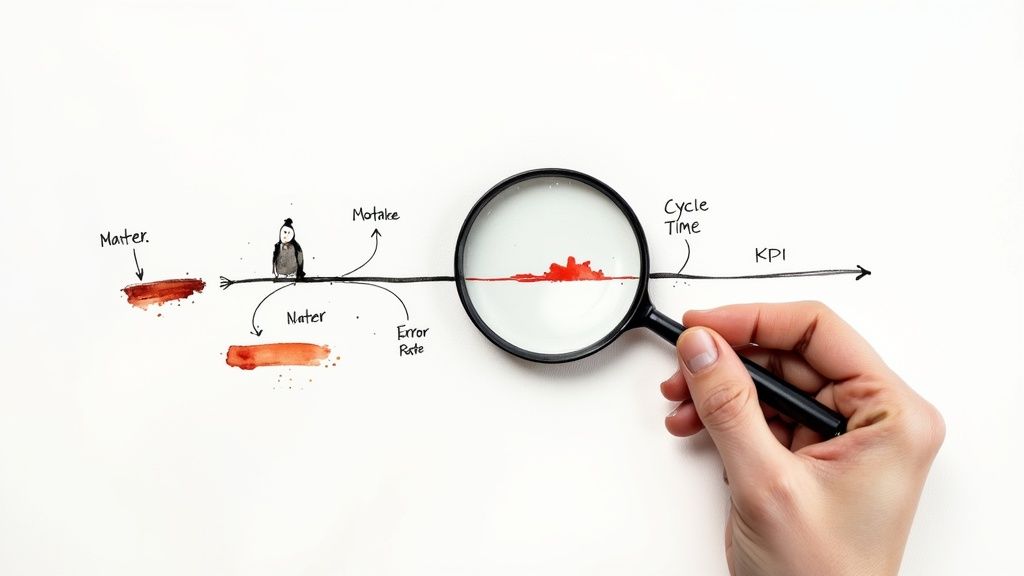
This process kicks off with a thorough operational audit. Forget about pointing fingers; this is about getting an honest, objective view of how work actually gets done. By mapping out your core workflows from the first customer touchpoint to final delivery, you create a blueprint that makes friction points jump off the page.
Map Your Current Workflows
The first real step is to get your processes down on paper. Tools like simple flowcharts or value stream maps are perfect for this. They force you to break down a complex operation into its individual steps, showing how a task really moves through your organization.
Think about an e-commerce business wrestling with fulfillment delays. Mapping their process might show that order information is manually keyed into three different systems. Right there, you’ve found multiple chances for human error and major delays. This kind of insight is nearly invisible when you’re in the thick of it, but it becomes glaringly obvious on a flowchart.
This is also a great time to bring in an outside perspective. Working with an outsourcing partner from the USA to help with the audit provides a fresh set of eyes. They’re experts at spotting process gaps and can benchmark your workflows against industry best practices, all while operating in your time zone and understanding your business context.
Establish and Track Key Performance Indicators
Once you have a map, you need a compass. Key Performance Indicators (KPIs) are the vital signs of your business’s operational health. They turn vague feelings like “things seem slow” into hard data that can actually guide your decisions.
Good KPIs are specific, measurable, and tied directly to your business goals. So, instead of a fuzzy objective like “improve customer service,” you’d track concrete metrics.
- Cycle Time: How long does a process take from start to finish? For example, the total time from a customer clicking “buy” to the package leaving your warehouse. A long cycle time is a classic sign of a bottleneck.
- Error Rate: What percentage of outcomes are flawed? This could be the number of incorrect shipments, data entry mistakes, or manufacturing defects per 1,000 units. A rising error rate is a clear warning that quality control is slipping.
- Resource Utilization: Are your people and equipment being used effectively? Tracking things like employee billable hours or machine uptime reveals if you have capacity issues or are simply paying for idle assets.
A common pitfall is tracking too many KPIs at once. You end up with a lot of noise that hides the important signals. For each core process, start by identifying the one or two metrics that have the biggest impact on your costs and customer satisfaction.
Pinpoint Bottlenecks and Redundancies
With your processes mapped and your KPIs in place, the bottlenecks and redundant work will start to stick out. A bottleneck is any point where work piles up faster than it can be handled—think of a single manager who has to approve every invoice for a 100-person company.
Redundant tasks are the little things that add no real value but chew up time. This could be re-entering the same customer data into multiple spreadsheets or holding a meeting to share information that could have been an email. These small time-wasters compound, leading to a massive amount of wasted effort across the organization.
This kind of analysis is the foundation for anyone serious about figuring out how to improve operational efficiency. By taking a structured, data-driven approach to finding the root causes of problems, you ensure your solutions are targeted and deliver real, measurable results—not just temporary fixes.
4. Put Automation and AI to Work
Once you’ve identified the bottlenecks in your operations, it’s time to bring in the heavy hitters: automation and AI. Let’s be clear—this isn’t about replacing people. It’s about getting rid of the mind-numbing, repetitive work that drains morale and freeing up your team to focus on what they do best: thinking critically, strategizing, and connecting with customers.
We can get right past the buzzwords and look at where this technology actually makes a difference. One of the simplest yet most effective moves is automating repetitive tasks to boost efficiency. This is often the low-hanging fruit, delivering quick wins that build momentum for bigger projects.
Executives are already focused on this, with PwC data showing cost reduction and productivity boosts are the top goals for their AI and automation investments.

This isn’t about chasing shiny objects; it’s about a direct line between smart tech implementation and tangible business results.
Find the Best Automation Opportunities
The secret to a winning automation strategy is to start small. Don’t try to boil the ocean with a massive, company-wide overhaul. Instead, pick one high-pain, high-impact process and prove the concept.
I’ve found that the best candidates for a first project usually have these traits:
- High-Volume & Repetitive: Think processing thousands of invoices, endless CRM data entry, or compiling the same weekly reports.
- Rules-Based: The process is straightforward, following a clear “if this, then that” logic without much need for human judgment.
- Prone to Human Error: If a simple typo can cause a cascade of problems, that process is a prime target for a bot.
Take a finance department that manually handles vendor invoices. An employee gets an email, opens a PDF, keys data into the accounting system, and archives the file. This entire workflow is a perfect match for Robotic Process Automation (RPA). An RPA “bot” can be programmed to do those exact steps—flawlessly, 24/7, and at a much lower cost.
Make Smarter Decisions with AI
While RPA is fantastic for mimicking human actions in rules-based tasks, Artificial Intelligence (AI) takes it a step further. AI can dig into complex, data-driven decisions by analyzing massive datasets to spot patterns, predict outcomes, and offer insights a person could never find on their own.
Here are a few practical ways it’s being used right now:
- Customer Service: An AI-powered chatbot can handle common questions like “Where’s my order?” or “What’s your return policy?” instantly. This frees up your human agents for the complex, high-stakes conversations that really matter.
- Inventory Management: AI algorithms can analyze sales trends, seasonality, and even external factors like weather to predict demand with incredible accuracy. The result? No more costly overstock or frustrating stockouts.
- Data Analysis: Forget spending days building reports. With generative AI solutions, you can just ask questions in plain English (“Show me Q3 sales by region”) and get instant charts and summaries.
The real magic happens when you integrate these technologies. For instance, Tesla’s “hyper-automation” approach—combining robotics, IoT, and AI for predictive maintenance—led to a 30% reduction in production costs and a 40% jump in efficiency.
Working with an Outsourcing Partner from the USA
Implementing and managing automation and AI requires a specific skill set that many small and mid-sized businesses just don’t have in-house. This is where a strategic partner can be a game-changer.
Bringing on an outsourcing partner from the USA has some serious advantages. They’re in your time zone, which means no frustrating communication lags. More importantly, they understand the cultural and business context you operate in, so they can integrate with your team smoothly and ensure compliance with US data privacy laws.
A good partner from the USA can handle the entire lifecycle for you—from spotting the right automation opportunities to deploying the tech and providing ongoing support. You get all the benefits without the steep learning curve or the high cost of building a dedicated internal team.
Bringing Your Operations Online with the Right Digital Tools
Investing in your digital toolset isn’t just about modernizing; it’s one of the most direct routes to operational excellence. This is where we get into the idea of ‘smart operations’—creating an ecosystem where your systems are connected, feeding you real-time data, and even automating decisions. It’s the difference between reacting to problems and getting ahead of them.
This shift fundamentally changes how a business runs, no matter the industry. Take a manufacturing floor, for example. What if the IoT sensors on your machinery did more than just track performance? What if they could predict when a part was about to fail? That’s predictive maintenance. You fix the issue before it causes a costly, unplanned shutdown, which is a game-changer for improving operational efficiency in production.
Or think about a logistics company. A cloud-based platform can give them a crystal-clear view of their entire supply chain. They’re no longer guessing where a shipment is. They can pinpoint its location, monitor its condition, and see delays coming. This lets them reroute packages and give customers a heads-up, turning a potential crisis into a manageable hiccup.
Digital Tools Aren’t Just for the Big Guys
One of the biggest myths out there is that these kinds of advanced tools are reserved for massive corporations with bottomless IT budgets. That’s simply not true anymore. The explosion of affordable Software-as-a-Service (SaaS) tools and scalable cloud solutions has completely leveled the playing field.
Now, small and mid-sized businesses can tap into the same powerful technology that was once exclusive to the titans of industry.
A small e-commerce brand can use a cloud inventory system that automatically syncs with every sales channel. A local plumbing company can use a scheduling platform that maps out the most efficient routes for its technicians, saving big on fuel and time. These aren’t pie-in-the-sky concepts; they are practical, off-the-shelf solutions that can deliver a return almost immediately.
The trick is to start with a specific problem. Don’t chase technology for technology’s sake. Pinpoint a real bottleneck in your business—maybe it’s tedious manual data entry or communication breakdowns between departments—and then find a digital tool designed to fix that.
The Real Power of Connected Systems
The magic really happens when you get your different systems talking to each other. When your data isn’t trapped in separate silos, you start uncovering insights and efficiencies you never could have seen before. For instance, connecting your sales CRM to your inventory system means your sales team can never accidentally sell a product that’s out of stock. Simple, but powerful.
This kind of connectivity is no longer a “nice-to-have”; it’s essential for staying competitive. The data backs this up: investments in smart manufacturing and digital operations are consistently linked to huge productivity gains. A Deloitte survey found that a staggering 92% of manufacturers see smart factory initiatives as critical. Even better, those who’ve adopted these practices are reporting productivity boosts of up to 30%. You can dig deeper into these data transformation trends and see the impact for yourself.
Think of it this way: by connecting your digital tools, you’re not just automating tasks. You’re building a central nervous system for your entire business. This gives you the visibility and data you need to make smarter, faster decisions and stay one step ahead of the competition.
Finding the Right Partner to Build Your Digital Ecosystem
Let’s be realistic. Implementing and managing a fully connected digital ecosystem can get complicated, especially if you don’t have a dedicated IT department. This is where bringing in an outsourcing partner can be a brilliant strategic move. Instead of trying to become an expert in cloud architecture or data integration overnight, you can lean on a team that lives and breathes this stuff.
For businesses on this journey, working with an outsourcing partner from the USA offers some clear advantages. They operate in your time zone, understand the market pressures you’re facing, and can provide real-time support during your actual business hours. You get to skip the communication lags and cultural disconnects that can so easily derail a project.
A partner from the USA can help you vet and select the right SaaS tools, integrate them seamlessly with your current workflows, and manage the underlying infrastructure. This frees you up to do what you do best: run your business, not your software.
Strategic Outsourcing with a US-Based Partner
Once you’ve tightened up your internal processes with new tools and automation, the next big move for boosting operational efficiency is often strategic outsourcing. This isn’t just about offloading work; it’s about delegating specific, non-core business functions to a specialized partner. The goal is straightforward: free up your team’s time and energy so they can laser-focus on what they do best—driving revenue and strategic growth.
Think about functions like the IT helpdesk, bookkeeping, payroll, or routine customer service. These are all critical, of course, but they don’t directly build your product or close a deal. By handing these tasks to experts, you not only get them done right but also redirect your most valuable asset, your people, to work that truly moves the needle.
Choosing the right partner, however, is what makes or breaks this strategy. The geographical and cultural fit of your partner can have a massive, and often underestimated, impact on the whole experience.
The Clear Advantage of a US-Based Partner
While sending work overseas has its place, partnering with a US-based provider immediately sidesteps some of the most common headaches. This simple choice can be a game-changer for keeping things running smoothly.
- No Time Zone Disconnect: A partner in the US works when you work. That means no more waiting overnight for a critical answer or scheduling meetings at 6 AM. Real-time collaboration becomes the norm, not a logistical puzzle.
- Shared Cultural and Business Context: Your partner just gets it. They understand the nuances of the US market, what customers expect, and the regulatory environment you operate in. This shared context prevents the subtle miscommunications that can derail projects.
- Regulatory and Data Security Alignment: Operating under the same data privacy laws is a huge plus. This is especially critical when you’re outsourcing functions that handle sensitive customer or financial data. It adds a crucial layer of security and compliance.
For instance, imagine a growing fintech startup outsourcing its customer support to a US-based firm. The agents not only speak perfect English but also understand the cultural subtleties of talking about money, which directly boosts customer satisfaction. They’re also bound by the same financial regulations, which strengthens both compliance and brand trust. You can see how this plays out in practice with comprehensive Business Process Outsourcing solutions.
Integrating Technology with Outsourced Services
Modern outsourcing is far more than a labor-cost play. It’s about tapping into specialized expertise and technology that you might not have—or want to build—in-house. The best outsourcing partners are heavily invested in their own automation and AI to deliver their services more efficiently.
This isn’t just a trend. A recent PwC digital supply chain survey of operations executives found that a majority of companies are already using AI. Nearly all of them saw it driving revenue, boosting productivity, or managing costs. Cloud tech showed a similarly high satisfaction rate for creating value and improving efficiency.
Key Takeaway: A quality US-based outsourcing partner doesn’t just provide people; they provide highly optimized processes powered by modern technology. You’re effectively renting a super-efficient, pre-built operational function.
What Functions Are Best for Outsourcing?
So, what should you hand off? The best candidates are essential, rules-based functions that aren’t a core part of your competitive advantage. Here are some of the most common areas where businesses see an immediate and powerful impact:
- IT Management and Support: Everything from managing your cloud infrastructure and Microsoft 365 environments to providing 24/7 helpdesk support. A specialized IT partner can deliver enterprise-grade service at a fraction of the cost of an internal team.
- Financial and Accounting Tasks: Delegating bookkeeping, accounts payable/receivable, payroll, and tax prep ensures accuracy and compliance. More importantly, it frees your leadership from drowning in administrative work.
- Customer Service Operations: Handling inbound calls, emails, and chat support through a professional partner means your customers get prompt, consistent service. This is a direct line to improving retention and brand loyalty.
- Data Entry and Administrative Support: High-volume, repetitive tasks are perfect for virtual assistants. Things like data entry, transcription, and scheduling can be done quickly and accurately, clearing up your team’s to-do list.
By strategically delegating these functions to a US-based partner, you do more than just cut costs. You build a more resilient, focused, and efficient organization—one that’s positioned to scale without being crushed by its own operational weight.
Building a Culture of Continuous Improvement
All the tools, automation, and strategies in the world will only get you so far. Real, lasting operational efficiency isn’t a one-and-done project; it’s a commitment to constant refinement. The secret lies in building a culture where continuous improvement is woven into the very fabric of your company.
This means moving away from a top-down, project-based approach. Instead, you need to create an environment where every single employee feels empowered—and encouraged—to find and suggest better ways of working.

A cultural shift like this really hinges on creating solid feedback loops. When someone on the front lines spots a recurring problem or a process bottleneck, do they have a clear and simple way to report it? Just as importantly, do they see that their feedback is actually valued and acted upon? When they do, it sparks more engagement and proactive problem-solving across the board.
Fostering an Improvement Mindset
Adopting a formal methodology can give you a solid framework to guide this cultural change. Systems like Kaizen, for example, are built around the idea of making small, incremental improvements. It teaches teams that tiny adjustments, compounded over time, lead to massive gains. The whole point is to make efficiency a shared responsibility, not just another management directive.
By making continuous improvement a core value, you create an agile organization that doesn’t just react to change but actively seeks out opportunities to evolve. This mindset is the ultimate competitive advantage in any market.
This is another area where an external partner can add tremendous value. An outsourcing partner from the USA brings a fresh, outside perspective, helping you implement best practices for feedback and process reviews without getting bogged down by internal politics.
They can introduce proven systems for tracking suggestions and showing the ROI, which helps institutionalize the very culture you’re trying to build. Their expertise can really speed up the transition, making sure your push for operational efficiency becomes a sustainable, self-perpetuating cycle of excellence.
Frequently Asked Questions
When you start digging into operational efficiency, a few common questions always seem to pop up. Let’s tackle them head-on with some practical answers to get you past those early hurdles and on your way to making real improvements.
Where Should a Small Business Even Start with Operational Efficiency?
The key is to start small. Don’t try to boil the ocean. Pick the single biggest headache in your day-to-day work. Is it the time it takes to process invoices? Maybe it’s the chaos of onboarding a new client or just keeping track of inventory.
Whatever it is, focus on that one thing. Sketch out the entire process, from the very first step to the last. You’ll be surprised at what you find—unnecessary steps, frustrating bottlenecks, or simple tasks that are screaming for a bit of automation. Your first wins don’t need to be expensive. Think about a shared project management board, creating standard templates for common documents, or using basic accounting software to handle invoicing automatically. Resist the temptation to fix everything at once. Small, incremental gains are what build momentum.
How Do I Actually Measure the ROI on These Kinds of Improvements?
You can’t measure what you don’t define. Before you change a single thing, you need to know what success looks like. If you set vague goals, you’ll get vague results. So, get specific with your Key Performance Indicators (KPIs).
Here are a few ways to think about it:
- For Automation: How many hours will this save someone each week? Take those hours and multiply them by that employee’s fully-loaded hourly wage. That’s your direct cost savings.
- For Process Changes: Are you seeing less wasted material? Have product defect rates gone down? Track the before-and-after numbers.
- For Customer Service: Look at metrics like average call handling time—if it drops, you’re more efficient. Or, see if your customer satisfaction (CSAT) scores are on the rise.
Your ROI is simply the financial value of these gains, minus what it cost you to get there (think software fees, training time, etc.). This data-driven approach is how you prove that your efforts are paying off.
When Is It Better to Outsource a Task Instead of Automating It?
This is a big strategic question, and it really comes down to expertise and focus.
Outsourcing makes the most sense for critical functions that are not your company’s core strength. We’re talking about things that require specialized skills you don’t have, or where the workload goes up and down unpredictably. Think complex IT security, navigating payroll and tax laws, or handling specialized bookkeeping.
While you can automate parts of these tasks, a dedicated outsourcing partner from the USA brings a whole team of specialists and top-tier technology to the table—something that would be far too expensive to build yourself. Working with a US-based partner also smooths out a lot of wrinkles, thanks to aligned time zones, a shared business culture, and a solid understanding of the regulatory environment.
Automation, on the other hand, is your best bet for those high-volume, repetitive, rules-based tasks that are part of your main operations. These are the processes where you want to maintain complete control and oversight while freeing up your team’s time.
Ready to unlock the next level of efficiency without the overhead? NineArchs LLC provides scalable IT services, BPO, and virtual assistants to handle your operational burdens. Get started with NineArchs and reclaim your focus today.