

Let’s be honest: staring at a tech problem you can’t solve is a massive headache. It’s frustrating, it costs money, and it pulls you away from the work that actually grows your business. This is where IT outsourcing for small businesses comes in—it’s a smart way to hand over your tech management to experts, giving you access to top-tier skills without the sticker shock of a full-time hire.
Why Smart Businesses Outsource Their IT
We’ve all been there. A critical piece of software crashes, the network goes down, and suddenly, productivity grinds to a halt. For years, the default solution was to hire an in-house IT person, but that model is quickly becoming a thing of the past, especially for smaller companies. Today, IT outsourcing is a powerful tool that helps small businesses punch above their weight.
Think of it like having a world-class pit crew for your business. Instead of trying to hire, train, and manage a mechanic for the engine, another for the tires, and a third for the electronics, you get an entire specialized team on standby. They’re there to keep things running at peak performance, fix problems before they slow you down, and give you a competitive edge.

Access Expertise on a Small Business Budget
This is one of the biggest wins. An outsourced partner gives you access to specialized knowledge that’s usually too expensive to bring in-house. Your one IT hire might be a whiz at troubleshooting network issues but know next to nothing about cybersecurity. An outsourced team gives you both.
By partnering with an IT provider, you get a deep bench of specialists—from cloud architects to security analysts—for a fraction of what it would cost to hire them individually. It completely levels the playing field, giving your small business the same tech advantages as the big players.
Choosing an outsourcing partner here in the USA also brings some serious operational perks. You get a team that works when you work, so there are no frustrating delays from mismatched time zones. The shared culture and language mean they get what you’re trying to do, responding faster and acting like a true extension of your own team.
Focus on Your Core Business
At the end of the day, every hour you spend fighting with software updates, network failures, or security threats is an hour you aren’t spending on sales, marketing, or product innovation.
Outsourcing these essential but time-consuming tasks lets you get back to what you do best. Your new “pit crew” handles the technical side of things, making sure everything runs smoothly and securely in the background. All you have to do is focus on winning the race.
The Real Benefits of Outsourcing Your IT
Let’s move past the theory. The decision to outsource your IT has real, tangible effects on your bottom line and your ability to compete. The first and most obvious win is a serious cut in your operating costs. When you bring in an IT partner, you get to sidestep all the heavy expenses of hiring full-time tech staff—we’re talking salaries, benefits, payroll taxes, and constant training.
But this isn’t just about swapping one expense for another. IT outsourcing for small businesses fundamentally changes your financial model. You trade a large, unpredictable capital expense for a fixed, manageable operational one. No more surprise bills for dead servers, emergency repairs, or expensive software licenses. It all gets bundled into your service agreement.

This single shift can fuel major growth. In fact, around 24% of small businesses in the US are already outsourcing some of their IT work, and they typically see their operating costs drop by 20-30% compared to keeping everything in-house. You can dig deeper into these IT outsourcing statistics to see just how it impacts business efficiency.
Gain Instant Access to a Deep Bench of Specialists
Here’s where outsourcing really becomes a game-changer. It gives you immediate access to an entire team of experts. Let’s be realistic—a small business can’t afford to hire a dedicated cybersecurity analyst, a cloud engineer, a network administrator, and a database manager.
With an outsourced partner, you get all of them. This “deep bench” means you have the right specialist ready for any challenge, whether it’s deflecting a sophisticated phishing attack or moving your entire operation to the cloud for better performance.
Think of it this way: instead of hiring one general practitioner to handle every medical issue, you gain on-demand access to a full team of specialists—a cardiologist for heart health, a neurologist for complex issues, and an orthopedist for structural problems—all for a single, predictable fee.
This model ensures your technology isn’t just being maintained; it’s being actively optimized by people at the top of their game. They can spot and fix problems before they ever have a chance to disrupt your business, which is a massive competitive advantage.
The Undeniable Value of a US-Based Partner
While you can technically find IT talent anywhere in the world, sticking with a US-based partner provides some critical benefits that you’ll feel every single day. This is about more than just convenience.
Working with a domestic team means communication is seamless. You won’t have to deal with frustrating delays caused by a 12-hour time difference. When a critical system goes down at 2 PM your time, you need a team that’s wide awake and ready to jump on it—not one that’s just starting their day.
This shared cultural and business context makes a huge difference. Your partner just gets it, which leads to faster resolutions and a much smoother working relationship.
Simplify Compliance and Enhance Security
If your business handles sensitive data—like customer PII or patient health records—navigating data privacy laws is non-negotiable. A US-based IT provider operates under the exact same legal framework you do, which is a massive layer of protection.
Key Advantages of a US-Based Provider:
- Regulatory Adherence: They are legally required to comply with US regulations like the Health Insurance Portability and Accountability Act (HIPAA) and the California Consumer Privacy Act (CCPA). This takes a huge compliance burden off your shoulders.
- Data Sovereignty: Your sensitive business data stays within US borders, protected by strong domestic privacy and security laws. You know exactly where your information lives.
- Clear Legal Recourse: In the unlikely event of a dispute or a data breach, you have a straightforward legal path within the US court system. That’s real accountability and peace of mind.
Ultimately, choosing a US-based partner isn’t just a preference; it’s a strategic security decision. It ensures your most valuable asset—your data—is protected by a team that shares your business hours, your language, and your legal obligations.
Finding Your Perfect IT Outsourcing Model
Deciding to outsource your IT is a big move, but it’s just the first step. Not all IT outsourcing is created equal, and the type of partnership you choose will define everything that follows. Getting familiar with the different models is the key to finding a perfect fit—one that gives you the exact support your business needs without making you pay for things you don’t.
Think of it this way: you wouldn’t rent a moving truck just to grab a few groceries, and you wouldn’t try to haul a new sofa in a compact car. Each tool has a purpose. In the same way, each outsourcing model is built to solve a specific business problem. The right choice will align with your budget, your goals, and exactly how much control you want to keep over your tech operations.
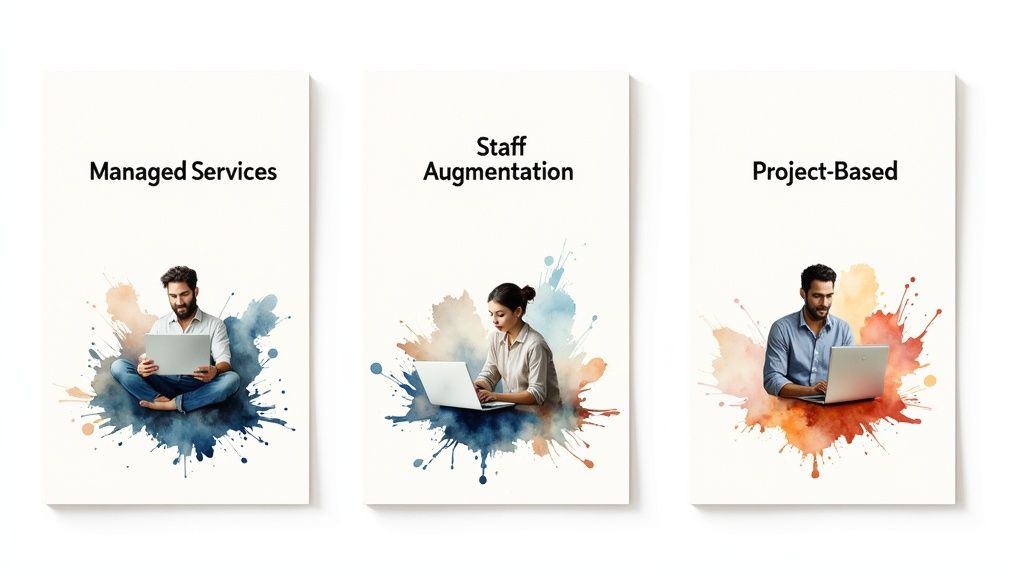
H3: The “All-Inclusive Subscription”: Managed Services
Imagine subscribing to a service that takes care of all your home maintenance—plumbing, electrical, heating, the works—all for one predictable monthly fee. That’s Managed Services in a nutshell. You pay a flat rate, and your IT provider takes complete ownership of monitoring, managing, and maintaining your entire technology environment.
This model is all about being proactive, not reactive. The provider’s main job is to stop problems before they can start. They’ll handle everything from 24/7 network monitoring and cybersecurity defense to routine software updates and help desk support for your team. It’s a fantastic “set it and forget it” solution for businesses that want a stable, reliable IT infrastructure without the headache of managing it day-to-day.
H3: The “Specialist on Demand”: Staff Augmentation
Now, let’s say your in-house team is solid, but you’ve hit a wall. Maybe you have a big project that requires a skill you don’t have, like developing a mobile app or migrating your servers to a new cloud platform. This is where Staff Augmentation comes in. It’s like hiring a freelance specialist for a very specific mission.
You bring an expert from an outsourcing partner onto your team for a defined period. They work directly under your management, fitting right in with your existing staff to fill a temporary skills gap. You keep full control over the project, and when it’s finished, the contract ends. This approach is perfect for adding targeted expertise exactly when and where you need it, avoiding the long-term commitment of a full-time hire.
H3: The “Defined Mission”: Project-Based Outsourcing
Finally, we have Project-Based Outsourcing. This model is your go-to when you have a specific, well-defined task with a clear beginning, middle, and end. Think building a new website from scratch or setting up a secure network for a brand-new office.
With this approach, you hand the entire project over to your outsourcing partner, and they manage it from start to finish. You agree on the scope, timeline, and deliverables upfront, and they take it from there. Your day-to-day involvement is minimal, freeing you up to focus on other parts of your business while the experts deliver the finished product on time and on budget.
This is a smart way to get things done, which is why the global IT outsourcing market is booming. It was valued at around $471 billion in 2023 and is projected to hit nearly $1.095 trillion by 2033. With roughly 70% of companies confirming that outsourcing is more economical than keeping teams in-house, it’s a proven strategy for efficiency. You can explore more trends in IT outsourcing to see how they’re shaping the industry.
Comparing IT Outsourcing Models for Your Business
To make the decision a bit easier, here’s a breakdown of how these models stack up against each other. Think about your current challenges, your budget, and how hands-on you want to be as you review the options.
| Model | Best For | Typical Pricing | Control Level | Scalability |
|---|---|---|---|---|
| Managed Services | Businesses needing comprehensive, ongoing IT management and support without an in-house team. | Fixed monthly subscription (per user/device). | Low (Provider manages everything). | High (Easy to add/remove users or services). |
| Staff Augmentation | Companies with an existing IT team that need to fill a specific skill gap for a limited time. | Hourly or daily rate per specialist. | High (External staff work under your direction). | Medium (Scales with project needs, but requires management). |
| Project-Based | Organizations with a well-defined, one-time project with a clear scope and deadline. | Fixed price per project or Time & Materials. | Medium (Control over outcomes, not daily tasks). | Low (Tied to a single project). |
Ultimately, there’s no single “best” model—only the one that’s best for your business right now. Your needs might even change over time, and a good partner will be flexible enough to adapt with you.
Why Choosing a US-Based Partner Matters
No matter which model you choose, who you partner with is just as critical. A US-based provider brings significant advantages to the table. For Managed Services, it means your 24/7 support team is in a familiar time zone. For Staff Augmentation, it ensures a seamless cultural fit and easier collaboration. For Project-Based work, it guarantees everyone is on the same page regarding US data privacy and business standards.
No matter which path you take, a domestic partner acts as a true extension of your team, sharing your work hours, business culture, and regulatory landscape. This simplifies communication, accelerates project timelines, and provides an essential layer of security and compliance.
Sometimes, outsourcing your IT is just one piece of a larger strategy to offload other operational tasks. To see how this fits into the bigger picture, you might be interested in our guide on understanding business process outsourcing.
High-Impact Services You Can Outsource Today

Figuring out what to hand off to an IT partner is the first real step to getting immediate value. The smartest move is to start with the tasks that are most critical, complicated, or just plain time-consuming for your team.
By outsourcing these high-impact areas, you’re not just keeping the lights on; you’re freeing up your people to focus on what actually grows the business.
Think of it this way: you wouldn’t ask your best salesperson to fix the office Wi-Fi. So why let technical headaches pull your team away from their real jobs? Let’s break down the services that give you the biggest bang for your buck right out of the gate.
Fortify Your Defenses with Outsourced Cybersecurity
For any small business, a single data breach can be an extinction-level event. Cybersecurity isn’t a luxury anymore—it’s a basic requirement for survival. The problem is, building an in-house security team with the right skills is often completely out of reach financially.
This is exactly where outsourcing becomes a game-changer. A specialized provider can deliver the kind of enterprise-grade protection you see at large corporations, but on a small business budget.
- Managed Threat Detection: Your partner is on the lookout 24/7, actively monitoring your network for anything suspicious and stopping threats before they can do any harm.
- Proactive Vulnerability Scans: They don’t wait for a problem. They’re constantly testing your systems for weaknesses and patching them, effectively locking the doors that hackers look for.
- Employee Security Training: Many providers offer programs that turn your own team into a human firewall, teaching them how to spot phishing scams and other common tricks.
Working with a USA-based partner for cybersecurity is a particularly strong move. They’re deeply familiar with US data privacy laws, helping you stay compliant, and they operate in your time zone, which is critical when you need an immediate response to an incident.
Unlock Agility with Cloud Management
The cloud offers incredible power, but it’s also incredibly complex. A simple misconfiguration can easily lead to a security breach or a shocking monthly bill. Outsourcing your cloud management means you get all the upside without the risks.
An experienced partner can handle everything from the initial migration to day-to-day optimization. They’ll ensure a smooth transition to the cloud with as little disruption to your business as possible.
A huge part of their job is cost optimization. They constantly analyze how you’re using cloud resources to cut out waste, making sure you only pay for what you actually need. This turns the cloud from a potential budget-buster into a lean, efficient advantage.
On top of that, they will design and manage a robust disaster recovery plan. If the worst happens, you can rest easy knowing your data and applications are safe and can be restored quickly, keeping your business running. Opting for a US-based cloud partner also ensures your data remains within national borders, simplifying compliance with domestic regulations.
Ensure Seamless Operations with Support and Network Management
Beyond the big-ticket items like security and the cloud, the daily grind of keeping your IT running is just as important. Slow networks, crashing software, and lingering tech problems can bring productivity to a screeching halt. Handing off these foundational services keeps your team moving forward.
24/7 Help Desk Support is a cornerstone of IT outsourcing for small businesses. It gives every employee a direct line to an expert who can solve their problem quickly, minimizing downtime. This is one of the first benefits your team will notice and appreciate. With a US-based provider, this support aligns perfectly with your business hours for maximum efficiency. To see how this works in detail, check out our guide on the fundamentals of IT support.
Modern tools can make support even more efficient. For example, building a chatbot for IT support shows how automation can instantly handle common questions, freeing up human agents for more complex issues.
Finally, Network Management keeps your digital backbone strong and reliable. Your provider will monitor performance, manage routers and switches, and ensure everything is connected securely, creating a stable foundation for your entire operation.
How to Choose the Right IT Partner
Picking an IT partner is one of the most critical decisions you’ll make as a small business owner. This isn’t just about finding someone to fix a broken laptop. It’s about entrusting a strategic ally with your data, your operations, and your ability to grow. Get it right, and you’ll accelerate your success. Get it wrong, and you’re in for a world of frustration and risk.
The best way to make a smart choice is to follow a clear, structured vetting process. You have to look beyond the slick sales pitch and really dig into a provider’s capabilities, track record, and how they actually operate day-to-day. A methodical approach is the only way to find a partner who truly gets your business and shares your values.
Doing this homework is more important than ever. The trend of IT outsourcing for small businesses is exploding—globally, around 37% of small businesses already outsource at least one process, and that number is expected to hit 54% soon. This isn’t just a fad; it’s a strategic shift as companies realize they need external expertise to stay in the game. To get the bigger picture, you can read more about global outsourcing trends and market insights.
Define Your Needs Before You Search
You can’t find the right partner if you don’t know what you’re looking for. Seriously. Before you even open a Google search, sit down and make a detailed list of your technical headaches and business goals.
Are you tired of constant network outages? Do you need to beef up your cybersecurity to meet industry regulations? Are you eyeing a big move to the cloud in the next year?
Once you have that clarity, you can build a scorecard to evaluate potential partners. Here’s what should be on it:
- Industry Experience: Have they worked with businesses like yours? The IT needs of a law firm are worlds apart from those of a creative agency, especially when it comes to compliance.
- Technical Certifications: Look for credentials from heavy hitters like Microsoft, Cisco, or CompTIA. These aren’t just fancy badges; they validate a team’s technical skills.
- Case Studies and Testimonials: Ask for proof. Real-world stories show you exactly how they solve problems for clients facing the same challenges you are.
The Strategic Advantage of a USA-Based Partner
While it’s tempting to shop on price alone, the location of your IT partner has huge implications for your operations and security. Opting for a provider based right here in the USA offers a level of peace of mind and stability you just can’t get elsewhere.
A US-based team works when you work. Simple as that. When a critical issue pops up at 2 PM on a Tuesday, you get an immediate response, not a reply that’s 12 hours late. They also share the same cultural and business context, so communication is clear and they feel like a true extension of your own team.
From a security standpoint, a US-based partner is bound by the same data privacy laws you are. This simplifies compliance with regulations like HIPAA and CCPA, as your data remains under US jurisdiction, offering straightforward legal recourse and greater accountability.
Critical Questions to Ask Potential Partners
Once you’ve got a shortlist, it’s time to put them in the hot seat. The answers to these questions will tell you everything you need to know about their professionalism, their processes, and how much they actually care about their clients.
- What is your client onboarding process like? A great partner will have a structured, transparent plan for auditing your current setup and managing the transition without causing chaos.
- Can you provide a sample Service Level Agreement (SLA)? The SLA is the heart of your contract. It needs to spell out, in no uncertain terms, their guaranteed response times, uptime promises, and what happens if they don’t deliver.
- How do you handle data security and incident response? Get specific. Ask about their security protocols, data encryption methods, access controls, and their playbook for what to do when—not if—a breach occurs.
To make sure you’re selecting a reliable and secure IT partner, a thorough background check is non-negotiable. You can use a comprehensive vendor due diligence checklist to guide your evaluation. This kind of structured approach ensures you’ve covered all your bases before you sign on the dotted line.
Got Questions About IT Outsourcing? Let’s Clear Things Up.
Deciding to hand over a piece of your business is a big step, and it’s only natural to have questions. When it’s something as critical as your technology, you need absolute clarity before moving forward. We’ve heard all the common concerns from small business owners over the years, and we’re here to give you direct, practical answers.
This is all about cutting through the jargon to address the real-world worries you might have. Let’s get these questions answered so you can make a decision with confidence.
Is Outsourcing IT Really Cheaper Than an In-House Hire?
For the vast majority of small businesses, the answer is a resounding yes. The savings aren’t just significant; they come from several different angles. When you hire an in-house IT generalist, their salary is just the tip of the iceberg.
You also have to account for all the “hidden” costs, which add up fast. Think about health insurance, retirement contributions, payroll taxes, paid time off, and the constant need for training to keep their skills sharp. Then there’s the cost of their equipment and software licenses.
An outsourced model swaps all of that for a single, predictable monthly fee. But here’s the real kicker: that fee doesn’t just get you one person. It unlocks an entire team of specialists—experts in cybersecurity, cloud infrastructure, network engineering, and user support.
You get a deeper and wider range of expertise for a fraction of what it would cost to hire just one senior-level IT professional. This structure delivers a far greater return on your investment, turning a major cost center into a strategic asset.
Will I Lose Control Over My Technology?
This is probably the most common fear business owners have, and it’s completely understandable. The thought of handing over the keys to your digital kingdom can be nerve-wracking. However, modern IT outsourcing for small businesses is built on partnership, not surrender.
You always stay in the driver’s seat when it comes to the big picture. You set the strategic direction, define the business goals, and make the final calls on technology investments. Your outsourcing partner’s job is to handle the day-to-day execution and manage the complex technical details to make those goals a reality.
A quality provider makes sure you never feel left in the dark. They build in transparency and maintain your control through a few key practices:
- Clear Service Level Agreements (SLAs): These contracts legally define their responsibilities, guaranteed response times, and performance metrics, so you know exactly what to expect.
- Regular Performance Reports: You receive detailed reports on system health, security posture, and support ticket resolutions, giving you full visibility.
- Open Communication Channels: You’ll have direct lines of communication for strategic planning sessions and regular check-ins. A USA-based partner ensures these communications happen during your business hours, eliminating frustrating delays.
How Can I Trust a Third Party with My Company Data?
In today’s world, data is one of your most valuable assets, making this a critical question. The entire foundation of an outsourcing relationship is trust, and that trust has to be earned through proven security practices.
Data security should be a non-negotiable part of your vetting process. Don’t just take a provider’s word for it; demand proof of their commitment to protecting your information. Ask pointed questions about their security credentials, like SOC 2 compliance, which is a rigorous, third-party audit of their security controls.
You should also drill down into the specifics of their security framework. Ask about their data encryption methods (both in transit and at rest), their access control policies, and what their detailed incident response plan looks like. A vague answer here is a major red flag.
This is another area where choosing a USA-based provider offers a real advantage. A domestic partner is legally bound to follow strict U.S. data privacy laws like HIPAA and CCPA. This adds a powerful layer of accountability and ensures your data is managed under the same regulatory standards your own business has to follow.
What Does the Transition to an Outsourced Provider Look Like?
A reputable provider knows that a chaotic transition is the fastest way to lose a new client’s trust. Their goal is to make the switch as smooth and painless as possible, with minimal disruption to your daily operations.
The onboarding process is usually methodical and well-structured, following a clear roadmap.
- Discovery and Audit: The process kicks off with a thorough discovery phase where they do a deep dive into your current IT environment. They’ll assess your hardware, software, network infrastructure, and security posture to understand exactly what they’re working with.
- Strategic Planning: Based on their findings and your business goals, they’ll put together a customized migration and support strategy. This plan outlines the timeline, key milestones, and what to expect at each stage.
- Managed Transition: The migration itself is carefully managed. The provider handles the technical heavy lifting—like deploying monitoring agents, setting up security protocols, and migrating data—often during off-hours to avoid interrupting your team.
- Ongoing Support and Optimization: Once the transition is complete, their work isn’t done. They immediately shift into ongoing support and continuous optimization, making sure you start seeing the value from day one.
The entire process is designed to be a seamless handoff, letting your team stay focused on their work while the experts get your new and improved IT foundation in place. A US-based team can often accelerate this process through real-time collaboration and clear communication.
Ready to stop worrying about IT and start focusing on growth? At NineArchs LLC, we provide U.S.-based IT outsourcing solutions designed specifically for small and mid-sized businesses. Let us show you how a strategic partnership can secure your data, streamline your operations, and give you a powerful competitive edge. Explore our custom IT services today.