



Most American business owners spend over 30 percent of their workweek on tasks that could be handled by someone else. When everyday activities eat up valuable hours, leadership and creative thinking suffer. Knowing exactly what to delegate and how to guide a virtual assistant can turn wasted time into measurable growth. This step by step approach helps American entrepreneurs prioritize, document, and optimize their delegation process for real results.
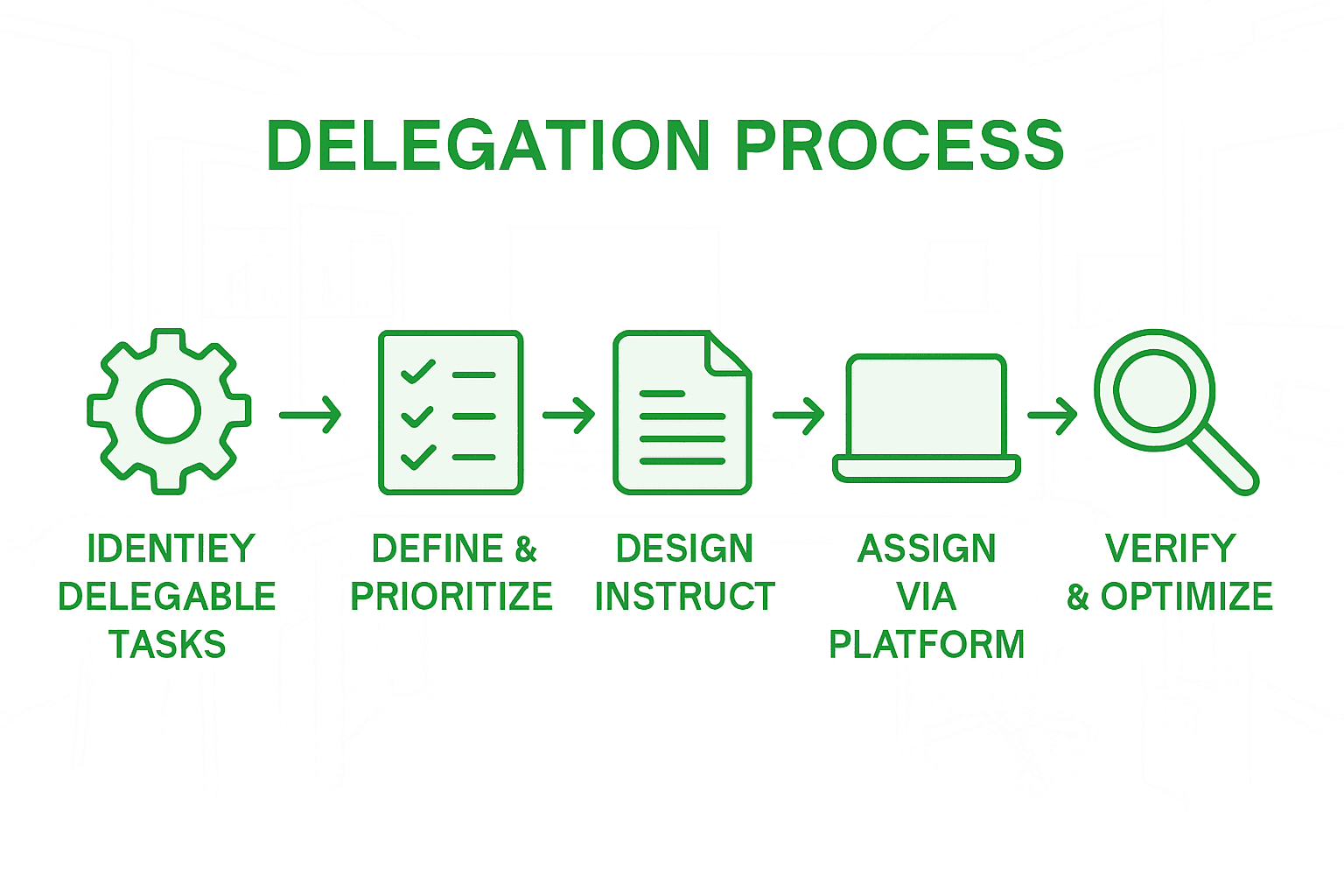
Step 1: Identify key business processes to delegate
Successful business delegation starts with pinpointing the right tasks that will maximize your team’s productivity and free up strategic bandwidth. By understanding which operational elements can be efficiently managed by a virtual assistant, you transform routine work into streamlined performance.
To effectively identify delegable processes, start by mapping out your current workflow and analyzing which tasks consistently consume time without directly generating revenue. The business process documentation guide can help systematically break down your operational activities. Focus on administrative tasks that are repeatable and do not require deep strategic decision making such as:
- Email management and communication filtering
- Data entry and spreadsheet maintenance
- Social media scheduling and basic content management
- Calendar and appointment coordination
- Research and preliminary report compilation
- Customer support initial screening
Prioritize tasks that are time consuming but do not require your personal expertise. These are prime candidates for virtual assistant delegation. Assess each potential task through two critical lenses: complexity and strategic value. Simple repetitive tasks with clear guidelines are ideal for outsourcing.
Pro tip: Create a detailed task log for one week tracking everything you do. Highlight activities that could be performed by someone else with clear instructions, revealing your best delegation opportunities.
Step 2: Define and prioritize virtual assistant tasks
Successfully defining and prioritizing virtual assistant tasks requires a strategic approach that transforms your operational workflow and maximizes productivity. The goal is to create a clear roadmap that allows your virtual assistant to deliver maximum value with minimal supervision.
Utilize the top support tasks to outsource guide to help structure your task categorization. Implement the Eisenhower Matrix a powerful framework for task prioritization that classifies activities into four quadrants based on urgency and importance:
- Urgent and Important: Critical tasks requiring immediate attention
- Important but Not Urgent: Strategic activities needing proactive planning
- Urgent but Not Important: Tasks that can be delegated
- Neither Urgent nor Important: Activities to eliminate or minimize
When defining tasks for your virtual assistant, focus on creating detailed standard operating procedures that outline expectations, desired outcomes, and specific performance metrics. Clearly communicate the scope of work, preferred communication channels, and expected response times. This approach ensures your virtual assistant understands exactly what is required and can execute tasks with precision.
Pro tip: Develop a weekly task template with estimated time allocations for each activity, allowing your virtual assistant to understand priority levels and manage workload effectively.
Step 3: Design clear task instructions and guidelines
Creating comprehensive and precise instructions is the cornerstone of successful virtual assistant collaboration. Your goal is to develop guidelines that eliminate ambiguity and enable your virtual assistant to complete tasks with minimal back and forth communication.
The administrative support outsourcing guide can help you structure your documentation approach. When designing task instructions, follow a systematic method that breaks down complex processes into clear actionable steps:
- Provide context for why the task matters
- Include step by step procedural details
- Specify exact formatting and quality expectations
- Define success metrics and desired outcomes
- List potential challenges and recommended solutions
- Attach relevant templates or reference materials
Effective instructions require more than just sequential steps. They demand a holistic approach that helps your virtual assistant understand the broader business objective. Write instructions as if explaining the task to someone unfamiliar with your specific workflow. Use clear language avoiding industry jargon, include screenshots or screen recordings when possible, and anticipate potential questions or points of confusion.

Pro tip: Create a standardized instruction template with consistent sections for background, specific steps, tools required, and expected deliverables to streamline your documentation process and ensure clarity across different tasks.
Step 4: Assign tasks using collaboration platforms
Streamlining task assignment and tracking requires robust collaboration platforms that transform how you manage virtual assistant workflows. Modern digital tools enable seamless communication, real time progress monitoring, and transparent task management across distributed teams.
Explore the outsourcing solutions for business growth to understand platform selection strategies. When choosing collaboration platforms, consider tools that offer comprehensive features such as:
- Task creation and detailed assignment capabilities
- Real time progress tracking
- Communication channels within task threads
- File sharing and document management
- Performance analytics and reporting
- Integration with existing business software
Select platforms that align with your specific business needs and virtual assistant work style. Popular project management tools like Trello, Asana, and Monday.com provide intuitive interfaces that allow granular task breakdown, deadline setting, and priority ranking. These platforms enable you to create structured workflows where tasks can be assigned, tracked, and completed with maximum transparency and minimal communication overhead.
Here’s a comparison of common collaboration platforms used for managing virtual assistants, highlighting their strengths:
| Platform | Task Management Strength | Communication Features |
|---|---|---|
| Trello | Visual boards, easy task tracking | Basic card comments |
| Asana | Detailed project segmentation | Task comments, notification system |
| Monday.com | Highly customizable workflows | Built-in messaging and updates |
Pro tip: Configure platform notifications and set up automated reminders to ensure tasks are completed on schedule and your virtual assistant remains consistently informed about upcoming deadlines and priority shifts.
Step 5: Verify task quality and optimize assignments
Maintaining high performance standards requires a systematic approach to task verification and continuous improvement. Your objective is to create a robust feedback mechanism that ensures consistent quality and helps your virtual assistant progressively enhance their work effectiveness.
Utilize the 7 essential outsourcing tips to develop a comprehensive quality verification strategy. Implement a multi tiered review process that includes:
- Initial task submission review
- Detailed performance assessment
- Quantitative and qualitative feedback
- Regular performance metric tracking
- Skill development recommendations
- Iterative improvement planning
Quality verification goes beyond simple error checking. Develop a holistic evaluation framework that considers not just task completion but overall efficiency, attention to detail, and alignment with your business objectives. Use data driven insights to identify patterns in performance, recognize strengths, and address potential skill gaps. Regularly schedule feedback sessions that are constructive and focus on professional growth rather than punitive criticism.
Pro tip: Create a standardized performance scorecard with clear metrics and weighted scoring to provide objective and transparent feedback that motivates continuous improvement and skill development.
Below is a summary of steps to optimize virtual assistant delegation for business efficiency:
| Step | Key Focus | Impact on Business |
|---|---|---|
| Identify Processes | Analyze and select tasks | Frees up time for core priorities |
| Define & Prioritize Tasks | Set clear guidelines, order | Maximizes assistant productivity |
| Design Instructions | Detailed, structured guides | Reduces errors, boosts accuracy |
| Assign via Platforms | Use digital tools, monitor | Streamlined coordination |
| Verify & Optimize | Review, feedback, improve | Enhances ongoing task quality |
Unlock the Power of Effective Virtual Assistant Delegation to Accelerate Your Business Growth
If you find yourself overwhelmed trying to identify the best tasks to delegate or struggling to create clear, actionable guidelines for your virtual assistant, you are not alone. Many businesses face challenges turning routine workflows into streamlined processes that truly free up leadership bandwidth and enhance productivity. This article highlights the importance of well-defined task lists, structured instructions, and smart collaboration tools—key concepts that resonate deeply with enterprises aiming to boost efficiency without sacrificing quality.
At NineArchs LLC, we understand these critical pain points. Our professional remote workforce solutions specialize in providing scalable virtual assistant services tailored to your unique operational needs. By leveraging our expertise in business process outsourcing and digital transformation, you gain access to a reliable and cost-efficient partner dedicated to elevating your business operations. Partner with us to enjoy clear task definition, seamless assignment via leading collaboration platforms, and continuous quality verification that empowers your team to focus on what matters most.
Ready to transform your approach to virtual assistant delegation and unlock new levels of productivity? Connect with our experts today at NineArchs Contact to discuss how our customized outsourcing solutions can help you build an effective virtual assistant task list that drives tangible results. Do not wait take the first step toward operational excellence now.
Also explore how our Business Process Outsourcing services and custom software development expertise can further streamline your workflows and support sustained business growth.
Frequently Asked Questions
How do I identify which tasks to delegate to a virtual assistant?
To identify tasks for delegation, start by analyzing your current workflow for time-consuming activities that don’t directly generate revenue. Create a task log for one week, highlighting repetitive tasks that can be completed with clear instructions, which will reveal the best delegation opportunities.
What criteria should I use to prioritize tasks for my virtual assistant?
Prioritize tasks by using the Eisenhower Matrix, which classifies tasks into four categories based on urgency and importance. Focus on tasks that are urgent but not important for delegation, allowing you to maximize your virtual assistant’s productivity while freeing up your time for strategic activities.
How can I create effective task instructions for my virtual assistant?
To create effective task instructions, provide clear, step-by-step guidelines along with the context and importance of the task. Incorporate specific formatting and quality expectations, and include any necessary templates or reference materials to ensure your virtual assistant understands the requirements fully.
What are the best collaboration platforms for assigning tasks to a virtual assistant?
Select collaboration platforms that offer task creation, real-time progress tracking, and effective communication features. Popular project management tools can streamline task assignment and monitoring, making it easier for your virtual assistant to manage their workload effectively.
How do I verify the quality of tasks completed by my virtual assistant?
Establish a multi-tiered review process that includes initial task submissions, detailed performance assessments, and regular feedback sessions. This strategy helps maintain high standards and encourages your virtual assistant to improve over time by providing constructive feedback and skill development recommendations.