



More than 60 percent of technology firms, including giants across American and European markets, now rely on remote back office solutions to drive measurable results. For operations managers, finding smarter ways to reduce costs while maintaining top-tier productivity is no longer a distant goal. This guide breaks down what remote back office really means, dismantles common myths, and reveals how strategic outsourcing can transform both cost structures and team performance on a global scale.
Remote Back Office Explained and Common Myths
A remote back office represents a strategic operational approach where critical administrative and support functions are managed by professionals working outside traditional office environments. Unlike conventional workplace models, remote back offices leverage technology and global talent networks to deliver comprehensive business support services without geographical constraints.
Contrary to prevalent misconceptions, remote back office models are not simply about cost reduction. Scientific research reveals these arrangements can significantly enhance organizational efficiency and performance. Systematic research on remote work models demonstrates that well-implemented remote strategies can improve productivity, expand talent access, and create more flexible operational frameworks.
Several persistent myths surround remote back office operations that require careful examination:
- Productivity Myth: The assumption that remote workers are less productive is fundamentally flawed. Studies consistently show remote professionals often demonstrate higher output and engagement levels compared to traditional office settings.
- Communication Challenge Myth: Modern collaboration technologies have effectively eliminated most communication barriers, enabling seamless interaction across distributed teams.
- Quality Control Myth: Professional remote back office providers implement rigorous performance tracking and quality assurance mechanisms that frequently exceed traditional workplace monitoring.
Understanding these nuanced dynamics requires recognizing remote back offices as sophisticated, technology-enabled operational strategies rather than simple outsourcing mechanisms. Successful implementation demands strategic planning, robust technological infrastructure, and a forward-thinking organizational culture.
Pro Operational Strategy Tip: Develop clear performance metrics and communication protocols before transitioning to a remote back office model to ensure smooth integration and maintain consistent service quality.
Key Functions and Service Models in Practice
Remote back office services represent a sophisticated ecosystem of specialized operational support that extends far beyond traditional administrative tasks. These comprehensive service models encompass a wide range of critical business functions designed to optimize organizational performance and strategic capabilities.
The core service models typically include several key operational domains:
- Data Management and Processing
- Comprehensive data entry and validation
- Database maintenance and cleansing
- Digital document management
- Financial Support Services
- Accounts payable and receivable management
- Expense tracking and reporting
- Financial record reconciliation
- Customer Support Functions
- Technical support coordination
- Email and chat support management
- Customer inquiry resolution
Administrative support outsourcing strategies enable organizations to transform these backend processes from cost centers into strategic value generators. By leveraging specialized remote teams, businesses can access high-caliber talent without significant infrastructure investments, creating scalable and flexible operational frameworks.
Here’s a summary of core remote back office service models and their strategic business benefits:
| Service Domain | Key Functions | Strategic Benefits |
|---|---|---|
| Data Management & Processing | Data validation, document handling | Improved accuracy, streamlined records |
| Financial Support Services | Accounts, expense reporting | Enhanced transparency, better budgeting |
| Customer Support Functions | Technical, inquiry resolution | Increased customer satisfaction, loyalty |
Advanced remote back office models now integrate sophisticated technological platforms that enable real-time collaboration, secure data management, and seamless workflow integration. These platforms utilize cloud-based technologies, advanced encryption protocols, and intelligent workflow management systems to ensure precision, confidentiality, and operational continuity across distributed teams.
The evolution of remote back office services represents a paradigm shift in how organizations conceptualize operational support. Modern approaches emphasize not just task completion, but strategic alignment, continuous improvement, and adaptive capabilities that respond dynamically to changing business landscapes.
Pro Strategic Alignment Tip: Conduct a comprehensive workflow audit before implementing remote back office services to identify precise outsourcing opportunities and create targeted integration strategies that maximize operational efficiency.
Advantages of Global Talent and Scalability
Global talent acquisition represents a transformative strategy that enables organizations to transcend traditional geographical limitations in workforce recruitment. By embracing remote back office models, businesses gain unprecedented access to a diverse, highly skilled professional pool that spans international boundaries, creating opportunities for innovation and operational excellence.
Virtual staffing strategies empower companies to build dynamic, flexible teams with specialized expertise that can be rapidly scaled to match evolving business requirements. The key advantages of global talent engagement include:
- Skill Diversity
- Access to specialized professionals across multiple disciplines
- Broader range of technical and cultural perspectives
- Reduced limitations of local talent markets
- Cost Efficiency
- Lower recruitment and infrastructure expenses
- Competitive compensation structures
- Reduced overhead associated with traditional hiring
- 24/7 Operational Capabilities
- Continuous workflow across different time zones
- Enhanced productivity and response times
- Seamless global business continuity
Modern technological infrastructure has dramatically transformed global talent management, enabling real-time collaboration through advanced communication platforms, cloud-based project management tools, and intelligent workflow systems. These technologies ensure seamless integration, transparent performance tracking, and robust security protocols that maintain operational integrity across distributed teams.

The scalability of remote back office models provides businesses with unprecedented strategic flexibility. Organizations can now dynamically adjust team sizes, rapidly onboard specialized talent, and create adaptive workforce configurations that respond quickly to market changes and emerging business opportunities.
Pro Talent Strategy Tip: Develop comprehensive onboarding and integration protocols that prioritize cultural alignment and clear communication expectations when building global remote teams.
Cost Savings, Security, and Productivity Impacts
Remote back office models represent a strategic approach to dramatically transforming organizational economics, offering unprecedented opportunities for cost reduction, enhanced security, and productivity optimization. By reimagining traditional workplace structures, businesses can unlock significant financial and operational advantages that extend far beyond simple expense management.
Key strategies for IT outsourcing reveal substantial economic benefits across multiple dimensions. Research indicates organizations can achieve remarkable financial efficiencies through remote back office implementation:
- Direct Cost Savings
- Reduction of physical office infrastructure expenses
- Lower overhead for utilities and workspace maintenance
- Decreased equipment and technology procurement costs
- Workforce Optimization
- Access to global talent at competitive rates
- Reduced recruitment and training expenditures
- Flexible staffing models with minimal fixed labor costs
- Productivity Enhancement
- Increased employee performance through flexible work arrangements
- Reduced workplace distractions
- Enhanced focus and individual accountability
Cybersecurity emerges as a critical consideration in remote back office environments. Advanced technological platforms now provide robust security frameworks that often surpass traditional office-based protection mechanisms. Sophisticated encryption protocols, multi-factor authentication, and continuous monitoring systems ensure comprehensive data protection and regulatory compliance.
Productivity metrics demonstrate that remote back office teams frequently outperform traditional workplace models. Stanford research highlights that carefully implemented remote strategies can generate significant performance gains, with some organizations reporting productivity increases of 13% to 35% through strategic digital workforce management.
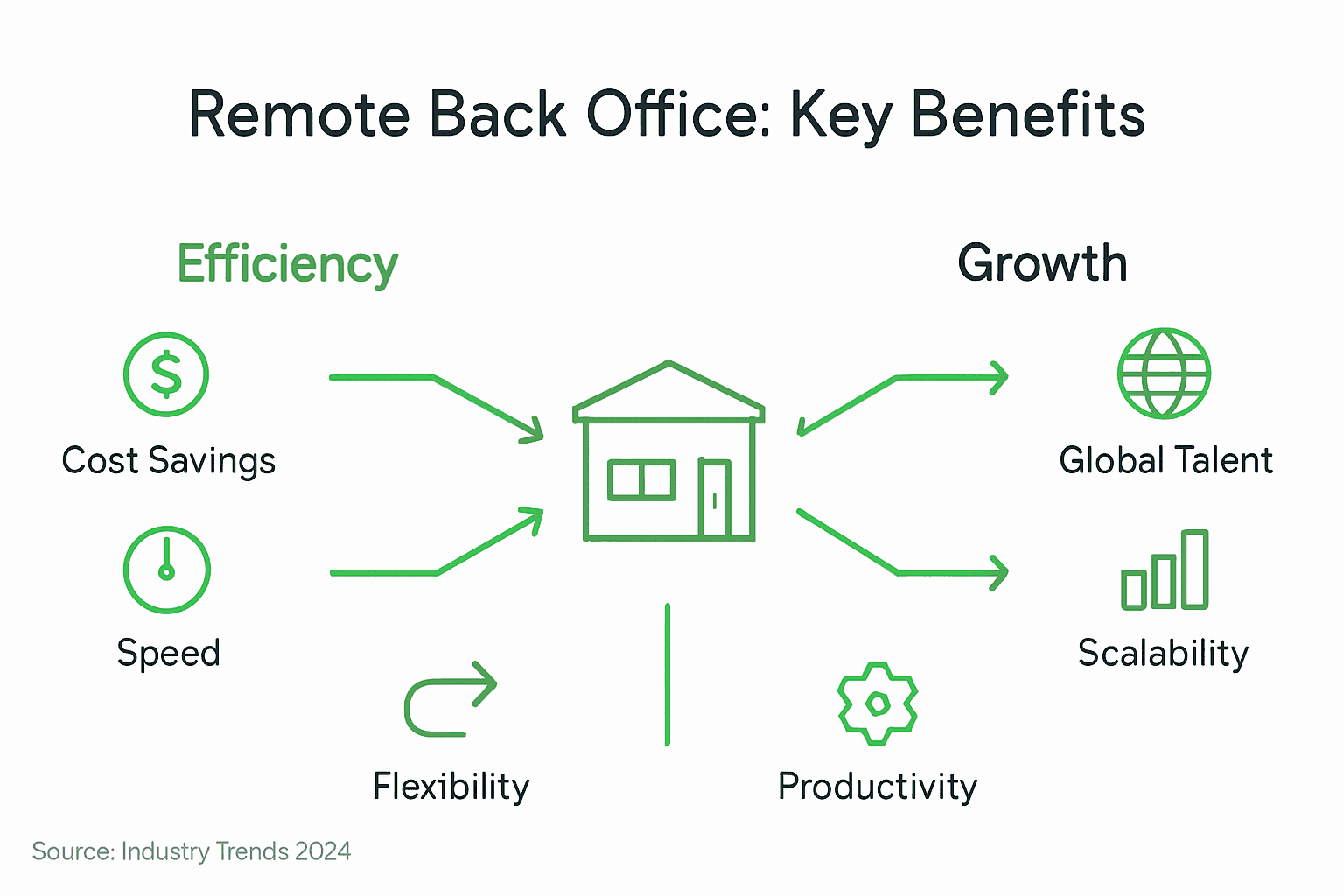
A quick comparison of traditional office models versus remote back office approaches:
| Aspect | Traditional Office Model | Remote Back Office Model |
|---|---|---|
| Cost Structure | Fixed office, equipment, staffing costs | Lower overhead, flexible labor costs |
| Talent Access | Local workforce limitations | Global, diverse talent pool |
| Productivity | Prone to distractions, rigid hours | Flexible, individualized performance |
| Security Approach | Physical security, standard IT policies | Multi-layered cybersecurity protocols |
Pro Security Strategy Tip: Implement comprehensive digital security training and develop clear, enforceable protocols for data handling, device management, and secure communication before transitioning to a remote back office model.
Mitigating Risks and Managing Quality Remotely
Risk management in remote back office environments represents a complex strategic challenge that demands sophisticated technological and human-centric approaches. Organizations must develop comprehensive frameworks that simultaneously address cybersecurity vulnerabilities, performance consistency, and operational integrity across distributed teams.
Security strategies for IT outsourcing require multilayered protection mechanisms that go beyond traditional workplace security models. The most effective risk mitigation strategies encompass several critical dimensions:
- Technological Security
- Zero-trust network architecture
- Advanced multi-factor authentication
- Continuous endpoint monitoring
- Encrypted communication channels
- Policy and Compliance
- Comprehensive remote work guidelines
- Regular security awareness training
- Strict data handling protocols
- Periodic risk assessment frameworks
- Performance Management
- Objective productivity tracking
- Clear performance metrics
- Regular skill development programs
- Transparent communication channels
Quality management in remote back office settings demands a proactive approach that balances technological oversight with human-centered management techniques. Advanced performance tracking tools enable real-time monitoring of key productivity indicators, allowing organizations to identify potential issues before they escalate and maintain consistent service quality across global teams.
Cybersecurity research highlights the importance of creating adaptive, resilient systems that can respond dynamically to emerging digital threats. This requires ongoing employee training, sophisticated technological infrastructure, and a culture of continuous learning and vigilance that transforms security from a technical challenge into a comprehensive organizational capability.
Pro Security Integration Tip: Develop a comprehensive onboarding program that includes mandatory cybersecurity training, hands-on simulation exercises, and regular skill refresh sessions to ensure consistent security awareness across your remote back office teams.
Unlock Your Business Potential with Remote Back Office Solutions
Managing a remote back office can be challenging when it comes to ensuring productivity, maintaining data security, and effectively accessing global talent. This article highlights critical insights such as improving organizational efficiency, overcoming communication myths, and leveraging scalable remote teams to boost growth. If you face the challenge of integrating flexible, cost-efficient operational support without compromising on quality or security, NineArchs LLC offers tailored outsourcing solutions designed precisely for these needs.
Our expertise in virtual assistance, business process outsourcing, and skills outsourcing ensures you gain access to a diverse, skilled workforce that drives productivity and innovation. By partnering with us, you invest in a reliable, scalable, and secure remote workforce that transforms your back office from a cost center into a strategic growth driver.
Discover how to enhance your operational efficiency through virtual staffing strategies and robust digital transformation solutions that empower your business to thrive in a competitive global market.
Start your journey toward streamlined operations and measurable growth today.
Are you ready to boost your business efficiency and secure strategic growth with proven remote back office solutions?
Contact the experts at NineArchs LLC now and unlock the full potential of your remote workforce. Learn more and get personalized support by visiting our contact page. Take action today to experience the benefits of professional outsourcing and IT services that put your business goals first.
Frequently Asked Questions
What are the main advantages of a remote back office model?
A remote back office model offers several advantages, including access to global talent, cost efficiencies, increased productivity, and enhanced operational flexibility. It allows organizations to optimize their support functions while fostering strategic alignment with business goals.
How do remote back office services enhance productivity?
Remote back office services enhance productivity by enabling flexible work arrangements that minimize distractions, leveraging advanced collaboration tools for seamless communication, and providing access to skilled professionals who can deliver high-quality work efficiently.
What key functions are typically included in remote back office services?
Key functions in remote back office services often include data management, financial support, customer support, and administrative tasks. These services are designed to streamline operations and generate strategic value for businesses.
How can organizations ensure quality management in remote back office operations?
Organizations can ensure quality management by implementing rigorous performance tracking, setting clear KPIs, conducting regular training programs, and establishing transparent communication channels, which help maintain consistent service quality across distributed teams.
Recommended
- What Is Remote Workforce? Complete Business Guide | NineArchs
- 7 Top Support Tasks to Outsource for Greater Efficiency | NineArchs
- How to Outsource Back Office for Business Efficiency | NineArchs
- 7 Key Pros and Cons of Outsourcing for Business Success | NineArchs
- Блог компании Aiday | Преимущества оценки методом 360 градусов для