


Cloud computing solutions for businesses are services—like data storage, servers, and software—that you access over the internet instead of hosting them on-premises. Think of it as a fundamental shift from buying technology outright to renting it, a move that drastically cuts costs and boosts flexibility.
What Are Cloud Computing Solutions for Business

At its heart, cloud computing is a lot like swapping your own personal power generator for the public electrical grid. Instead of buying, maintaining, and housing your own expensive servers and hardware, you just plug into the resources you need, when you need them, from a dedicated provider.
This simple change removes the enormous headache of managing physical infrastructure. You can stop worrying about server rooms, cooling systems, or the inevitable hardware failures and instead pour those resources back into what really matters: growing your business.
From Capital Expense to Operational Expense
In the past, launching any new service meant a huge upfront investment in hardware. This old model, known as Capital Expenditure (CapEx), was slow, expensive, and frankly, quite risky. Cloud solutions flip this on its head, turning that massive initial cost into a predictable monthly Operating Expense (OpEx).
The ability to pay-as-you-go completely changes how businesses budget for technology. It levels the playing field, giving smaller companies access to enterprise-grade tools that once required millions in funding just for the infrastructure.
This model gives you incredible financial agility. You can ramp up your resources to handle a holiday rush and scale them right back down during slower months, making sure you only ever pay for exactly what you use. The logic is so compelling that even Microsoft now runs over 98% of its own internal IT systems on its Azure cloud platform.
The Role of an Outsourcing Partner
While the cloud offers incredible power, getting it right requires deep, specialized knowledge. That’s where an expert partner becomes absolutely essential. And choosing an outsourcing partner located in the USA brings some distinct advantages that can directly shape your success and security.
A USA-based partner brings several key things to the table:
- Regulatory Expertise: They live and breathe domestic compliance standards like HIPAA and SOX, ensuring your cloud setup is built to meet legal requirements from the very start.
- Real-Time Collaboration: Working in the same or nearby time zones means no more communication lags. Problems get solved faster, and projects move forward smoothly.
- Data Security Assurance: Your sensitive business data is managed under strict US data privacy laws, which adds a critical layer of protection and gives you real peace of mind.
Partnering with a US-based expert ensures your cloud strategy is more than just technically functional. It becomes a strategic asset, perfectly aligned with your business goals, security posture, and compliance mandates. They are the ones who bridge the gap between powerful technology and practical business results, making your transition a genuine success.
Understanding IaaS PaaS and SaaS Cloud Models
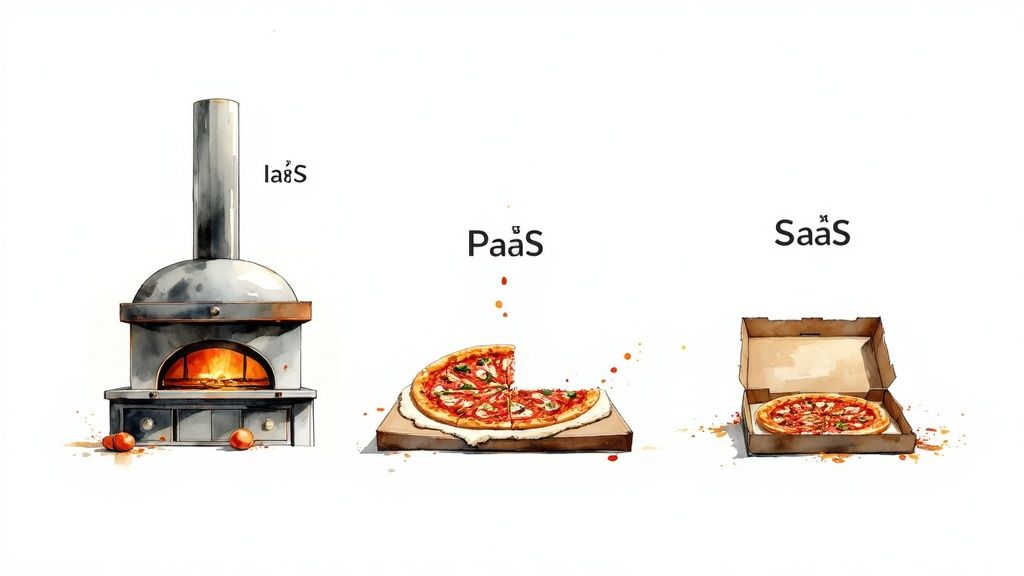
When you’re looking at cloud computing solutions, it really boils down to three core models. The easiest way to wrap your head around them is to think about making a pizza. Each approach—IaaS, PaaS, and SaaS—gives you a different level of control and convenience, just like deciding whether you want to cook from scratch, use a meal kit, or simply order delivery.
These aren’t just tech buzzwords. They represent strategic choices that define how much of your IT stack you manage yourself versus what you offload to a provider. Getting this right is the first step toward building a powerful and efficient cloud strategy.
Infrastructure as a Service (IaaS): The DIY Approach
Think of Infrastructure as a Service (IaaS) as leasing a fully equipped commercial kitchen. Your provider gives you the fundamental infrastructure—the oven, the workspace, the utilities (which in the cloud world are the servers, storage, and networking)—but you bring everything else. You’re in charge of the recipe, the ingredients, and the entire cooking process.
This model gives you the most control. Your IT team manages the operating systems, middleware, and every application you run on top of that foundation. It’s a perfect fit for businesses that have complex technical needs or need to run legacy systems in a highly customized environment.
You can learn more about how Infrastructure as a Service (IaaS) solutions provide the essential backbone for businesses needing flexible server capacity.
Platform as a Service (PaaS): The Ready-to-Build Kit
Platform as a Service (PaaS) goes one step further. It’s like that same kitchen rental, but this time it comes stocked with pre-made pizza dough and sauce. This is your “platform.” It includes the underlying infrastructure plus the operating system, development tools, and database management systems you need to get started.
With PaaS, your team can skip all the tedious setup and jump right into what makes your pizza unique—the toppings, the cheese, and the final bake. This model is a massive accelerator for developers, letting them build, test, and deploy applications much faster without getting bogged down in managing the core platform.
Software as a Service (SaaS): The Ready-to-Eat Solution
Finally, Software as a Service (SaaS) is the simplest of all: it’s like ordering a pizza for delivery. The finished product arrives at your door, hot and ready to eat. You don’t have to think about the kitchen, the ingredients, or the cooking. You just enjoy it.
SaaS applications are the ready-to-use software you access over the internet, usually on a subscription basis. This model is incredibly popular because it demands almost no technical management from you. Just log in and get to work. Our own expertise in Microsoft 365 cloud computing, for instance, helps businesses tap into powerful SaaS tools for day-to-day productivity.
The “just works” nature of SaaS has made it a game-changer. By 2025, it’s expected that 83% of mid-sized companies will have moved more than half of their workloads to the cloud. What’s more, a staggering 72% of companies with fewer than 50 employees already lean heavily on SaaS, making it the primary driver of cloud adoption for small businesses.
To help you visualize the differences and decide what’s best for your team, here’s a quick breakdown of how these three models stack up against each other.
Comparing IaaS vs PaaS vs SaaS
| Aspect | Infrastructure as a Service (IaaS) | Platform as a Service (PaaS) | Software as a Service (SaaS) |
|---|---|---|---|
| You Manage | Applications, Data, Runtime, Middleware, Operating System | Applications, Data | Nothing—all is managed by the vendor |
| Vendor Manages | Virtualization, Servers, Storage, Networking | Everything from IaaS, plus Runtime, Middleware, OS | Everything from PaaS, plus Applications & Data |
| Typical Use Cases | Data hosting, disaster recovery, virtual data centers, high-performance computing | Application development & deployment, analytics, business intelligence tools | Email, CRM, collaboration tools, HR software, ERP systems |
| Key Benefits | Maximum control & flexibility, easy scalability, pay-as-you-go pricing | Speeds up development cycles, reduces infrastructure management, cost-effective | Minimal setup, accessible anywhere, predictable subscription costs, automatic updates |
Ultimately, the right choice comes down to your business goals, in-house technical skills, and how much control you truly need.
Choosing Your Cloud Deployment Strategy
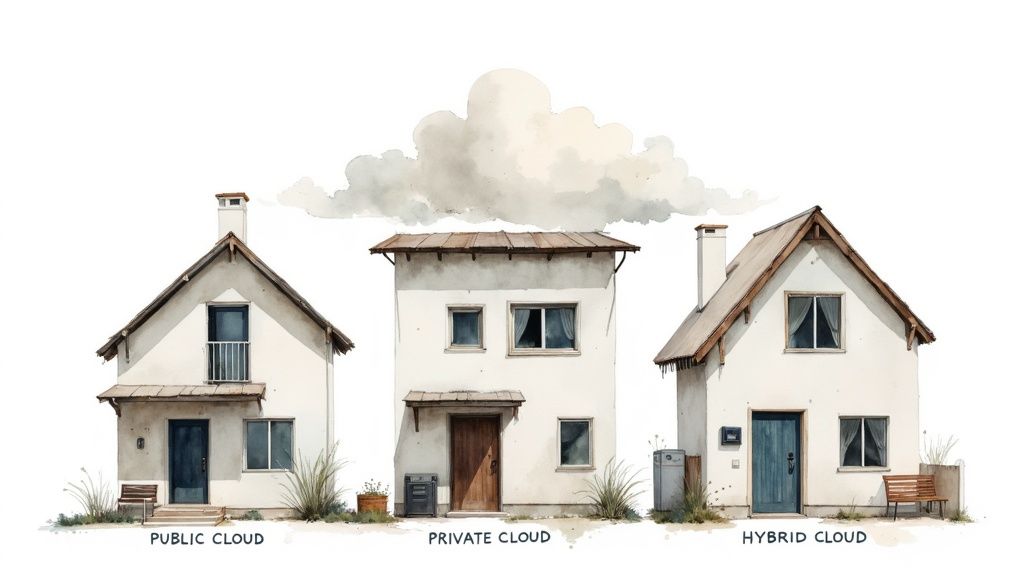
Once you’ve figured out what kind of cloud service you need—IaaS, PaaS, or SaaS—the next big question is where that cloud will actually run. This is your deployment strategy, and it’s a bit like choosing where to live. Each option has its own mix of cost, control, security, and maintenance, so the right choice really boils down to what your business needs to accomplish.
Getting this right is foundational to building an effective cloud computing solution for your business. This single decision will ripple through everything, from your budget and compliance efforts to how easily you can grow down the road. Let’s break down the three main models to see which one fits your vision.
The Public Cloud Model
The public cloud is the most common model, and it works a lot like renting an apartment in a massive, high-tech building. A major provider like Amazon Web Services (AWS) or Microsoft Azure owns and manages everything—the servers, the networking, the cooling systems—and you rent a piece of it. You share the overall building with other tenants, but your space is private and secure.
This model is incredibly popular for a reason: it’s cost-effective and built for scale. You get to tap into the provider’s massive infrastructure without spending a dime on your own hardware. Imagine a startup launching a new app. They can use the public cloud to handle a sudden surge of users without ever having to buy a physical server.
The trade-off? Because it’s a shared environment, it can sometimes be a non-starter for companies in heavily regulated fields. While the security is top-notch, it might not satisfy the strict compliance rules for certain types of sensitive data.
The Private Cloud Model
If the public cloud is an apartment, the private cloud is your own custom-built house. All the computing resources are dedicated exclusively to your business. This setup can live in your own on-site data center or be hosted for you by a third-party provider, but the key is that it’s all yours.
The main draw here is the absolute control and security it offers. You call all the shots. You can fine-tune the architecture to meet very specific security protocols or compliance standards. A hospital, for example, would likely choose a private cloud to store patient records, ensuring it has full control to meet HIPAA regulations.
Choosing a private cloud gives you maximum control, but it also means you assume maximum responsibility. This model requires significant capital investment and deep technical expertise for management and maintenance.
Of course, that level of control doesn’t come cheap. Private clouds are more expensive to build and run, and they don’t offer the same effortless scalability as their public cousins.
The Hybrid Cloud Model
The hybrid cloud is exactly what it sounds like: a practical blend of the other two models. It connects a private cloud with one or more public cloud services, giving you the best of both worlds. Think of it as owning your house (the private cloud) but also renting a secure, flexible storage unit down the street (the public cloud) for when you need extra room. This design lets you move applications and data between the two environments as needed.
This strategy is a game-changer for businesses with mixed needs. You can keep your most sensitive data and critical workloads safe on your private cloud while using the public cloud’s power for things like disaster recovery, development, or handling unexpected traffic spikes. An e-commerce site, for instance, might run its day-to-day business on a private cloud but “burst” into the public cloud to manage the holiday rush during Black Friday.
The Crucial Role of a USA-Based Partner
Trying to pick the right model and implement it securely can get complicated, fast. This is where having an experienced outsourcing partner based in the USA becomes a real strategic advantage. A US-based team brings an intimate understanding of domestic regulations, ensuring that whichever model you choose is built for compliance from the ground up.
More practically, they operate in your time zone, which means no more late-night calls or frustrating communication delays when you need support. That proximity and shared business culture make for a much smoother partnership, ensuring the cloud strategy you build is not just technically sound but perfectly aligned with your business goals and security needs for the long haul.
The Strategic Benefits of Adopting Cloud Solutions
Moving to the cloud is much more than a simple IT refresh. It’s a core business decision that can fundamentally change how you operate—impacting your budget, your speed, and your ability to compete. Think of it less as a technical update and more as a strategic move to build a more agile and growth-oriented company.
One of the first things you’ll notice is the impact on your finances. The old way of doing things meant spending a fortune on physical servers and hardware before you even got started. Cloud computing flips that model on its head, turning those hefty, unpredictable capital expenses (CapEx) into a manageable, predictable operating expense (OpEx).
This pay-as-you-go approach gives you incredible financial freedom. You can test new ideas or launch new products without betting the farm on expensive hardware, which makes innovation faster and a whole lot less risky.
Gaining Unmatched Scalability and Agility
Picture your e-commerce site on Black Friday. With traditional servers, a massive spike in traffic could easily crash your system, costing you sales and damaging your reputation. The cloud solves this with elasticity—the ability to automatically add or remove resources in real-time based on demand.
This means your website can handle a holiday rush without a hiccup and then scale back down when traffic returns to normal. You only pay for the extra horsepower when you actually use it. But this agility goes far beyond just managing traffic.
- Launch Faster: You can spin up new development and testing environments in minutes, not the weeks it used to take. This slashes the time it takes to get new products and features into your customers’ hands.
- Go Global in an Instant: Deploy your applications across different continents with just a few clicks. This brings your services closer to your international customers, giving them a much better and faster experience.
- Strengthen Your Backup Plan: Cloud providers offer powerful disaster recovery solutions that were once only affordable for the biggest corporations, making your business far more resilient.
The market is clearly voting for this agile approach. The global cloud computing market is expected to rocket past $1.6 trillion by 2030. It’s not just hype; businesses are getting real value. 65% of tech leaders say the cloud helps them get to market faster, and a staggering 94% report seeing better security after making the switch. You can find more data on these cloud computing trends on Brightlio.com.
The Advantage of a USA-Based Outsourcing Partner
While the cloud offers incredible potential, getting it right takes expertise. This is where choosing a USA-based outsourcing partner can give you a real competitive edge. The right domestic partner doesn’t just manage your tech; they make it work harder for your business.
Working with a team in the US means no more frustrating communication gaps or late-night calls. When you’re in the same or a nearby time zone, you get real-time support when you need it, which is essential for keeping projects on track and solving problems quickly.
More importantly, a US-based partner inherently understands the complexities of domestic data privacy and compliance laws. They design your cloud setup from day one to meet strict American regulations, shielding you from costly legal and financial trouble. This local expertise also means they can build security protocols specific to your industry, creating a stronger defense for your entire operation. To see how this works, take a look at our guide on end-point security solutions and how a multi-layered strategy protects your cloud environment.
How to Select the Right Cloud Partner
Picking the right cloud technology is just the start. The real make-or-break decision for a secure, successful, and cost-effective cloud strategy is finding the right partner to guide you through it. A great partner is more than a vendor; they become a true extension of your team, bringing the strategic vision and technical chops needed to make the cloud work for your business.
Let’s be honest, the market is crowded, and navigating it can feel like a chore. But if you have a structured way to evaluate potential partners, you’ll quickly see the real experts rise to the top. The goal is simple: find a team that doesn’t just get the technology but also gets you—your business goals, your security needs, and what you’re trying to achieve.
This decision is more critical than ever. By 2025, a staggering 94% of enterprises will be using cloud computing, making it a standard part of doing business. This isn’t just a tech trend; it’s a fundamental shift that demands the right expertise to manage increasingly complex multi-cloud and hybrid setups. You can explore more on these widespread cloud adoption rates at sqmagazine.co.uk.
Verifying Technical Expertise and Reliability
First things first: you need proof of their technical skills. Don’t just rely on a slick sales pitch; look for hard evidence.
- Certifications: Do they hold top-tier certifications from major players like AWS, Microsoft Azure, or Google Cloud? This is a baseline indicator of a verified skillset.
- Relevant Experience: Ask for case studies or client references from companies in your industry or with similar challenges. A partner who has already solved problems like yours is a much safer bet.
- Service Level Agreements (SLAs): Dig into their SLAs. These aren’t just documents; they are legally binding commitments to uptime and performance. What guarantees are they willing to make in writing?
Focusing on Security and Compliance Mandates
Security can’t be a feature you add on later. It has to be baked into your partner’s very culture. A solid partner will have a comprehensive security framework covering everything from data encryption and access control to proactive threat hunting. They should be able to clearly explain exactly how they’ll keep your data safe.
For most businesses, regulatory compliance is also completely non-negotiable. Whether you’re dealing with HIPAA in healthcare, SOX in finance, or GDPR for customer data, your partner must have deep, demonstrable experience in these specific areas. A mistake here can be catastrophic.
A partner’s ability to build and manage a compliant cloud architecture is one of the most important factors in your decision. A misstep in this area can lead to severe financial penalties and reputational damage, making expertise in this domain absolutely essential.
For a deeper dive into the nuts and bolts of what to look for, this practical guide to choosing a cloud provider is an excellent resource.
The Strategic Advantage of a USA-Based Outsourcing Partner
While technical skill is a global commodity, there are distinct and powerful benefits to working with a partner based right here in the USA. Choosing a domestic team can have a huge impact on communication, project flow, and legal peace of mind.
Here’s why it matters:
- Seamless Real-Time Collaboration: Working in the same time zones just makes life easier. When your team needs help, your partner is awake and available. Problems get solved faster, and projects keep moving forward without the usual friction of offshore communication.
- Unerring Adherence to US Data Laws: A USA-based partner operates under the exact same data privacy and security laws that your business does. This isn’t a small detail—it’s a critical layer of legal protection that ensures your data is handled according to the standards you’re held to.
- Cultural and Business Alignment: There’s an unspoken understanding that comes with a shared business culture. It smooths out everything from project management meetings to high-level strategic planning, reducing misunderstandings and building a much stronger, more intuitive partnership.
In the end, choosing a cloud partner is a strategic business decision that will echo for years. By prioritizing proven expertise, a rock-solid security posture, and the clear advantages of a USA-based team, you can build a relationship that delivers powerful cloud computing solutions for your business and becomes a genuine driver of your growth.
Your Roadmap to a Successful Cloud Migration

Moving to the cloud is a major step, but it’s far from a leap of faith. With a clear, phased approach, you can shift your operations smoothly, keep disruptions to a minimum, and start realizing the benefits much faster. Let’s break down the process into manageable stages so your migration is built on solid ground from the start.
Think of it like planning a major office relocation. You wouldn’t just start throwing things in boxes. First, you’d take inventory of your current space, design the layout of the new one, and then execute the move methodically. A cloud migration follows that same logical path, turning a complex project into a sequence of well-planned wins.
Phase 1: Assess Your Current IT Landscape
The first step is always to take a deep, honest look at your existing infrastructure, applications, and data. This initial audit is the most critical part of the entire journey because it informs every single decision that comes after. You simply have to know what you have before you can figure out how to move it.
During this discovery phase, you’ll catalog every application and data set, noting its business value and technical dependencies. Some apps might be ready to move as-is, while others might need to be modernized—or even retired. This is also the perfect time to spot security weak points and compliance gaps that need fixing.
Phase 2: Develop a Smart Migration Strategy
With your assessment in hand, you can build a strategy that actually fits your business. Not all applications are created equal, and your migration plan should reflect that reality. There are several proven models you can use, often in combination for different parts of your system.
- Rehost (Lift-and-Shift): This is the most straightforward approach. You’re essentially moving an application to the cloud with minimal changes. It’s fast and works well for legacy systems or when you have a hard deadline to exit a physical data center.
- Replatform (Lift-and-Reshape): This involves making a few smart cloud optimizations while you migrate. For instance, you might switch from a self-managed database to a fully managed cloud database service. This simple change can boost performance and cut down on your team’s admin work.
- Refactor (Re-architect): This is the most intensive strategy, where you fundamentally redesign an application to use cloud-native features. It demands more upfront investment but delivers the biggest long-term rewards in scalability, resilience, and cost-efficiency.
The migration strategy you choose will directly impact your timeline, budget, and the long-term performance of your cloud computing solutions for business. A rushed, one-size-fits-all plan often leads to unforeseen costs and technical debt down the road.
Phase 3: Execute the Migration and Optimize
Now it’s time to bring the plan to life. The migration itself should happen in carefully planned waves, starting with less critical workloads to build momentum and iron out your process. Throughout this stage, clear communication and rigorous testing are non-negotiable for a smooth transition that doesn’t disrupt your daily operations.
But the journey isn’t over once your applications are running in the cloud. The final, ongoing phase is all about optimization. This means continuously monitoring performance, keeping a close eye on costs, and refining your security posture to ensure you’re getting every bit of value from your investment.
Bringing a USA-based outsourcing partner in from day one can make this entire process far more manageable. An expert domestic team can guide the initial assessment, help you choose the most cost-effective strategies, and prevent expensive mistakes. Their real-time collaboration and deep knowledge of US compliance standards ensure your new cloud environment is built right—and built securely—from the very beginning.
Frequently Asked Questions About Cloud Solutions
Moving to the cloud naturally brings up some big questions. You’re not just thinking about the technology, but also how it impacts your security, your projects, and your legal obligations. Let’s tackle some of the most common concerns we hear from business leaders to give you some clarity.
Getting these answers right is key to making sure your move to the cloud is both successful and secure.
Is the Cloud Really More Secure Than Our Own Servers?
For most companies, the answer is a resounding yes. Think about it: major cloud providers like AWS and Azure spend billions of dollars every year on security. They have fortified data centers, platoons of cybersecurity experts, and threat detection systems that are far beyond what a typical business could afford on its own.
But that doesn’t mean you can just set it and forget it. Security in the cloud is a partnership. The provider handles the security of the cloud (the physical hardware and infrastructure), but you are responsible for security in the cloud (your data, applications, and access controls). This is precisely where a skilled USA-based partner makes a world of difference. They’ll configure your setup based on proven security principles, ensuring you’re taking full advantage of all the protective tools at your disposal.
What Is the Biggest Challenge in a Cloud Migration?
You might think the biggest hurdles are technical, but more often than not, they’re strategic. We’ve seen more cloud projects stumble because of a fuzzy plan, surprise costs from bad estimates, or a team that isn’t quite ready for the new environment. It’s easy to underestimate the complexity, which can lead to missed deadlines and a cloud setup that ends up costing more than it should.
The best way to avoid these headaches is with a thorough assessment upfront and a migration plan that’s broken down into manageable phases. This is an area where an experienced partner provides incredible value. They can help you accurately forecast costs, navigate the tricky parts of the transition, and steer clear of the common traps that trip up so many projects.
The success of a cloud migration hinges on meticulous planning. Without a strategic roadmap, businesses risk trading one set of problems for another, failing to capture the full cost and performance benefits the cloud offers.
How Does a USA-Based Partner Help with Compliance?
When it comes to navigating the maze of regulations, a USA-based partner is an essential guide. They bring deep, practical knowledge of US-specific rules like HIPAA for healthcare, SOX for financial companies, and state privacy laws like the CCPA. They know the domestic legal landscape inside and out, which means they can design your cloud architecture to meet these stringent demands from the very beginning.
This isn’t just about ticking boxes; it’s about protecting your business from the hefty fines and reputational damage that come with compliance failures. Plus, working with a US-based team ensures your data is managed under US data sovereignty laws—a non-negotiable for anyone in a sensitive or regulated field.
Ready to build a secure, efficient, and compliant cloud strategy that powers your growth? The team at NineArchs LLC combines deep technical expertise with strategic business insight to deliver cloud solutions that drive real results.
Start your cloud journey with a trusted US-based partner today.