

Over 60 percent of American businesses report significant challenges when delegating IT support tasks. Struggling to define who is responsible for what often leads to confusion and missed deadlines, which can impact productivity. Laying a strong foundation for IT support delegation is crucial if your goal is a smooth running operation. Discover practical steps that help clarify responsibilities, build strong teams, and create transparent processes so your IT support becomes a true asset rather than a source of stress.
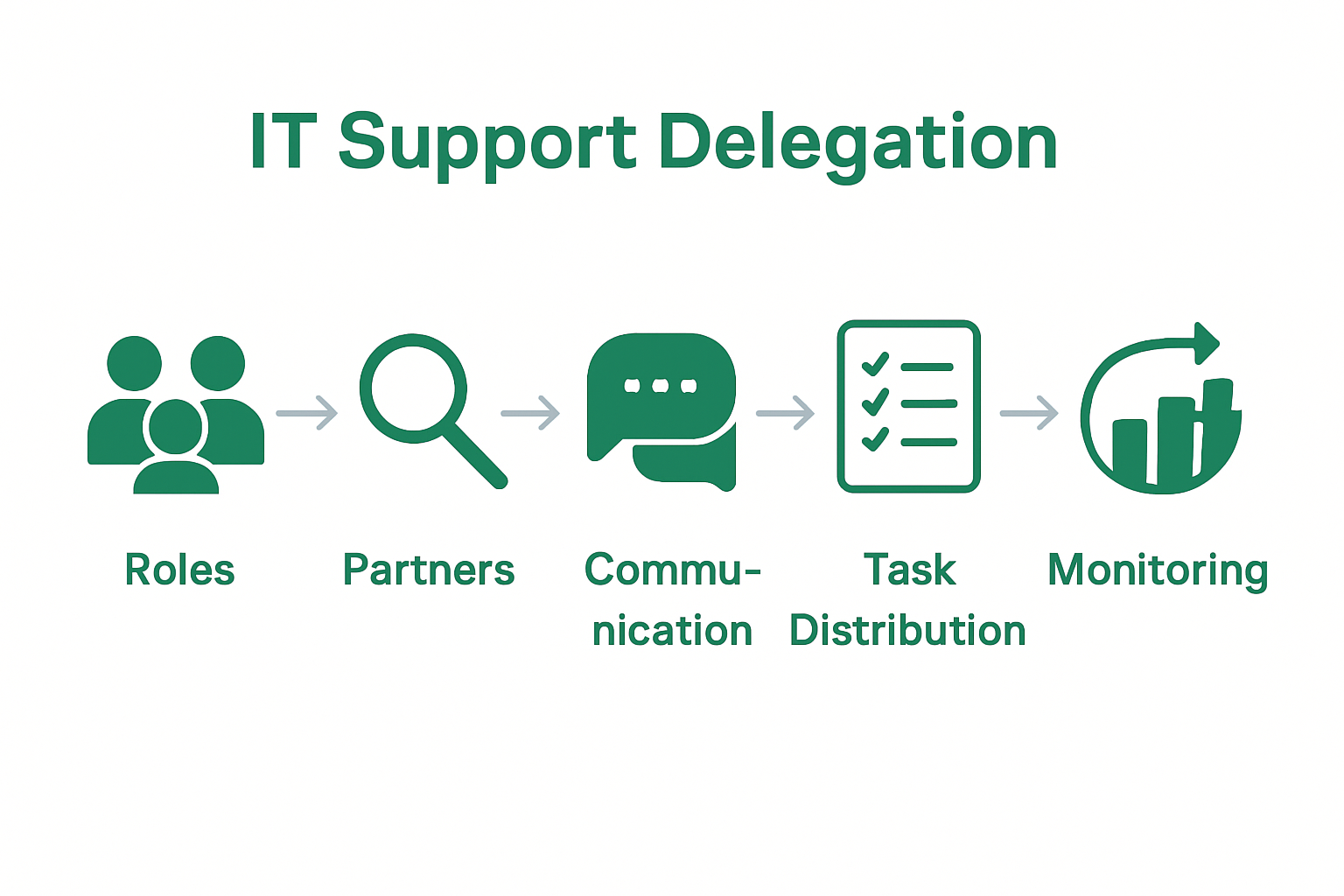
Step 1: Define IT Support Roles and Responsibilities
Successfully delegating IT support requires a crystal clear understanding of each team member’s specific roles and responsibilities. In this critical first step, you’ll establish a comprehensive blueprint that ensures every team member knows exactly what they are accountable for and how their work contributes to overall operational efficiency.
Start by mapping out core responsibilities across different IT support functions. Efficient IT support processes typically include several key roles such as technical support officers, network administrators, system engineers, and help desk specialists. Each role carries distinct responsibilities: technical support officers maintain computer systems and install software, network administrators manage infrastructure and connectivity, system engineers design and optimize technological architecture, and help desk specialists provide direct user support and troubleshooting.
To create a robust role definition framework, break down responsibilities into granular categories like incident management, problem resolution, system maintenance, and user support. Document specific tasks for each role including response times, escalation protocols, and performance metrics. This detailed approach prevents overlapping responsibilities and ensures clear accountability. Pro tip: Create a responsibility matrix that visually maps each role’s specific duties, making it easy for team members to understand their precise contributions to the IT support ecosystem.
As you finalize your role definitions, prepare to transition into establishing clear communication channels and performance tracking mechanisms that will transform these roles from theoretical descriptions into a high performing IT support team.
Step 2: Select Qualified Delegation Partners or Teams
Identifying the right IT support talent represents a critical milestone in building a robust outsourcing strategy. Your goal is to select delegation partners who possess not just technical skills but also the communication prowess and problem solving capabilities necessary for exceptional support delivery.
When evaluating potential IT support teams, focus on comprehensive skill assessments that go beyond technical proficiency. Efficient IT support processes demand professionals with deep knowledge of Windows operating systems, PC hardware, networking concepts, and advanced troubleshooting capabilities. Look for candidates who demonstrate strong communication skills, proven front line support experience, and the ability to handle complex technical challenges with precision and patience.
Develop a rigorous screening process that includes technical assessments, scenario based interviews, and practical skills demonstrations. Examine candidates holistic capabilities including their hardware and software maintenance expertise, response times, and adaptability to changing technological landscapes. Pro tip: Create a multi stage evaluation framework that tests not just technical competence but also cultural fit and teamwork potential. Prioritize candidates who show continuous learning mindset and can effectively translate complex technical concepts into clear user friendly solutions.
As you finalize your team selection, prepare to establish clear performance metrics and communication protocols that will transform your carefully selected IT support professionals into a high performing technological support ecosystem.
Step 3: Establish Clear Communication Protocols
Communication is the backbone of successful IT support delegation. Your primary objective in this step is to design a comprehensive communication framework that ensures seamless information flow, rapid problem resolution, and transparent interactions between your internal teams and external support partners.
Efficient IT support processes demand robust communication channels that go beyond traditional email and phone interactions. Implement a structured communication strategy using specialized service management platforms like Jira Service Desk, which allows for detailed ticket tracking, priority management, and real time updates. Establish clear guidelines for communication that specify response times, escalation procedures, and expected communication formats for different types of technical issues.
Develop a comprehensive communication matrix that outlines specific protocols for various scenarios. This should include standard operating procedures for reporting technical problems, defining severity levels, expected resolution timelines, and preferred communication methods for each type of issue. Pro tip: Create a standardized communication template that includes mandatory fields such as problem description, system impact, urgency level, and required technical expertise. This approach ensures consistent and precise information exchange, reducing misunderstandings and accelerating problem resolution.
As you finalize your communication protocols, prepare to implement performance tracking mechanisms that will help you monitor the effectiveness of your communication strategy and continuously refine your IT support delegation approach.
Step 4: Assign and Distribute IT Support Tasks
Effective task distribution is the cornerstone of a high performing IT support team. Your goal is to create a strategic allocation system that matches individual team members technical expertise with specific support responsibilities while maintaining overall operational flexibility.

Optimize IT support workflow by implementing a comprehensive task management approach that considers each team members unique skills and capabilities. Design a dynamic task allocation framework that covers critical areas such as user account management, equipment support, network maintenance, and technical troubleshooting. Evaluate each team members strengths and assign responsibilities that align with their specific technical competencies and experience levels.
Develop a flexible task distribution matrix that allows for balanced workload management and enables seamless task rotation. This approach prevents burnout and ensures comprehensive skill development across your IT support team. Pro tip: Create a real time task tracking system that provides visibility into current assignments, pending issues, and individual performance metrics. Implement a weighted scoring mechanism that considers task complexity, resolution time, and individual expertise to ensure fair and efficient task distribution.
As you finalize your task assignment strategy, prepare to establish robust performance monitoring mechanisms that will help you continuously refine your IT support team’s operational effectiveness.
Step 5: Monitor Progress and Ensure Task Quality
Monitoring IT support task performance is crucial for maintaining operational excellence and continuous improvement. Your primary objective is to implement a comprehensive tracking system that provides real time insights into team performance, task completion rates, and overall service quality.
Optimize IT support workflow by establishing robust performance measurement frameworks that go beyond traditional metrics. Develop a multi dimensional assessment approach that evaluates not just technical resolution times but also user satisfaction, problem complexity, and individual team member effectiveness. Create quantitative performance indicators such as first contact resolution rates, average response times, and ticket complexity distribution to provide objective measurements of your IT support teams performance.
Implement a dynamic performance tracking system that allows for continuous feedback and rapid adjustments. This should include regular performance reviews, automated reporting mechanisms, and periodic skill assessment protocols. Pro tip: Utilize advanced analytics tools that can provide predictive insights into potential bottlenecks, skill gaps, and emerging support trends. Establish a transparent performance evaluation process that rewards exceptional problem solving, encourages knowledge sharing, and motivates continuous professional development among your IT support team members.
As you refine your monitoring strategies, prepare to develop adaptive training and development programs that will help your IT support team consistently elevate their technical capabilities and service delivery standards.
Step 6: Evaluate Outcomes and Optimize the Process
Successful IT support delegation requires a systematic approach to continuous improvement. Your primary goal is to develop a comprehensive evaluation framework that transforms performance data into actionable insights for ongoing process refinement.
Optimize business process documentation by implementing a multifaceted assessment strategy that goes beyond surface level metrics. Conduct thorough performance reviews that analyze both quantitative indicators like resolution times and ticket volumes as well as qualitative measures such as user satisfaction scores and team feedback. Develop a holistic scoring mechanism that captures the nuanced aspects of IT support performance including technical accuracy, communication effectiveness, and problem solving efficiency.
Establish a structured continuous improvement cycle that translates evaluation insights into concrete process enhancements. This approach should include regular retrospective meetings, detailed performance trend analysis, and targeted skill development initiatives. Pro tip: Implement a feedback loop that not only tracks technical performance but also captures emerging technological trends and potential skill gaps. Create a dynamic optimization framework that allows for rapid process adjustments based on real time performance data and evolving organizational needs.
As you complete your initial process evaluation, prepare to develop a long term strategic approach that will transform your IT support delegation from a static model to a continuously evolving and adaptive system.
Streamline Your IT Support Delegation with Expert Outsourcing Solutions
Delegating IT support can be overwhelming when juggling roles, clear communication protocols, and task distribution. This article highlights how well-defined responsibilities, robust communication, and continuous monitoring are crucial to avoiding costly delays, overlapping duties, and inefficient workflows. If you want to overcome these common challenges and achieve scalable, cost-efficient IT support, consider partnering with proven experts who understand these intricacies.
NineArchs LLC specializes in tailored IT outsourcing solutions designed to optimize your remote workforce and enhance operational efficiency. Our team supports you by aligning technical expertise with your business demands to accelerate problem resolution and improve service quality.
Ready to master IT support delegation with professional remote assistance? Visit our Contact page to explore how our virtual assistance and technical outsourcing can transform your IT support processes. Don’t wait to reduce downtime and boost productivity with flexible, scalable solutions from NineArchs. Take the next step today by connecting with us at https://ninearchs.com/contact.
Frequently Asked Questions
What are the key roles in IT support delegation?
The key roles in IT support delegation include technical support officers, network administrators, system engineers, and help desk specialists. Clearly define each role’s responsibilities to ensure effective collaboration and operational efficiency.
How do I choose the right IT support partners?
To choose the right IT support partners, assess their technical skills and communication abilities. Implement a rigorous screening process with technical assessments and scenario-based interviews to ensure they can effectively solve problems and interact with your users.
What should be included in our IT support communication protocol?
Your IT support communication protocol should include clear guidelines for response times, escalation procedures, and preferred communication methods for different technical issues. Create a communication matrix that specifies procedures for reporting problems and outlines expectations for resolution timelines.
How can I ensure effective task distribution among my IT support team?
Ensure effective task distribution by creating a dynamic allocation framework that matches individual team members’ skills with specific responsibilities. Regularly review workloads, and implement a task tracking system to maintain balance and transparency in assignments.
What metrics should I track to monitor IT support performance?
Track metrics such as first contact resolution rates, average response times, and user satisfaction scores to assess IT support performance. Regularly analyze these metrics to identify trends and areas for improvement, allowing for informed adjustments over time.
How can I implement a continuous improvement process for IT support?
Implement a continuous improvement process by conducting regular performance reviews and establishing a feedback loop. Use insights from evaluations to make data-driven adjustments and enhance technical capabilities, aiming for consistent service quality.
Recommended
- Mastering IT Support Processes for Efficient Operations | NineArchs
- Why Outsource Support Desk: Complete Guide for 2025 | NineArchs
- Outsource Repetitive Tasks Guide for Seamless Efficiency | NineArchs
- Complete Guide to IT Support Outsourcing | NineArchs
- it support interview questions – ParakeetAI
- Stop Micromanaging: Lead Your Sales Team Better