

When people hear “IT support,” they often picture a help desk—the folks you call when a printer jams or a password gets lost. But for a small business, true IT support is so much more than that. It’s the entire technological framework that keeps your operations running smoothly, securely, and efficiently.
Think of it as the digital architect for your business, proactively designing and maintaining your systems, not just showing up to fix things when they break.
Building Your Business on a Solid Digital Foundation
Imagine constructing a new building for your company. You wouldn’t dream of putting up walls or installing expensive equipment without first pouring a rock-solid foundation. In today’s economy, your technology is that foundation.
If that digital groundwork is shaky, everything you build on top of it is at risk. A small software bug can grind productivity to a halt. A single security breach can shatter customer trust overnight. Outdated systems can leave you struggling to keep up with the competition. This is precisely where professional IT support for small businesses proves its worth.
More Than Just a “Break-Fix” Mentality
The old way of thinking about IT was purely reactive. Something breaks, you call for help, you wait for a fix. That model just doesn’t cut it anymore.
Modern IT support is a strategic partnership. It’s about having an expert team that proactively manages your entire tech ecosystem to prevent problems before they start. Let’s look at what that actually means.
Here’s a quick overview of the essential services that form a comprehensive IT support strategy for any small business.
Core Components of Modern IT Support
| Service Area | What It Means For You | Direct Business Impact |
|---|---|---|
| Proactive Monitoring | Constant, 24/7 watch over your network, servers, and devices. | Issues like failing hard drives or security vulnerabilities are caught and fixed before they cause downtime. |
| Cybersecurity Defense | A multi-layered security plan including firewalls, anti-virus, and employee training. | Protects your sensitive company data and customer information from constant threats like phishing and ransomware. |
| Cloud Management | Expert setup and maintenance of services like Microsoft 365 or Google Workspace. | Your team can collaborate and access their tools securely from anywhere, on any device. |
| Strategic Planning | Guidance on new technology investments and creating an IT roadmap. | Ensures your technology spending aligns directly with your long-term business goals for smart, sustainable growth. |
By treating IT as a core business function instead of an afterthought, you move from constantly putting out fires to building a truly resilient and competitive operation.
The Growing Need for Strategic IT
This reliance on solid tech isn’t just for big corporations anymore. The global market for IT support services aimed at small businesses is on track to hit around $5.46 billion in 2025. That number tells a clear story: technology is now woven into the fabric of every modern business, regardless of size.
A proactive approach to technology is no longer a luxury for small businesses; it is a fundamental requirement for survival and growth in a competitive, digital-first economy.
To truly secure that digital foundation, you need to be proactive. Getting familiar with the top cybersecurity tips for small businesses is a great starting point for protecting your digital assets.
When you combine that proactive security mindset with powerful platforms like Microsoft 365, you create a robust defense. You can learn more about how https://ninearchs.com/technology-services/o365-cloud-computing/ can fortify your business, creating a framework that supports everything from daily help desk tickets to long-term strategic growth.
Choosing Your IT Support Model
Figuring out how to handle your company’s technology is a big deal. The decision you make will ripple through your budget, day-to-day operations, and even your company’s security. There’s no single right answer here—the best path forward really depends on your specific needs, how much risk you’re comfortable with, and where you see your business heading.
Let’s walk through the three main ways small businesses tackle IT support. We’ll start with the most basic and build from there, giving you a clear picture of what each one offers so you can make a smart choice.
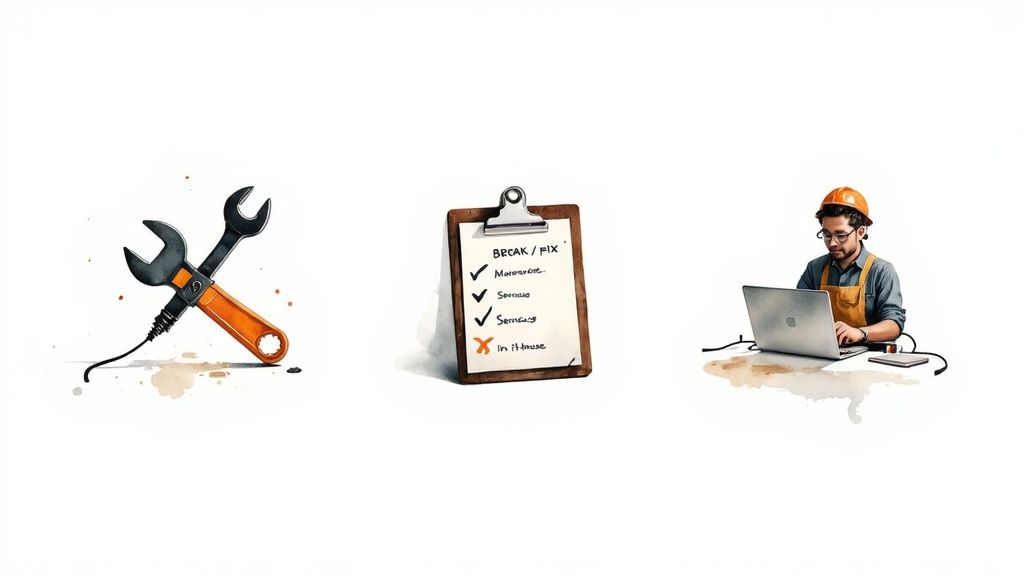
The Break/Fix Model: An On-Demand Approach
Think of the break/fix model as the “IT firefighter.” You only call them when there’s a fire—a server has crashed, a laptop won’t turn on, or the Wi-Fi is down. You pay them, usually by the hour, to come in and put out the flames.
This is a purely reactive approach. There’s no ongoing maintenance or oversight; the technician’s only job is to solve the immediate crisis. For a tiny business with just a couple of computers and a high tolerance for downtime, this might seem like the cheapest way to go.
But the costs are a total wildcard and can spiral out of control. A major hardware failure can rack up a huge bill for emergency labor, not to mention the revenue you lose while your operations are at a standstill. It also creates a strange dynamic where the IT provider actually makes more money when your technology breaks.
The In-House Team: A Dedicated Resource
Putting an IT professional (or a small team) on your payroll gives you a dedicated expert who is always there. This person gets to know your business inside and out, is on-site for immediate help, and can tackle problems the moment they pop up. This model gives you the ultimate level of control and hands-on attention.
The elephant in the room, of course, is the cost. The salary, benefits, and continuous training for a full-time IT specialist are a major financial commitment, one that’s often too steep for small businesses. Plus, you’re banking on one person’s skillset, which makes it tough to cover all the bases of modern IT, from complex cybersecurity to cloud infrastructure.
Relying on a single in-house person creates a huge vulnerability for a small business. What happens if they get sick, take a vacation, or find a new job? Your entire operation is left exposed without critical support.
Managed IT Services: A Proactive Partnership
Managed IT Services, typically delivered by a Managed Service Provider (MSP), completely flips the script. Instead of just reacting to disasters, an MSP’s job is to proactively keep them from happening in the first place. It’s like having a building manager who constantly checks the pipes to prevent a flood, rather than just showing up to clean up the mess afterward.
With this model, you pay a predictable, flat monthly fee for a whole suite of services. This usually includes:
- 24/7 Monitoring: Someone is always watching your systems to catch and fix issues before they can cause any real trouble.
- Cybersecurity: You get a complete security setup, including firewalls, antivirus, and threat detection, to keep your data locked down.
- Data Backup & Recovery: This ensures your critical business information is backed up and can be restored quickly if the worst happens.
- Help Desk Support: Your team gets on-demand access to experts for all their day-to-day tech headaches and questions.
The beauty of this model is that the MSP’s goals are perfectly aligned with yours—they only succeed when your technology is running smoothly and securely. It gives you access to an entire team of specialists for what is often a fraction of the cost of hiring just one person in-house. When looking for an outsourced partner, picking one based in the USA means they’ll be operating under the same business regulations and available during your working hours, eliminating time zone headaches. This strategic move simplifies compliance and ensures that when you need help, it’s just a phone call away.
As you build out your tech infrastructure, choosing the right communication tools is a key piece of the puzzle. It’s worth digging into resources for comparing small business phone systems to ensure you find the right fit.
The Advantage of a US-Based IT Partner

When you outsource your IT, you’re doing more than just buying a service—you’re bringing a new partner into the fold. And where that partner is based can have a massive impact on your business’s security, day-to-day efficiency, and even its long-term strategy. While the lower price tags of offshore providers can look appealing on paper, the real value of working with a US-based partner often wins out in the long run.
Choosing a domestic provider for IT support for small businesses isn’t about patriotism; it’s a smart business decision. It touches everything from how you manage risk to how quickly you can jump on opportunities.
Navigating the Maze of US Data Regulations
One of the clearest wins of keeping your IT partner stateside is their built-in familiarity with US data privacy laws. Regulations like the Health Insurance Portability and Accountability Act (HIPAA) or the California Consumer Privacy Act (CCPA) aren’t just guidelines—they come with serious teeth and hefty penalties for getting it wrong.
A US-based provider operates under the exact same legal system your business does. They’ve built their entire operation around these rules, so compliance isn’t an add-on; it’s baked into their DNA.
For any small business handling sensitive customer or patient information, choosing a US-based IT provider is more than just a good idea. It’s a vital shield against devastating compliance fines and data breaches.
This shared legal ground means you get better advice on everything from data handling and security protocols to incident response plans that are actually relevant to the American regulatory environment. It takes a huge weight off your shoulders, knowing your partner is held to the same high standards you are.
The Power of Speaking the Same Language
Great IT support is all about clear, fast communication, especially when things go wrong. If your network grinds to a halt or you’re facing a potential security threat, communication roadblocks are the last thing you need.
Working with a domestic team instantly removes two of the biggest hurdles: time zones and cultural gaps.
- Time Zone Sync: When your provider’s business hours are your business hours, you get help when you actually need it. No more waiting overnight for a ticket response from a team on the other side of the planet.
- Cultural and Language Fluency: With a shared language and business culture, nothing gets lost in translation. Problems are understood quicker, instructions are crystal clear, and solutions get rolled out more efficiently. It makes your outsourced support feel less like a vendor and more like an extension of your own team.
Think about it. A critical server fails at 2 PM on a Tuesday. With a US partner, you’re on the phone, collaborating in real-time. With an offshore team, you might be sending a ticket into a void that won’t be seen until your workday is long over.
Getting Real-World Insights for the US Market
Beyond just fixing what’s broken, a great IT partner should offer strategic advice to help your business thrive. A US-based provider is in a unique position to do this because they live and breathe the same market you do. They get the competitive pressures, the customer expectations, and the tech trends that are shaping American business right now.
This firsthand knowledge means they can offer more than just reactive support. They become a genuine advisor, helping you make smarter tech investments that align with your goals in the US market. They might recommend specific e-commerce security measures geared toward American consumer behavior or suggest cloud services that meet domestic data storage requirements.
At the end of the day, picking a US-based provider is an investment in reliability and a much deeper, more strategic partnership. They don’t just solve your technical issues; they understand the world your business operates in, protecting you while helping you succeed.
How Smart IT Support Fuels Growth and Efficiency

It’s easy to look at IT support as just another line item on the budget—a necessary expense. But that’s like seeing a delivery truck as only a cost for gas. In reality, that truck is what generates revenue and allows your business to grow. In the same way, professional IT support for small businesses isn’t a cost center. It’s a direct investment in your company’s ability to innovate, compete, and scale.
A stable and secure tech environment is the launchpad for everything else you do. Without it, you’re stuck in a reactive loop: wasted hours on system crashes, lost sales from a downed website, and missed opportunities because your team is fighting their tools instead of using them.
Smart IT support completely flips that dynamic. It builds a reliable foundation where you can confidently deploy the tools you need to succeed, moving your business from just surviving to actively thriving.
Boosting Productivity by Eliminating Friction
Think about every minute an employee spends wrestling with a slow computer, a buggy app, or a spotty network connection. Each of those moments is a minute they aren’t helping a customer or moving a project forward. These little bits of tech friction add up, costing an employee up to a full work week of productivity over the course of a year.
Professional IT support is all about systematically removing those roadblocks. By making sure systems are optimized, software is patched, and networks are solid, your team can simply get to work without interruption.
When technology works seamlessly in the background, your team can focus entirely on their actual jobs. This direct link between stable IT and employee output is one of the fastest ways to see a return on your support investment.
This is especially true when you partner with a provider who understands your operational needs. For example, a US-based provider will get the nuances of domestic business workflows, ensuring support is perfectly aligned with your team’s rhythm without time-zone headaches or cultural misunderstandings.
Enabling Innovation and Digital Adoption
In today’s market, growing your business often means adopting new digital tools. From cloud platforms to AI, these technologies are no longer optional. Studies show that 98% of small businesses now use at least one AI-enabled tool, and 51% apply AI specifically to their marketing. As you can read in this deep dive on how digital services are empowering SMEs and startups, these tools are driving collaboration, efficiency, and revenue.
But just buying a new piece of software isn’t enough. You need a secure and stable platform to run it on. A great IT partner does more than fix what’s broken; they create an environment where you can safely experiment and integrate new solutions. They make sure new software is compatible, secure, and properly configured—turning a potential tech headache into a true competitive advantage.
Securing Your Most Valuable Asset: Data
Nearly every business decision you make, from a marketing campaign to a new product line, relies on data. It’s one of your most valuable assets, and protecting it is absolutely non-negotiable. At its core, a strong IT support strategy is a data security strategy.
This means putting multiple layers of protection in place:
- Access Control: Making sure only the right people can access sensitive information.
- Threat Prevention: Actively blocking malware, phishing attempts, and other cyber threats before they can cause damage.
- Data Backup and Recovery: Creating secure, restorable copies of your data so you can get back on your feet quickly after any incident.
When your data is secure, you can make decisions with confidence, knowing the information you’re using is both accurate and protected. A huge part of this is securing every single device that connects to your network. Bolstering your defenses with robust end-point security solutions is a fundamental step in building that trust and safeguarding your company’s future.
Your Checklist for Selecting the Right IT Provider
Choosing an IT provider feels a lot like hiring a key team member—because that’s exactly what it is. This partner will have access to your most sensitive data and be responsible for the technology that keeps your entire operation running. Rushing this decision can lead to serious security gaps and endless operational headaches, but a thoughtful choice can become a powerful competitive advantage.
This checklist is designed to help you confidently navigate the selection process. It gives you a clear, step-by-step framework to evaluate potential partners, ask the right questions, and ultimately find a provider who truly gets your business goals. Remember, the best IT support for small businesses is about finding a partner, not just another vendor.
Initial Research and Vetting
Before you even start making calls, a little homework will help you build a strong shortlist. You’re looking for providers who not only have a solid reputation but also have experience that’s actually relevant to your specific industry and how you work.
Your initial screening should zero in on a few key areas:
- Industry Experience: Have they worked with businesses like yours before? A provider who already understands the unique compliance rules and workflows in your field (like healthcare or finance) will be far more effective from day one.
- Customer Testimonials and Reviews: Dig deeper than the hand-picked quotes on their website. Check third-party review sites to see what real clients are saying about their responsiveness, expertise, and overall service quality.
- Company Size and Scalability: You need a provider that’s big enough to handle your needs but not so massive that you’ll just be another number. Ask them how they support businesses as they grow.
A critical factor in your initial search is location. Prioritizing a US-based outsourcing partner ensures they operate under the same data privacy laws you do, which simplifies compliance and guarantees support during your actual business hours.
Critical Questions to Ask Potential Providers
Once you have a shortlist, it’s time to start the interviews. The answers you get to these questions will reveal a ton about a provider’s technical skills, their approach to customer service, and how they’d really function as a strategic partner.
Don’t be afraid to dig into the specifics.
- How do you handle cybersecurity? Ask them to walk you through their security stack. What specific tools do they use for threat detection, firewalls, and endpoint protection? How do they help train your employees to spot phishing attempts?
- What are your typical response and resolution times? Don’t settle for vague answers—get concrete numbers. Their Service Level Agreement (SLA) should clearly define guaranteed times for acknowledging a ticket and resolving issues based on their priority.
- Can you provide client references? Any provider worth their salt will be happy to connect you with current clients. When you speak to them, ask about a time they had a major IT issue and how the provider handled the pressure.
- How will you help us plan for the future? A true partner does more than just fix what’s broken. Ask how they create technology roadmaps, assist with budgeting, and advise on new solutions that could give your business an edge.
Evaluating Contracts and SLAs
The contract and the Service Level Agreement (SLA) are where all those verbal promises get put into writing. This is arguably the most important part of the evaluation, so you need to read every single line. Be on the lookout for vague language and make sure all the critical parts of their service are clearly defined.
Here’s a simple framework you can use to compare what different providers are actually offering in their contracts.
IT Provider Evaluation Scorecard
| Evaluation Criteria | Provider A | Provider B | Importance (1-5) |
|---|---|---|---|
| Guaranteed Response Time (Critical Issue) | 15 Minutes | 1 Hour | 5 |
| Cybersecurity Tools Included | EDR, Firewall, Phishing Training | Antivirus Only | 5 |
| On-Site Support Availability | Included in Plan | Extra Hourly Fee | 4 |
| Contract Length and Termination Policy | 1-Year, 30-day notice | 3-Year, 60-day notice | 3 |
Also, pay close attention to what isn’t included. Hidden fees for on-site visits, after-hours support, or specific software projects can make your costs balloon unexpectedly.
A transparent, all-inclusive pricing model from a reputable US-based provider often delivers better long-term value by eliminating surprises and ensuring clear communication from day one. By being methodical in your search, you can find a partner who will not only protect your business but help it grow securely.
Answering Your Questions About Small Business IT
Even when you know you need help, taking the plunge into professional IT support brings up a ton of questions. Let’s cut through the noise and get you some straight answers to what’s probably on your mind. Think of this as your quick-start guide to clearing up any confusion so you can move forward with confidence.
We’ll tackle everything from “How much is this going to cost?” to “Is my business even big enough for this?”
How Much Should a Small Business Budget for IT Support?
This is a tough one because the models are so different. If you go with a reactive, on-demand guy, your costs are all over the place—and they always seem to spike right when you can least afford it.
The more modern approach, Managed IT Services (MSPs), gives you predictable, flat-fee pricing. You’re typically looking at $50 to $250 per user, per month. This model is all about preventing expensive disasters before they happen, which makes budgeting a whole lot easier. As a general rule of thumb, most small businesses find themselves putting 3% to 6% of their annual revenue toward their total tech spending, which includes support. The best move? Get detailed quotes from a few different providers to see what you’re really getting for your money.
What’s the Difference Between IT Support and an MSP?
The biggest difference is their entire philosophy. Traditional IT support for small businesses is what we call “break/fix”—it’s totally reactive. You only call them when a server is down or a laptop won’t boot, and you pay them to fix that one specific problem.
A Managed Service Provider (MSP), on the other hand, is proactive. You pay them a monthly fee to constantly monitor, manage, and maintain your systems. Their goal is to stop problems from ever happening in the first place. An MSP is more like a strategic partner who’s invested in keeping you up and running, while a break/fix shop is just an on-call repair service.
Is My Business Too Small for Managed IT Services?
Honestly, no business is too small anymore. Cybercriminals are increasingly hitting smaller companies precisely because they think they’re easy targets. The beauty of managed IT is that it’s incredibly scalable—it can be tailored for a one-person consultancy just as easily as for a 50-person team.
For a tiny business, an MSP is a game-changer. It gives you access to the kind of high-end security tools and deep expertise that big corporations have, but for a tiny fraction of what it would cost to hire even one full-time IT person. It’s a smart, cost-effective way to professionalize your operations right from the start.
Choosing a US-based provider offers significant strategic advantages. They operate under the same data privacy and security regulations your business does, which greatly simplifies compliance and reduces risk.
Why Should I Prioritize a US-Based Provider?
Working with a provider right here in the US offers some huge advantages that go way beyond just technical skills. For starters, they’re bound by the same data privacy laws your business is, like HIPAA or CCPA. That alignment alone is a massive security and compliance win.
Then there’s the practical side of things. You won’t be fighting with crazy time zone differences or language barriers when you have an urgent problem. Finally, a US-based partner just gets the local market. They understand the challenges you’re facing and can give you much more relevant, strategic advice that feels like it’s coming from a true extension of your team.
Ready to build a reliable and secure technology foundation for your business? The expert team at NineArchs LLC offers a full suite of IT services and outsourcing solutions designed to fuel growth and efficiency for small and mid-sized businesses. From proactive managed IT to scalable virtual assistants, we provide the US-based expertise you need to succeed. Learn how we can support your business today.