


More than half of American tech companies now consider virtual assistants as viable alternatives to full-time hires. With operational needs shifting faster than ever, choosing between a remote contractor and a traditional employee can have a direct impact on a company’s scalability and budget. This comparison uncovers how flexibility, costs, and integration truly differ for American organizations aiming for streamlined growth and smarter resource allocation.
Defining Virtual Assistants and Employees
The modern workplace has dramatically transformed, introducing new workforce models that challenge traditional employment structures. Virtual assistants represent a flexible professional category emerging as a strategic alternative to conventional full-time employees, offering businesses unprecedented agility in talent management.
A virtual assistant (VA) is a professional who provides remote administrative, technical, or creative support to businesses or entrepreneurs from a home office or external location. Unlike traditional employees, VAs typically operate as independent contractors, offering specialized services across multiple clients. Outsourced virtual assistants can handle diverse tasks including administrative coordination, customer support, digital marketing, research, and project management.
Traditional employees, in contrast, work directly for an organization with structured employment agreements, receive consistent salaries, benefits, and operate within specific workplace hierarchies. They are typically bound by company policies, work set hours, and function within a more regulated professional environment. Research from Springer indicates that virtual assistants can significantly enhance team collaboration, potentially becoming integral to daily organizational workflows while offering more dynamic engagement models.
The key distinctions between virtual assistants and employees center on employment classification, work arrangement flexibility, compensation structures, and organizational integration. Virtual assistants offer businesses scalable solutions with lower overhead, while employees provide deeper institutional knowledge and consistent organizational commitment.
Here’s a side-by-side comparison of virtual assistants and traditional employees focusing on key business factors:
| Factor | Virtual Assistants | Traditional Employees |
|---|---|---|
| Engagement Model | Independent contractor, flexible | Full-time, structured employment |
| Onboarding Speed | Rapid, task-focused | Gradual, culture integration |
| Overhead Costs | Minimal, pay for tasks only | High, includes salaries and benefits |
| Institutional Knowledge | Limited, varies by client | Deep, long-term organizational memory |
| Supervision Needed | Low, self-managed | Regular, hierarchical supervision |
| Organizational Loyalty | Generally short-term | Long-term, career development |
Pro tip: When considering a virtual assistant, carefully assess your specific operational needs and evaluate potential candidates based on their specialized skill sets and proven track record of remote collaboration.
Key Roles and Task Distinctions
Businesses today navigate increasingly complex workforce strategies, with virtual assistants and employees representing distinctly different professional engagement models. Understanding their unique roles and responsibilities is critical for effective organizational design and talent management.
Virtual assistants typically handle specialized, task-specific responsibilities that require minimal direct supervision. Virtual assistant tasks often encompass a wide range of administrative, technical, and creative functions such as:
- Email management and communication coordination
- Social media content creation and scheduling
- Data entry and research support
- Customer service and client communication
- Digital marketing and online administrative tasks
Traditional employees, by contrast, are deeply integrated into organizational structures with more comprehensive, long-term responsibilities. Their roles typically demand continuous engagement, institutional knowledge, and direct involvement in core business processes. Employees usually work within structured hierarchies, participate in team meetings, contribute to strategic planning, and maintain consistent physical or remote presence within the company ecosystem.
The fundamental difference lies in the depth of organizational integration and the nature of work commitment. Virtual assistants operate with greater flexibility, often serving multiple clients simultaneously and focusing on discrete, well-defined tasks. Employees, however, are committed to a single organization’s objectives, embodying its culture and working towards broader strategic goals.

Pro tip: Develop clear, detailed task descriptions when engaging virtual assistants to ensure precise expectations and smooth workflow integration.
Hiring Workflow and Onboarding Process
The hiring and onboarding processes for virtual assistants and traditional employees differ significantly, reflecting their distinct professional engagement models. Organizations must develop tailored approaches that account for the unique characteristics of each workforce category.
For virtual assistants, role of onboarding in outsourcing becomes critically important due to the remote and often short-term nature of their engagement. The hiring workflow typically involves:
- Detailed skills assessment
- Portfolio and experience review
- Technical competency testing
- Remote interview process
- Clear task definition and scope agreement
Traditional employee onboarding follows a more comprehensive, structured approach involving deeper organizational integration. This process usually includes intensive orientation programs, comprehensive training modules, formal introductions to team members, and gradual role immersion. Companies invest significant resources in helping new employees understand corporate culture, communication protocols, and long-term career development pathways.
The key distinction lies in the depth and duration of onboarding. Virtual assistants require precise, task-specific orientation that enables immediate productivity, while employees undergo more holistic socialization designed to align them with broader organizational objectives and long-term strategic goals. This fundamental difference necessitates flexible, targeted onboarding strategies that recognize the unique value proposition of each workforce category.
Pro tip: Develop standardized yet adaptable onboarding checklists that can be quickly customized for both virtual assistants and traditional employees to ensure efficient and consistent integration.
Cost, Benefits, and Tax Implications
The financial landscape of hiring virtual assistants versus traditional employees presents a complex array of economic considerations that can significantly impact an organization’s bottom line and operational strategy. Understanding the nuanced cost structures and potential financial advantages becomes crucial for strategic workforce management.
Cost Breakdown reveals substantial differences between virtual assistants and traditional employees. Virtual assistants typically offer more economical solutions, with businesses avoiding:
- Full-time salary commitments
- Health insurance expenses
- Retirement benefit contributions
- Office space and equipment costs
- Payroll tax obligations
- Ongoing training and professional development investments
HR support outsourcing strategies demonstrate that virtual assistants can reduce overall workforce expenditures by 30-50% compared to traditional full-time employees. These cost savings stem from the flexible engagement model, where businesses pay only for specific tasks completed rather than maintaining continuous overhead.
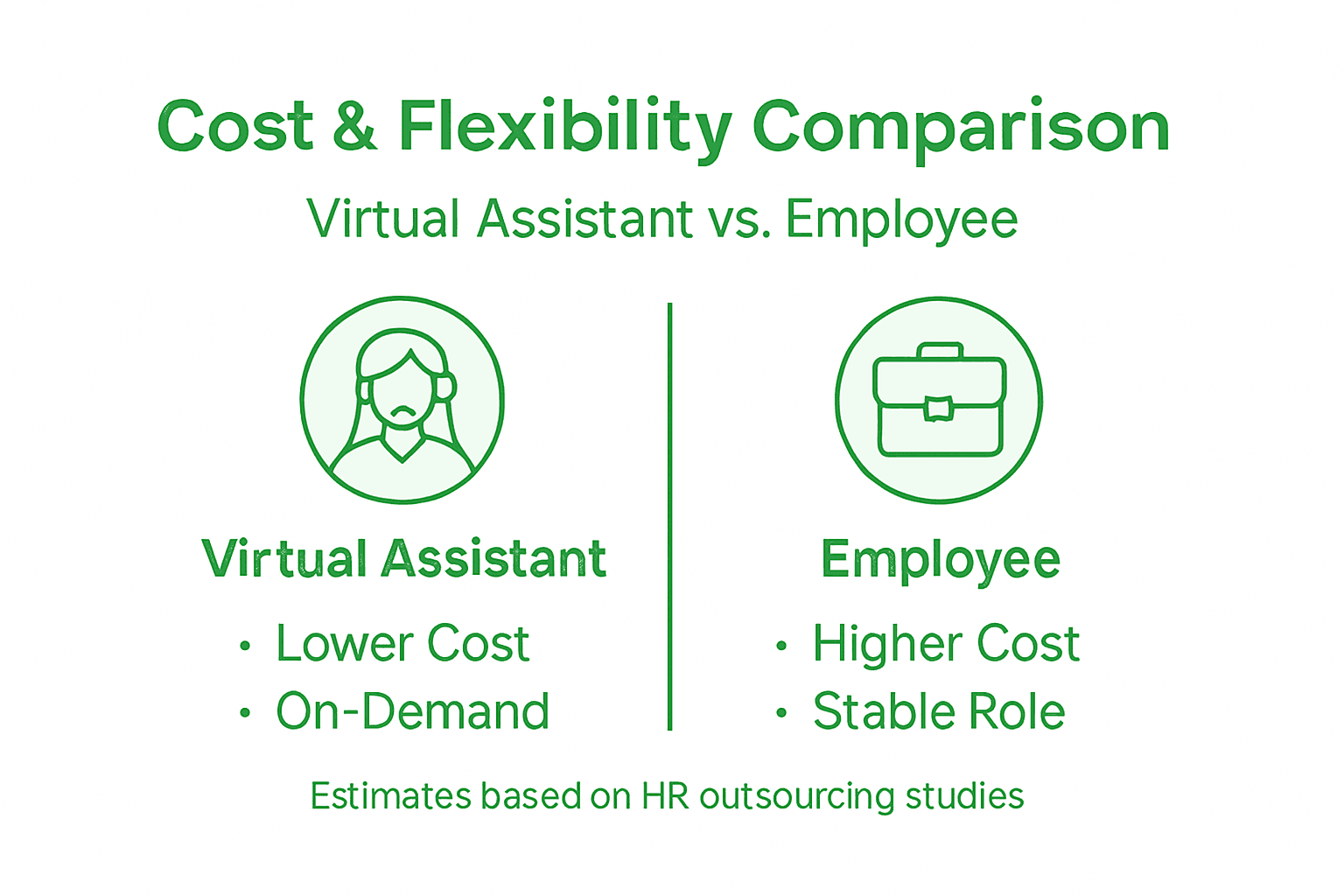
Tax implications present another critical consideration. Virtual assistants are typically classified as independent contractors, which offers significant tax advantages. Businesses can deduct payments made to virtual assistants as legitimate business expenses, potentially reducing overall tax liability. This classification eliminates complex payroll tax requirements and provides greater financial flexibility compared to traditional employee arrangements.
Traditional employees, while more expensive, offer long-term stability and deeper organizational integration. Their comprehensive compensation packages include benefits, job security, and potential career advancement opportunities that virtual assistants cannot provide. Organizations must carefully balance immediate cost savings against long-term strategic workforce needs when making hiring decisions.
Pro tip: Conduct a comprehensive cost-benefit analysis that includes both direct expenses and indirect value contributions when comparing virtual assistants and traditional employees to make informed hiring decisions.
Compliance, Risks, and Oversight Challenges
The evolving landscape of workforce engagement introduces complex compliance and risk management considerations that demand sophisticated strategic approaches when integrating virtual assistants and traditional employees into organizational frameworks.
Cybersecurity risks represent a critical concern, particularly with virtual assistants operating outside direct organizational infrastructure. Hire candidates with robust security awareness become essential, with key potential vulnerabilities including:
- Data confidentiality breaches
- Unauthorized network access
- Potential intellectual property exposure
- Inconsistent information security practices
- Communication channel vulnerability
- Potential compliance regulation violations
Regulatory compliance demands meticulous attention, especially concerning data protection frameworks like General Data Protection Regulation (GDPR) and industry-specific security standards. Virtual assistants require comprehensive background verification, signed non-disclosure agreements, and explicit contractual provisions defining data handling protocols and accountability mechanisms.
Traditional employees, by comparison, offer more predictable risk management through established organizational controls. Comprehensive onboarding processes, direct supervision, and integrated technological infrastructure provide inherent safeguards that independent virtual assistants cannot readily replicate. Companies must develop nuanced oversight strategies that balance operational flexibility with rigorous compliance requirements, recognizing the unique risk profiles presented by each workforce category.
Pro tip: Implement comprehensive digital security training and develop standardized protocol documents that clearly delineate data handling expectations for both virtual assistants and traditional employees.
When to Choose Each Model
Selecting between virtual assistants and traditional employees represents a strategic decision that requires careful evaluation of organizational needs, project complexity, and operational context. The most effective workforce strategy demands nuanced understanding of each model’s unique strengths and potential limitations.
Project Complexity and Duration serve as primary decision drivers. Virtual assistant tasks are ideal for scenarios characterized by:
- Short-term, well-defined projects
- Specialized skill requirements
- Discrete, repeatable tasks
- Cost-sensitive initiatives
- Flexible engagement needs
- Limited institutional knowledge requirements
Traditional employees become the preferred choice when organizations require deep organizational integration, sustained commitment, and comprehensive institutional knowledge. Complex roles demanding continuous collaboration, strategic thinking, and long-term developmental potential are best fulfilled through full-time employment. These positions typically involve:
- Strategic planning responsibilities
- Ongoing team coordination
- Complex, interdependent workflow management
- Deep understanding of organizational culture
- Leadership and mentorship potential
- Continuous professional development
Budgetary constraints and scalability further influence model selection. Small to medium enterprises often leverage virtual assistants to maintain operational flexibility, while larger organizations might prioritize comprehensive employee infrastructure for critical functions. Successful workforce strategies increasingly embrace hybrid models that combine the strengths of both approaches, creating adaptable, cost-effective talent ecosystems.
Summarized below are ideal scenarios for selecting each workforce model:
| Situation | Best Fit | Rationale |
|---|---|---|
| Short-term project | Virtual Assistant | Fast hiring, cost control |
| Knowledge-intensive ongoing work | Traditional Employee | Institutional commitment, company culture |
| Budget constraints | Virtual Assistant | Reduces fixed payroll and office costs |
| Strategic leadership needs | Traditional Employee | Mentorship and deep collaboration |
Pro tip: Conduct periodic workforce composition assessments to dynamically balance virtual assistants and traditional employees based on evolving organizational objectives and market conditions.
Unlock Cost Efficiency and Flexibility with Expert Virtual Assistance
Struggling to balance the higher overhead of traditional employees with the need for scalable, specialized support Virtual assistants offer a cost-effective, flexible solution to meet your dynamic business demands Without the burden of long onboarding or ongoing benefits you can quickly adapt to changing project requirements while controlling expenses With their ability to handle diverse tasks—from administrative work to digital marketing—virtual assistants can become indispensable assets for your organization
Take action now to transform your workforce strategy with NineArchs LLC Offering professional virtual assistance alongside comprehensive outsourcing services we help you reduce costs and improve productivity with reliable, scalable solutions Ready to bridge the gap between cost and flexibility Connect with us today on our contact page and discover how our outsourced virtual assistants and tailored virtual assistant tasks services can deliver measurable business growth
Frequently Asked Questions
What is the main difference between a virtual assistant and a traditional employee?
The primary distinction lies in their employment classification; virtual assistants are typically independent contractors offering specialized services with flexibility, while traditional employees work directly for an organization with structured agreements and benefits.
How can hiring a virtual assistant reduce costs for a business?
Hiring a virtual assistant can significantly lower expenses by eliminating full-time salary commitments, health insurance costs, and other employee benefits, leading to potential savings of 30-50% compared to traditional employees.
When should a business consider hiring a virtual assistant instead of a traditional employee?
Businesses should opt for virtual assistants for short-term, well-defined projects that require specialized skills or if they face budget constraints, whereas traditional employees are ideal for ongoing, complex roles that need deep organizational integration.
What are the onboarding process differences between virtual assistants and traditional employees?
Virtual assistant onboarding focuses on task-specific orientation for immediate productivity, whereas traditional employee onboarding involves comprehensive training and cultural integration within the organization.
Recommended
- Why Outsource Administrative Support: Complete Guide | NineArchs
- Outsourced Virtual Assistants | NineArchs
- 7 Top Support Tasks to Outsource for Greater Efficiency | NineArchs
- What Is Remote Workforce? Complete Business Guide | NineArchs
- Form ss-8 | Payroll Tax Employer vs Employee
- Best Careers for Work Life Balance: 10 Powerful Jobs for Moms
- Employee Management Reporting – Samtouch Point of Sale