



Nearly 60 percent of American small businesses outsource their bookkeeping to cut costs and improve accuracy. With the need for precise financial management growing every year, relying only on in-house solutions can leave businesses behind in a competitive market. Understanding how outsourced bookkeeping really works—and separating facts from common myths—can help American business owners make smarter decisions that protect their interests and position them for growth.
Outsourced Bookkeeping Explained and Common Myths
Outsourced bookkeeping represents a strategic approach where businesses delegate their financial record management to professional external teams. Unlike traditional in-house accounting, this modern solution leverages specialized expertise without maintaining a full internal finance department. Professional bookkeeping services enable companies to access high-quality financial management while reducing operational overhead.
Many business owners harbor misconceptions about outsourced bookkeeping that prevent them from experiencing its significant advantages. Common myths include concerns about data security, quality control, and potential communication barriers. However, professional outsourcing providers implement rigorous security protocols that often exceed internal capabilities. Advanced encryption, secure cloud platforms, and strict confidentiality agreements ensure that financial data remains protected and confidential.

The strategic benefits of outsourced bookkeeping extend far beyond cost savings. Businesses gain access to specialized talent without recruiting, training, or managing full-time accounting staff. Experienced bookkeeping professionals bring sophisticated financial insights, help identify potential tax optimization strategies, and provide real-time financial reporting. These experts utilize advanced accounting software and analytics tools that many small to medium enterprises cannot afford to implement independently.
Key Advantages of Professional Bookkeeping Outsourcing:
- Reduced operational expenses
- Access to specialized accounting expertise
- Advanced financial reporting capabilities
- Enhanced data security measures
- Scalable financial management solutions
By understanding the nuanced realities of outsourced bookkeeping, businesses can make informed decisions that drive operational efficiency and strategic growth.
Comparing In-House vs. Outsourced Bookkeeping
Choosing between in-house and outsourced bookkeeping requires a strategic understanding of each approach’s unique advantages and potential drawbacks. Traditional in-house bookkeeping involves maintaining a dedicated internal accounting team responsible for financial record management, while outsourced non-core functions represent a modern alternative that enables businesses to leverage external specialized expertise.
In-house bookkeeping offers direct oversight and immediate communication, with financial professionals physically present within the organization. However, this approach requires significant investment in recruitment, training, salary expenses, and ongoing professional development. Companies must manage infrastructure costs, including workstations, accounting software licenses, and continuous technological updates. Conversely, outsourced bookkeeping eliminates these overhead expenses, providing access to professional accountants without maintaining a full-time internal team.
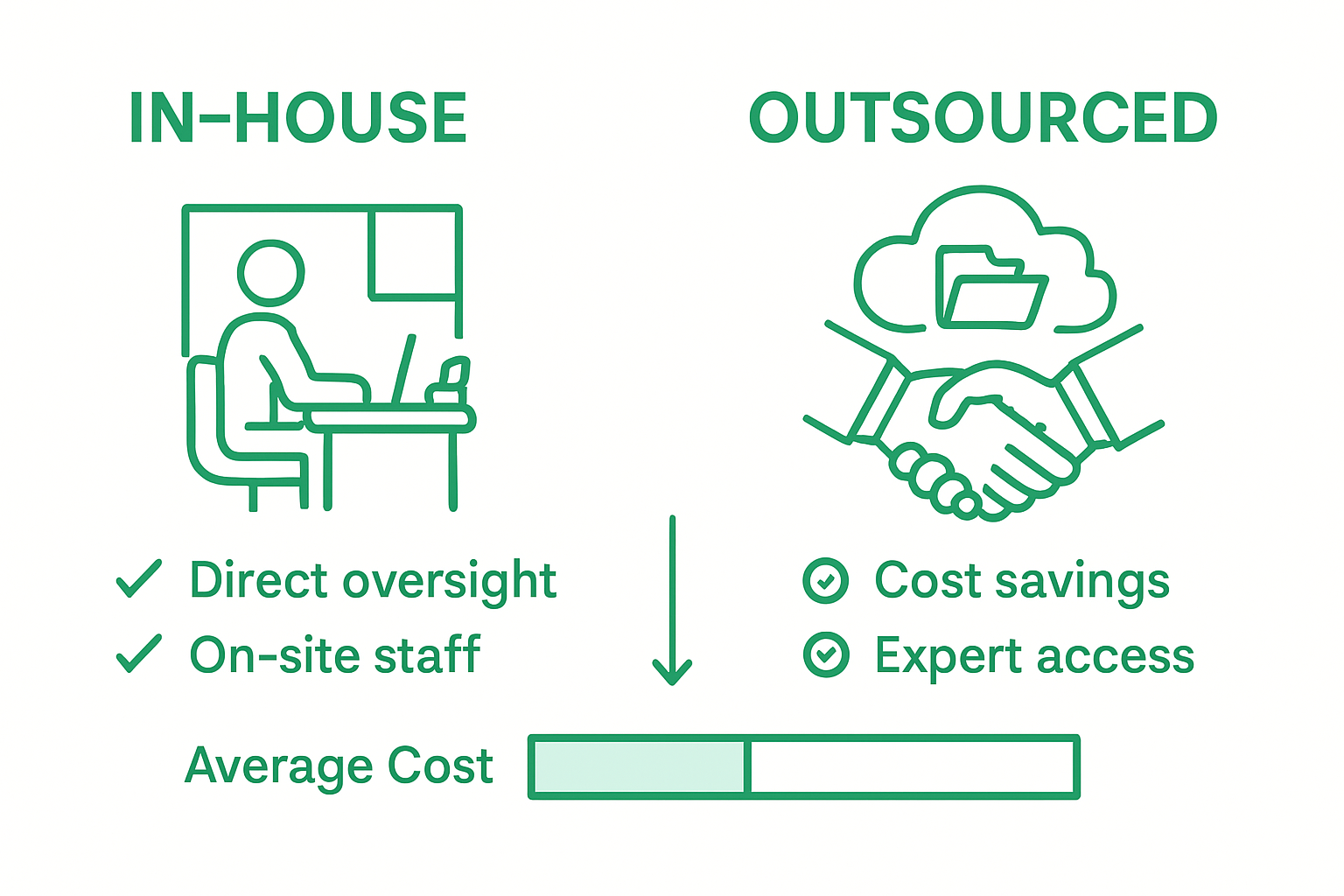
The financial implications of each approach reveal stark differences in operational efficiency. In-house teams typically involve fixed costs regardless of workload, meaning businesses pay consistent salaries even during low-activity periods. Outsourced bookkeeping operates on a flexible pricing model, allowing companies to scale services according to actual requirements. This model provides remarkable cost predictability and allows businesses to allocate financial resources more strategically.
Key Comparative Elements:
- Cost Structure
- In-House: Fixed salary expenses
- Outsourced: Variable, usage-based pricing
- Technological Access
- In-House: Limited by budget constraints
- Outsourced: Advanced tools and platforms included
- Expertise Level
- In-House: Dependent on individual qualifications
- Outsourced: Consistent professional standards
- Scalability
- In-House: Slow and expensive
- Outsourced: Rapid and cost-effective
Ultimately, the decision between in-house and outsourced bookkeeping depends on specific organizational needs, financial constraints, and growth objectives. Businesses must carefully evaluate their unique operational requirements to determine the most suitable financial management approach.
Benefits of Outsourcing for Modern Businesses
In today’s rapidly evolving business landscape, companies seek innovative strategies to optimize operational efficiency and maintain competitive advantage. Understanding outsourcing benefits reveals a transformative approach to managing critical business functions while maximizing resource allocation. Modern businesses increasingly recognize that strategic outsourcing is not merely a cost-cutting measure, but a sophisticated method of accessing specialized expertise and technological capabilities.
Outsourcing provides remarkable financial flexibility that traditional business models cannot match. Organizations can dynamically scale services according to actual operational requirements, avoiding the substantial fixed costs associated with maintaining full-time internal departments. This approach allows businesses to convert predictable overhead expenses into variable costs that directly correlate with business activity. Small and medium enterprises particularly benefit from this model, gaining access to professional-grade services without substantial upfront investments in recruitment, training, and infrastructure.
Technological advancement represents another critical advantage of outsourcing. Professional service providers continuously invest in cutting-edge software, analytics platforms, and cybersecurity infrastructure that would be prohibitively expensive for individual companies to implement independently. By partnering with specialized external teams, businesses gain immediate access to advanced technological ecosystems, sophisticated reporting tools, and expert knowledge that accelerates strategic decision-making and operational performance.
Key Strategic Benefits of Outsourcing:
- Reduced operational expenses
- Access to specialized global talent
- Enhanced technological capabilities
- Improved operational flexibility
- Risk mitigation and compliance management
- Accelerated business scalability
Ultimately, outsourcing empowers modern businesses to focus on core competencies, drive innovation, and maintain agility in an increasingly complex and competitive global marketplace. By strategically delegating non-core functions, companies can redirect internal resources toward growth-critical initiatives and long-term strategic objectives.
Security, Compliance, and Confidentiality Factors
Data security represents a paramount concern for businesses considering outsourced bookkeeping services. Key benefits of business process outsourcing extend far beyond cost savings, encompassing robust security protocols that frequently surpass traditional in-house financial management approaches. Professional outsourcing providers implement sophisticated multi-layered security strategies designed to protect sensitive financial information from potential breaches and unauthorized access.
Comprehensive Security Frameworks include advanced encryption technologies, secure cloud-based platforms, and stringent access control mechanisms. These systems utilize bank-grade security protocols that incorporate real-time monitoring, multi-factor authentication, and continuous vulnerability assessments. Unlike many internal accounting departments with limited technological resources, specialized outsourcing firms invest heavily in cybersecurity infrastructure, ensuring financial data remains protected through cutting-edge defensive technologies and proactive threat management strategies.
Regulatory compliance represents another critical dimension of outsourced bookkeeping security. Professional service providers maintain comprehensive understanding of complex financial regulations, including data protection standards like GDPR, HIPAA, and industry-specific compliance requirements. They consistently update their operational frameworks to align with evolving legal standards, reducing organizational risk and ensuring meticulous adherence to governmental and industry-specific guidelines. This approach provides businesses with an additional layer of protection and peace of mind that internal teams might struggle to maintain.
Key Security and Compliance Elements:
- Advanced encryption technologies
- Multi-factor authentication
- Continuous security monitoring
- Regular compliance updates
- Comprehensive data protection protocols
- Secure cloud-based infrastructure
By selecting reputable outsourcing partners with robust security frameworks, businesses can transform potential vulnerabilities into strategic advantages. The right provider not only protects sensitive financial information but also demonstrates a commitment to maintaining the highest standards of professional integrity and technological sophistication.
Recognizing Risks and Avoiding Common Pitfalls
Outsourcing bookkeeping functions presents complex challenges that require strategic navigation. Understanding why business owners outsource reveals critical insights into potential risks and essential mitigation strategies. Successful outsourcing demands meticulous vendor selection, comprehensive communication protocols, and robust performance monitoring mechanisms.
Data Integration Challenges emerge as a primary concern for businesses transitioning to external bookkeeping services. Potential risks include incompatible software systems, inconsistent data formatting, and potential information transfer gaps. Companies must establish clear data migration protocols, define precise integration requirements, and conduct comprehensive compatibility assessments before finalizing outsourcing arrangements. Implementing standardized reporting templates and conducting periodic system audits can significantly reduce potential integration complications.
Communication breakdowns represent another significant risk in outsourced bookkeeping relationships. Misaligned expectations, cultural differences, and timezone variations can create operational friction that undermines collaborative effectiveness. Successful partnerships require establishing explicit communication channels, defining response time expectations, and implementing regular performance review meetings. Businesses should develop comprehensive service level agreements that outline precise communication protocols, performance metrics, and accountability mechanisms.
Critical Risk Mitigation Strategies:
- Conduct thorough vendor background investigations
- Establish explicit service level agreements
- Define clear communication protocols
- Implement robust data security measures
- Create comprehensive performance monitoring systems
- Maintain flexible contract terms
Strategic risk management transforms potential outsourcing challenges into opportunities for operational optimization. By anticipating potential complications and implementing proactive mitigation strategies, businesses can develop resilient, productive partnerships that drive financial efficiency and organizational growth.
Unlock Business Growth with Expert Outsourced Bookkeeping Solutions
Managing your financial records while striving for business expansion can be overwhelming. This article highlights common challenges like data security concerns, scalability issues, and costly in-house bookkeeping limitations. At NineArchs LLC, we understand these pain points and provide tailored outsourcing services that ensure professionalism, reliability, and cost-efficiency. Our business process outsourcing solutions deliver access to specialized finance expertise, advanced technology platforms, and flexible support that scales with your growth objectives.
Experience the transformative impact of outsourcing by partnering with a provider committed to overcoming the myths and risks detailed in the article. Benefit from our committed team that safeguards your data with stringent security measures and streamlined communication protocols for seamless integration. Whether you need comprehensive bookkeeping or broader finance function support, NineArchs helps you reduce operational overhead while improving accuracy and compliance.
Explore how strategic outsourcing can redefine your financial management and unlock new opportunities. Ready to take the next step in transforming your business finances with trusted remote expertise? Visit our contact page to connect with our team today.
Discover customized outsourcing strategies designed for your unique business needs. Don’t let bookkeeping challenges slow your growth. Reach out to NineArchs LLC now and start leveraging global talent to streamline operations and drive success through business process outsourcing. Let us help you focus on what matters most—growing your company with confidence.
Frequently Asked Questions
What are the primary benefits of using outsourced bookkeeping for my business?
Outsourced bookkeeping provides several advantages, including reduced operational expenses, access to specialized accounting expertise, advanced financial reporting capabilities, enhanced data security, and scalable financial management solutions.
How does outsourced bookkeeping help with data security and compliance?
Professional outsourcing providers implement rigorous security protocols, including advanced encryption, secure cloud infrastructures, and continuous compliance updates, ensuring that your financial data remains protected while adhering to necessary legal standards.
Can outsourced bookkeeping improve my company’s financial insights and reporting?
Yes, outsourced bookkeeping allows your business to access experienced professionals who utilize sophisticated accounting software and analytics tools. This translates to enhanced financial insights, tax optimization strategies, and real-time financial reporting.
What should I consider when choosing an outsourced bookkeeping provider?
When selecting an outsourcing partner, evaluate their security frameworks, expertise level, compliance understanding, and technological capabilities. Establish clear service level agreements and communication protocols to ensure a successful partnership.




[…] critical back office functions that determine an organization’s fiscal health and transparency. Outsourced bookkeeping strategies can transform these complex processes from burdensome administrative tasks into strategic business […]