

Over half of American businesses now rely on remote IT support services to handle critical tech challenges efficiently. As organizations face mounting digital complexity, the ability to connect with skilled professionals anywhere is more than just convenient—it can be vital for security and productivity. You will discover why remote IT support has become the preferred choice for American companies seeking faster solutions, stronger data protection, and cost savings that keep them ahead in a competitive market.
Defining Remote IT Support Services
Remote IT support services represent a strategic technological approach where qualified professionals provide technical assistance and troubleshooting for computer systems, networks, and digital infrastructure without being physically present at the client’s location. These services leverage advanced digital communication technologies to diagnose, resolve, and manage technical challenges across various technological platforms.
The core functionality of remote IT support involves multiple sophisticated mechanisms that enable seamless technological intervention. Comprehensive IT support services typically include several key capabilities:
- Direct computer access through secure internet connections
- Real-time desktop sharing and screen control
- Comprehensive file transfer capabilities
- Advanced network diagnostics and performance monitoring
- Rapid troubleshooting for software and hardware issues
- Cybersecurity threat detection and mitigation
Modern remote IT support transcends traditional helpdesk models by providing proactive and predictive technological management. Unlike traditional on-site support, these services allow businesses to access specialized technical expertise instantaneously, eliminating geographical constraints and reducing response times. Technicians can seamlessly connect to client systems, execute complex diagnostics, implement software updates, and resolve technical challenges with minimal disruption to organizational workflows.
Here is a summary of core remote IT support features and their business impact:
| Feature | How It Works | Business Impact |
|---|---|---|
| Remote Desktop Access | Technicians control systems remotely | Faster issue resolution |
| Real-Time Monitoring | Continual analysis of systems | Early problem detection |
| Cybersecurity Threat Mitigation | Uses AI for proactive threat blocking | Reduced risk of data breaches |
| File Transfer Capabilities | Secure document exchange | Improved collaboration and troubleshooting |
| Performance Analytics | Gathers system data for insights | Enables better IT planning |
Pro Tip – Strategic Remote Support Selection: When evaluating remote IT support providers, prioritize vendors offering robust security protocols, demonstrated expertise across multiple technological platforms, and transparent performance metrics to ensure comprehensive and reliable technological assistance.
Core Benefits for Business Operations
Remote IT support services deliver substantial operational advantages that transform how modern businesses manage technological infrastructure and resolve technical challenges. By integrating strategic external support, organizations can dramatically improve their technological responsiveness, efficiency, and overall operational performance.
The primary benefits of remote IT support encompass multiple critical business dimensions:
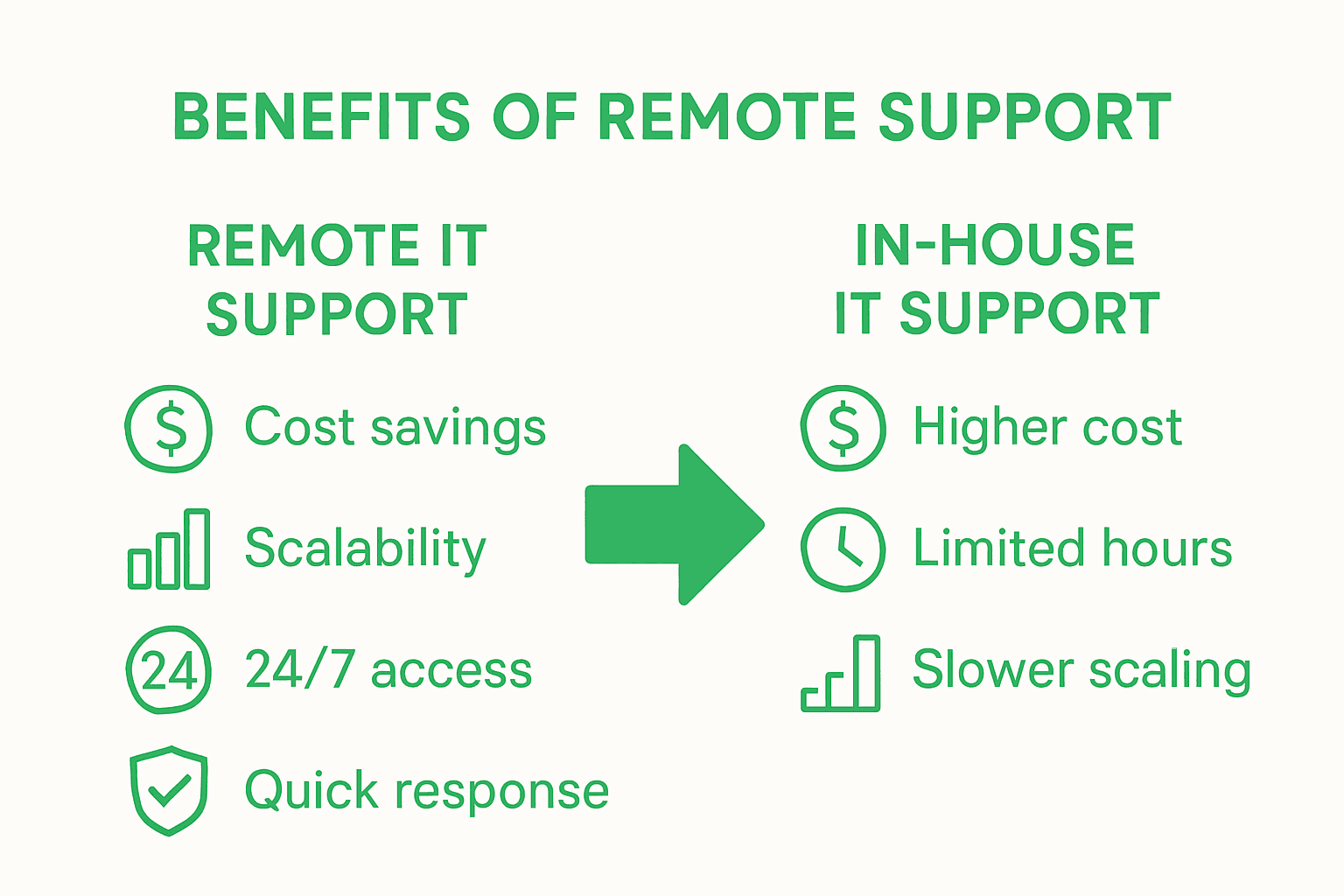
- Cost Reduction: Eliminating expensive on-site technical staff and minimizing downtime
- Scalability: Accessing specialized expertise without maintaining a full internal IT department
- 24/7 Availability: Continuous technical support across different time zones
- Rapid Problem Resolution: Immediate diagnostics and technological interventions
- Enhanced Security: Proactive monitoring and swift threat mitigation
- Technological Flexibility: Adapting quickly to emerging technological requirements
Businesses leveraging top support tasks for outsourcing can transform their operational models by converting fixed technological infrastructure costs into flexible, performance-driven investments. This approach allows companies to redirect internal resources toward core strategic initiatives while maintaining robust technological capabilities.
Remote IT support fundamentally reshapes organizational technology management by providing intelligent, responsive, and cost-effective solutions. Companies gain access to world-class technological expertise without the substantial overhead associated with maintaining comprehensive internal technical teams. This model enables businesses to stay technologically competitive, secure, and agile in an increasingly complex digital landscape.

Pro Tip – Strategic Outsourcing Assessment: Conduct a comprehensive internal technology audit before selecting a remote IT support provider to precisely match your organization’s unique technological requirements and performance expectations.
Types of Remote IT Support Solutions
Remote IT support solutions have evolved into sophisticated technological ecosystems designed to address diverse business technological challenges. These solutions range from comprehensive platform-based services to targeted, specialized support mechanisms that can be customized to meet specific organizational requirements.
The primary categories of remote IT support solutions include:
- Helpdesk Support: Centralized technical assistance for user issues and troubleshooting
- Cloud-Based Management: Integrated platforms for monitoring and managing technological infrastructure
- Managed Services: Comprehensive technological oversight and proactive system maintenance
- On-Demand Technical Support: Immediate responsive assistance for urgent technological problems
- Network Monitoring: Continuous surveillance of system performance and security
- Remote Desktop Support: Direct access and control of user systems for precise diagnostics
Examples of support desk services demonstrate how these solutions can be strategically implemented across different business scales. Advanced remote support platforms like cloud-based unified endpoint management systems enable IT teams to perform complex diagnostics, implement security protocols, and resolve technical challenges without physical intervention.
Each remote IT support solution offers unique advantages tailored to specific business needs. Some focus on immediate problem resolution, while others provide comprehensive technological infrastructure management. The key differentiator lies in their ability to deliver specialized expertise, reduce response times, and maintain technological systems with minimal disruption to business operations.
Pro Tip – Solution Selection Strategy: Conduct a thorough assessment of your organization’s technological complexity and support requirements before selecting a remote IT support solution to ensure optimal alignment with your specific business objectives.
Cost Savings and Scalability Factors
Remote IT support solutions fundamentally transform how businesses approach technological infrastructure management by offering unprecedented financial flexibility and operational scalability. Organizations can dramatically reduce fixed technological overhead while gaining access to specialized expertise that would be prohibitively expensive to maintain internally.
The key cost savings and scalability dimensions include:
- Reduced Personnel Expenses: Eliminating full-time internal IT staff costs
- Flexible Resource Allocation: Scaling technological support precisely to business needs
- Predictable Technological Expenditures: Converting variable costs into structured, manageable investments
- Rapid Workforce Adaptation: Quickly adjusting support capabilities without recruitment challenges
- Minimal Infrastructure Investment: Avoiding expensive hardware and software licensing requirements
- Performance-Based Pricing: Paying only for actual technological support consumed
Key reasons to outsource IT reveal how strategic technological partnerships can transform traditional cost structures. Businesses can redirect substantial financial resources previously locked into maintaining extensive internal technological infrastructure toward core strategic initiatives, innovation, and competitive development.
The scalability of remote IT support becomes particularly powerful for growing organizations. Small businesses can access enterprise-level technological capabilities without massive upfront investments, while larger corporations can dynamically adjust support levels to match changing operational requirements. This model provides unprecedented technological agility, enabling businesses to respond quickly to market changes and emerging technological challenges.
Pro Tip – Financial Optimization Strategy: Conduct a comprehensive total cost of ownership analysis comparing internal IT maintenance versus remote support services to accurately quantify potential financial benefits and operational efficiencies.
Security, Compliance, and Data Protection
Remote IT support solutions represent a sophisticated approach to technological security, providing businesses with comprehensive cybersecurity frameworks that extend far beyond traditional internal protection mechanisms. These advanced support models integrate multilayered security protocols designed to safeguard organizational digital assets against increasingly complex technological threats.
Critical security and compliance dimensions include:
- Continuous Network Monitoring: Real-time detection of potential security vulnerabilities
- Advanced Threat Prevention: Proactive identification and mitigation of cybersecurity risks
- Regulatory Compliance Management: Ensuring adherence to industry-specific technological standards
- Encrypted Communication Channels: Protecting sensitive data transmission
- Comprehensive Disaster Recovery: Minimizing potential operational disruptions
- Multi-Factor Authentication: Implementing robust access control mechanisms
Offshore support services demonstrate how strategic technological partnerships can dramatically enhance an organization’s security posture. Professional remote IT support providers invest substantially in cutting-edge security technologies and expertise that individual businesses might find prohibitively expensive to develop internally.
Modern remote IT support goes beyond traditional security measures by implementing sophisticated risk management strategies. These services utilize advanced artificial intelligence and machine learning algorithms to predict, identify, and neutralize potential security threats before they can compromise organizational systems. The result is a dynamic, adaptive security environment that provides significantly more robust protection than conventional internal IT infrastructure.
Pro Tip – Security Assessment Strategy: Conduct quarterly comprehensive security audits with your remote IT support provider to ensure continuous alignment with emerging technological threats and regulatory requirements.
Comparing Remote and In-House IT Support
The landscape of technological support has fundamentally transformed, with remote IT services challenging traditional in-house support models by offering more flexible, cost-effective, and technologically advanced solutions. While in-house IT teams have been the conventional approach, remote support represents a strategic evolution in how businesses manage their technological infrastructure.
Key comparative dimensions between remote and in-house IT support include:
- Cost Structure: – Remote Support: Predictable, scalable expenses
- In-House Support: Fixed overhead, substantial infrastructure investments
- Expertise Level:
- Remote Support: Access to specialized global talent
- In-House Support: Limited by local recruitment and training
- Response Time:
- Remote Support: 24/7 global coverage
- In-House Support: Limited by staff availability and work schedules
- Technological Adaptability:
- Remote Support: Rapid integration of emerging technologies
- In-House Support: Slower technological upgrade cycles
Tech support outsourcing strategies demonstrate how businesses can strategically leverage external expertise to overcome traditional technological limitations. Remote support providers invest continuously in cutting-edge technologies and training, offering capabilities that most internal teams cannot match cost-effectively.
The fundamental difference lies in approach and scalability. In-house IT support operates within organizational constraints, while remote support provides a dynamic, adaptive model that can quickly adjust to changing technological landscapes. Remote teams bring specialized knowledge across multiple technological domains, enabling businesses to access enterprise-grade capabilities without massive internal investments.
Compare remote and in-house IT support at a glance:
| Criteria | Remote Support | In-House Support |
|---|---|---|
| Expertise Access | Global specialists on demand | Local staff only |
| Scalability | Easy to adjust capacity | Fixed, harder to expand |
| Security Protocols | Advanced, frequently updated | May lag behind best practices |
| Cost Flexibility | Pay-as-needed | High fixed payroll costs |
Pro Tip – Hybrid Support Strategy: Consider implementing a hybrid model that combines remote expertise with minimal internal technological coordination to optimize support effectiveness and organizational flexibility.
Unlock the Full Potential of Remote IT Support for Your Business
The article highlights the critical challenges businesses face with managing costly in-house IT teams, slow response times, and the need for scalable, secure, and flexible technological support. If you are striving to reduce downtime, cut fixed overhead, and gain access to specialized global expertise, NineArchs LLC offers tailored remote workforce solutions designed to alleviate these exact pain points. By leveraging remote IT support alongside our comprehensive outsourcing services, including custom software development and business process outsourcing, you can transform your technology management into a cost-efficient and agile growth enabler.
Our commitment to professionalism, reliability, and innovation ensures your business benefits from 24/7 availability, enhanced cybersecurity, and rapid problem resolution backed by a global talent network. Experience how strategic outsourcing can reduce your IT expenditures while providing enterprise-grade support that adapts as your needs evolve.
Maximize your business efficiency with NineArchs’ trusted solutions. Take the smart step toward scalable and secure remote IT support now. Visit our contact page to connect with experts who understand how to align our services with your operational goals. Ready to see real change? Discover more about our top support tasks for outsourcing and explore examples of support desk services that can elevate your performance.
Transform your IT challenges into competitive advantages today.
Don’t wait for IT disruptions to hold your business back. Get in touch with NineArchs LLC at https://ninearchs.com/contact and empower your organization with expert remote IT support that drives growth and resilience.
Frequently Asked Questions
What are the main benefits of remote IT support for businesses?
Remote IT support offers several advantages, including cost reduction, scalability, enhanced security, 24/7 availability, and rapid problem resolution. This support model allows businesses to access specialized expertise without the overhead of maintaining a full internal IT department.
How does remote IT support enhance cybersecurity for organizations?
Remote IT support enhances cybersecurity through continuous network monitoring, advanced threat prevention, encrypted communication channels, and comprehensive disaster recovery solutions. This proactive approach helps detect and mitigate potential security vulnerabilities before they can compromise systems.
What types of services are included in remote IT support?
Remote IT support services typically include helpdesk support, cloud-based management, managed services, on-demand technical support, network monitoring, and remote desktop support. These services can be customized to meet specific business needs and challenges.
How does remote IT support compare to in-house IT support?
Remote IT support generally offers a more flexible and cost-effective solution than in-house IT support. It provides access to global expertise, 24/7 availability, and reduced fixed costs. In contrast, in-house support can be limited by local talent and has higher overhead expenses.




[…] like video conferencing, cloud-based collaboration platforms, and secure remote access systems. Remote IT support strategies have become increasingly sophisticated, allowing professionals to troubleshoot, manage systems, and […]