


Remote work exposes the gap between simple task assignment and real team productivity. For Operations Managers juggling multiple priorities across global teams, scattered delegation can mean lost time and rising costs. Adopting clear, SMART delegation goals transforms scattered effort into measurable performance and ensures everyone understands how their contribution supports the company’s larger mission. This step by step approach helps you set priorities, assign the right work, and drive efficiency in your distributed workforce.
Step 1: Define delegation goals and priorities
Delegation success starts with crystal clear goals that transform scattered tasks into strategic outcomes. By setting precise objectives, you create a roadmap that guides your remote team toward measurable performance and organizational alignment.
To define effective delegation goals, adopt the SMART framework – ensuring each task and responsibility meets specific criteria. Start by identifying the core outcomes you want to achieve. Are you looking to reduce operational bottlenecks? Accelerate project timelines? Or develop specific team capabilities? Break down these broader objectives into granular, actionable targets that individual team members can understand and execute.

Align your delegation goals with your organization’s strategic mission. This means connecting individual tasks to larger business objectives. For instance, if your company aims to improve customer service response times, delegate tasks that directly contribute to reducing resolution windows or enhancing communication quality. Quantify these goals with specific metrics – like reducing average response time by 35% or increasing customer satisfaction ratings by 20%.
Here’s how the SMART framework shapes effective delegation goals:
| SMART Criteria | What It Means | Business Impact |
|---|---|---|
| Specific | Clearly defines the task and outcome | Reduces confusion, increases accuracy |
| Measurable | Includes quantifiable metrics or targets | Enables tracking of progress |
| Achievable | Realistic within team capabilities | Prevents overcommitment, improves morale |
| Relevant | Aligns with strategic business objectives | Ensures work supports company mission |
| Time-bound | Specifies deadlines and timeframes | Keeps projects on schedule |
Pro tip: Create a visual delegation tracking dashboard that maps individual tasks to organizational goals, helping team members understand how their work contributes to broader company success.
Step 2: Select the right tasks to outsource
Successful delegation hinges on strategically selecting tasks that maximize your remote team’s potential and organizational efficiency. The goal is to match specific responsibilities with the right professionals who can execute them with precision and expertise.
Start by conducting a comprehensive task assessment across your operational landscape. Identify tasks that are repeatable, well-defined, and do not require constant in-house supervision. These typically include support tasks that can be standardized, such as data entry, customer support, administrative coordination, and routine research activities. Look for work that has clear processes, measurable outcomes, and minimal dependency on core strategic decision making.
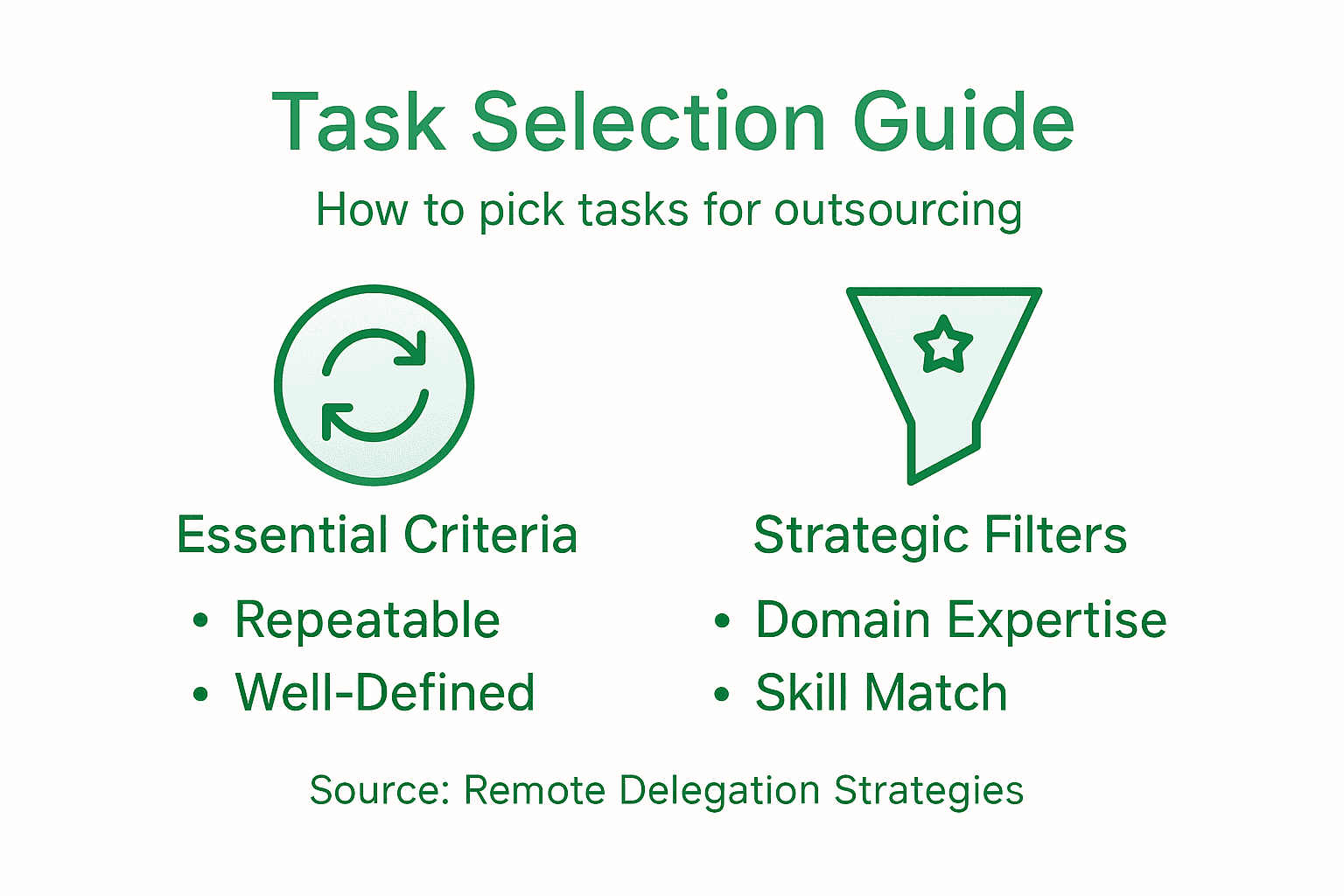
Consider each potential outsourced task through three critical lenses: domain expertise, skill alignment, and strategic value. Ensure the task matches the remote professional’s specific skill set and professional development trajectory. Avoid delegating complex, nuanced responsibilities that require deep institutional knowledge or continuous strategic input. Instead, focus on tasks where external professionals can immediately add value and demonstrate measurable performance improvements.
Pro tip: Create a detailed task evaluation matrix that scores potential outsourcing candidates across criteria like complexity, strategic importance, skill requirements, and potential performance impact.
Step 3: Identify and match the best-fit team members
Matching the right talent to specific tasks is the cornerstone of effective remote team delegation. Your goal is to create strategic alignments that maximize individual strengths and drive collective performance.
Begin by conducting a comprehensive skills assessment of your remote workforce. Outsource business operations strategically by mapping each team member’s capabilities, professional background, and unique competencies. Look beyond traditional job descriptions and explore individual nuances like problem solving approaches, communication styles, and demonstrated performance in previous projects. Pay attention to soft skills such as adaptability, self motivation, and cross cultural communication abilities that are critical in remote work environments.
Develop a dynamic matching process that considers not just current skill sets but also potential for growth. Evaluate each team member through multiple dimensions including technical expertise, past project performance, learning agility, and alignment with specific task requirements. Prioritize professionals who demonstrate a proactive attitude, quick comprehension, and the ability to work with minimal direct supervision. Remember that successful delegation is about creating opportunities for professional development while ensuring precise task completion.
Pro tip: Create a dynamic talent mapping spreadsheet that tracks individual skills, performance history, and potential growth trajectories to facilitate more intelligent task assignments.
Step 4: Communicate expectations and guidelines clearly
Communicating expectations is the critical bridge between delegation strategy and actual performance in remote teams. Your goal is to create a transparent communication framework that leaves no room for misunderstandings and empowers team members to execute tasks with confidence.
Outsourcing non-essential tasks requires establishing crystal clear communication protocols that transcend traditional workplace interactions. Develop a comprehensive communication guideline document that specifies expectations around response times, preferred communication channels, reporting structures, and project milestone tracking. Be explicit about communication norms including preferred messaging platforms, expected turnaround times for email and chat responses, and specific documentation requirements for task updates. Address potential communication barriers by establishing protocols for handling time zone differences, clarifying when synchronous versus asynchronous communication is appropriate, and setting clear escalation paths for urgent matters.
Ensure your communication guidelines include not just procedural details but also cultural expectations and collaborative norms. Articulate your team’s values around proactive communication, transparency, and mutual respect. Encourage team members to ask clarifying questions, provide context for their work, and maintain open lines of feedback. Create a communication environment that balances professional expectations with human connection, recognizing that effective remote collaboration requires both technical precision and interpersonal understanding.
Here is a summary of communication essentials for remote delegation:
| Aspect | Description | Why It Matters |
|---|---|---|
| Channels | Email, chat, video calls | Ensures appropriate information flow |
| Response Times | Define expected turnarounds | Reduces waiting, increases productivity |
| Escalation Paths | Clear steps for issues | Minimizes delays, resolves problems quickly |
| Cultural Norms | Respect, transparency, collaboration | Fosters trust and cohesion |
Pro tip: Create a visual communication matrix that maps communication channels, expected response times, and escalation procedures to provide a clear reference point for all team members.
Step 5: Monitor progress and provide timely feedback
Effective progress monitoring transforms delegation from a passive assignment into an active collaborative process. Your objective is to create a transparent tracking system that enables real-time insights while fostering team member autonomy and professional growth.
Support tasks require strategic tracking through a combination of quantitative metrics and qualitative assessment. Implement a comprehensive monitoring approach that balances structured check-ins with performance measurement tools. Establish regular intervals for progress reviews – weekly video conferences, daily short status updates, or milestone tracking reports. Use project management platforms that offer visual dashboards, allowing team members to update their progress and providing you with immediate visibility into task completion rates, potential bottlenecks, and overall project health.
Adopt a feedback approach that emphasizes constructive dialogue and continuous improvement. Move beyond simple performance evaluation to create meaningful coaching conversations. Recognize individual achievements, provide specific observations about task performance, and offer actionable suggestions for enhancement. Your feedback should be timely, balanced between positive reinforcement and developmental guidance, and always tied to clear performance expectations. Remember that effective feedback is a two way street that invites team members to share their perspectives, challenges, and innovative solutions.
Pro tip: Develop a standardized feedback template that captures both quantitative performance metrics and qualitative insights to ensure consistent and comprehensive performance reviews.
Step 6: Evaluate outcomes and refine the process
Successful delegation is an iterative journey of continuous improvement, not a one time event. Your ultimate goal is to transform initial delegation attempts into increasingly sophisticated and efficient team collaboration strategies.
Complete guide to outsourcing business operations requires systematic evaluation that goes beyond surface level metrics. Develop a comprehensive review process that captures both quantitative performance indicators and qualitative insights. Analyze task completion rates, quality of deliverables, time efficiency, and team member engagement. Conduct structured retrospective meetings where team members can openly share their experiences, challenges, and suggestions for process enhancement. Pay special attention to unexpected outcomes not just negative results but also innovative approaches or surprising efficiencies that emerged during task execution.
Create a dynamic feedback loop that treats each delegation cycle as a learning opportunity. Document key insights from each project review, identifying patterns of success and areas requiring strategic adjustment. Be willing to modify your delegation approach experimental with different communication techniques, adjust task allocation strategies, and invest in targeted skill development for team members. Recognize that effective delegation is a nuanced skill that evolves through intentional reflection, open communication, and a commitment to continuous organizational learning.
Pro tip: Implement a quarterly delegation performance dashboard that tracks key metrics, captures team feedback, and visualizes process improvement trends across multiple projects.
Unlock Remote Team Success with Expert Delegation Support
Struggling to define clear delegation goals or match the right tasks with your remote team? The challenges of communicating expectations and monitoring progress can overwhelm even the most seasoned managers. This article highlights the need for strategic task selection, transparent communication, and continuous feedback to boost your remote workforce’s productivity and alignment with your business objectives.
At NineArchs LLC we specialize in professional outsourcing solutions designed to address these exact pain points. Whether you need virtual assistance to handle non-core functions or want to leverage our expertise in business process outsourcing for efficient support tasks, we provide tailored services that help you delegate effectively. Our global talent pool and scalable IT services empower your team to achieve measurable results while reducing operational bottlenecks and costs.
Transform your remote delegation strategy now by partnering with NineArchs. Visit our contact page today to discover how we can help you build a high-performing remote team that meets SMART goals with confidence and clarity.
Frequently Asked Questions
How do I set effective delegation goals for my remote team?
Effective delegation goals are defined by the SMART framework, ensuring they are Specific, Measurable, Achievable, Relevant, and Time-bound. Break down your larger objectives into smaller, actionable tasks that clearly align with your team’s capabilities and the organization’s goals. Consider setting quantifiable targets, such as improving response times by 20% within the next quarter.
What tasks are best suited for delegation in a remote team?
Look for tasks that are repeatable, well-defined, and can be completed with minimal supervision. Ideal tasks usually include data entry, customer support, and routine research. Focus on responsibilities where remote professionals can immediately add value without requiring complex decision-making.
How can I match the right team members to delegated tasks?
Conduct a thorough skills assessment of your remote team to understand each member’s strengths and competencies. Consider not only their technical skills but also soft skills like adaptability and communication styles. Make task assignments based on this evaluation to maximize productivity and individual development.
What are the key components of effective communication for delegation?
Effective communication for delegation includes clear response expectations, designated communication channels, and established escalation paths for urgent issues. Create a communication guideline document that outlines these components, helping your team stay informed and aligned on project milestones.
How can I monitor progress and provide feedback on delegated tasks?
Implement regular check-ins and utilize project management tools for real-time progress tracking. Establish structured feedback sessions where you recognize achievements and provide actionable suggestions for improvement, helping your team stay engaged and motivated throughout their tasks.
How can I evaluate the outcomes of my delegation process?
Systematically review both quantitative metrics and qualitative insights after each delegation cycle. Analyze task completion rates and quality of deliverables, and gather team feedback on their experiences and challenges. Use this information to adjust and refine your delegation approach for future projects.