
Over 80 percent of American technology firms now rely on remote teams for critical projects. This shift has made effective monitoring and productivity management a daily priority for HR managers and team leads worldwide. With rapid growth in virtual collaboration, knowing how to balance transparency, data-driven insights, and trust is vital for long-term success. This article breaks down proven strategies that help define monitoring objectives, select the right tools, and support remote employee performance in a clear, actionable way.
Step 1: Define monitoring objectives and set expectations
Monitoring remote employees requires strategic planning that balances accountability with trust. In this step, you will establish clear performance expectations and create a monitoring framework that promotes transparency while respecting employee autonomy.
Start by developing specific goals linked directly to project outcomes and individual roles. This means moving beyond generic performance metrics and designing targeted measurements that reflect each team member’s unique responsibilities. For example, instead of tracking hours worked, focus on deliverable quality, project milestones achieved, and specific key performance indicators (KPIs) relevant to their position. Your monitoring objectives should communicate what success looks like for each role and provide a clear roadmap for employees to understand their performance expectations.
Communication is critical when setting these expectations. Schedule initial meetings with team members to discuss monitoring protocols transparently, emphasizing that the goal is collaboration and performance optimization rather than surveillance. Explain the specific metrics you will track, why they matter, and how they connect to broader team and organizational objectives. Create a mutual understanding that these monitoring practices aim to support employee growth and provide meaningful performance insights.

Pro Tip: Develop a written document outlining monitoring expectations that team members can reference, ensuring clarity and reducing potential misunderstandings about performance tracking.
Here is a summary of key remote employee monitoring objectives and their benefits:
| Objective | Description | Business Impact |
|---|---|---|
| Clarify expectations | Define role-based performance measures | Increases transparency and motivation |
| Promote transparency | Set clear, accessible monitoring protocols | Builds trust and buy-in |
| Support professional growth | Use data for constructive feedback | Drives skill development |
| Align with company goals | Link metrics to organizational outcomes | Improves overall team performance |
Step 2: Select monitoring tools and establish protocols
In this critical step, you will strategically choose monitoring technologies and develop comprehensive protocols that balance performance tracking with employee privacy and trust. The goal is to implement a monitoring approach that provides meaningful insights without creating a sense of invasive surveillance.
Start by evaluating monitoring tools that align with your specific team objectives and organizational culture. Focus on solutions that offer qualitative and quantitative performance metrics rather than intrusive tracking mechanisms. Consider tools that measure project outcomes, task completion rates, and collaborative effectiveness instead of purely time tracking software. Look for platforms that integrate seamlessly with your existing workflow and provide transparent reporting features that employees can understand and access. Prioritize tools that offer customizable dashboards, allowing you to adapt monitoring metrics to different roles and project requirements.
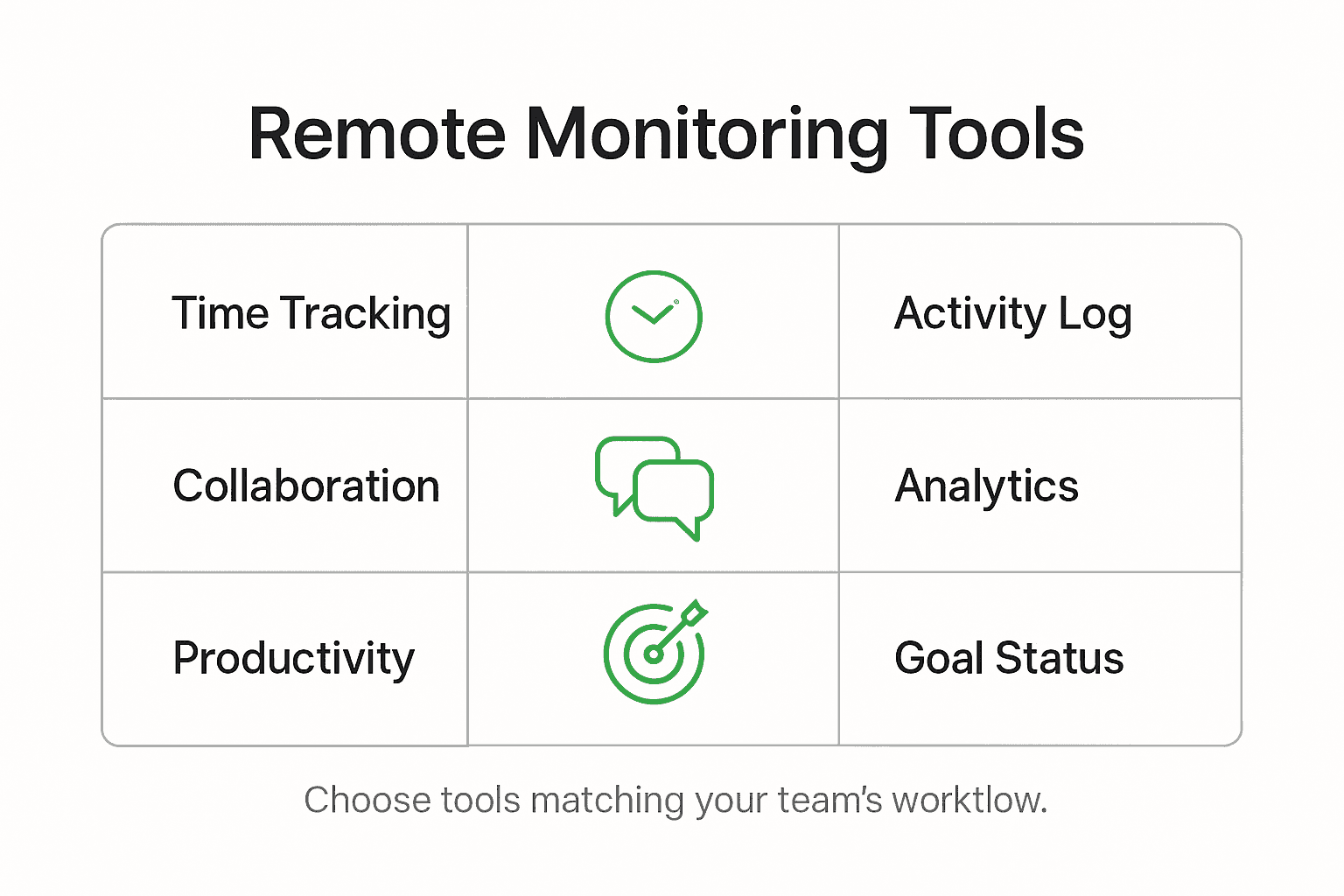
When establishing monitoring protocols, create a comprehensive written document that clearly outlines the scope of monitoring, data collection practices, and employee rights. This documentation should explicitly state what will be tracked, how the data will be used, and the specific performance benchmarks being evaluated. Schedule a team meeting to walk through these protocols, emphasizing that the monitoring approach is designed to support professional growth and provide constructive feedback. Crucially, build in mechanisms for employees to review their own performance data and engage in open dialogues about their progress and development opportunities.
Pro Tip: Select monitoring tools that offer granular permission settings and allow employees to review their own performance data to foster transparency and mutual trust.
Below is a comparison of popular categories of remote monitoring tools and their typical uses:
| Tool Category | Primary Focus | Example Insight Provided |
|---|---|---|
| Project Management | Track deliverables and tasks | Progress on project milestones |
| Productivity Analytics | Assess workflow efficiency | Task completion speed |
| Communication Tools | Monitor collaboration levels | Team response rates |
| Outcome Tracking | Evaluate results and KPIs | Achievement of set objectives |
Step 3: Implement monitoring systems with employee onboarding
Successful remote employee monitoring begins with strategic onboarding that integrates performance tracking seamlessly into the initial employee experience. Your goal is to create a transparent and supportive introduction to your organizational performance expectations and monitoring tools.
During the onboarding process, schedule comprehensive orientation sessions that walk new employees through your monitoring systems and performance tracking protocols. These sessions should provide detailed explanations of the specific tools you will use, including software interfaces, reporting mechanisms, and performance metrics. Role of onboarding in outsourcing success requires clear communication about how monitoring supports professional development rather than functioning as surveillance. Demonstrate each monitoring tool practically, allowing new hires to explore the platforms and understand how they will be used to track progress and provide constructive feedback.
Ensure that your onboarding documentation includes explicit information about monitoring practices, including the types of data collected, frequency of performance reviews, and the specific objectives behind your tracking approach. Create opportunities for new employees to ask questions and express any concerns about the monitoring systems. This transparent approach helps build trust and ensures that team members understand the collaborative nature of performance tracking. Emphasize that monitoring is designed to support their professional growth, provide actionable insights, and help them succeed in their roles.
Pro Tip: Develop interactive onboarding modules that allow new employees to practice using monitoring tools in simulated scenarios, helping them feel comfortable with performance tracking processes.
Step 4: Track productivity metrics and workflow data
Tracking productivity for remote teams requires a strategic approach that goes beyond simplistic time tracking and focuses on meaningful performance indicators. Your goal is to develop a comprehensive system that measures output quality, task completion, and collaborative effectiveness while respecting employee autonomy.
Begin by defining specific key performance indicators (KPIs) tailored to each role and project type. These metrics should focus on quantifiable outcomes rather than hours worked. For instance, a software developer might be evaluated on code quality, project milestones achieved, and collaboration efficiency. Use monitoring tools that provide granular insights into workflow progression, tracking productivity through outcome-based frameworks that align with organizational objectives. Implement tools that capture task completion rates, response times, and project advancement while offering visual dashboards that make performance data transparent and understandable.
Establish a regular review process where you analyze collected workflow data with team members collaboratively. Schedule periodic meetings to discuss performance metrics, identifying potential bottlenecks and opportunities for professional development. This approach transforms monitoring from a surveillance exercise into a constructive dialogue about performance improvement. Ensure that your tracking methods remain flexible, allowing for context and individual work styles while maintaining clear performance expectations.
Pro Tip: Create standardized performance templates that allow for both quantitative measurements and qualitative feedback to provide a holistic view of employee productivity.
Step 5: Analyze results and optimize monitoring strategies
Analyzing monitoring data requires a nuanced approach that transforms raw performance metrics into meaningful insights for organizational growth. Your goal is to develop a comprehensive review process that goes beyond simple number crunching and focuses on understanding team dynamics and individual potential.
Begin by conducting a systematic review of collected performance data, looking for patterns in productivity, collaboration effectiveness, and workflow efficiency. Analyzing remote workforce performance involves more than just identifying top performers. Create comparative analyses that highlight both individual strengths and potential areas for team wide improvement. Pay special attention to contextual factors that might influence productivity such as project complexity, team collaboration, and individual work styles. Use data visualization tools to make these insights more accessible and actionable, helping you identify subtle trends that might not be immediately apparent.
Develop a continuous improvement framework that incorporates employee feedback directly into your monitoring strategy. Schedule quarterly review sessions where team members can provide input on the monitoring process itself, discussing how current tracking methods impact their work performance and job satisfaction. This approach transforms monitoring from a one-way assessment into a collaborative dialogue. Be prepared to adjust your monitoring tools and key performance indicators based on these insights, demonstrating a commitment to creating a supportive and adaptive work environment that prioritizes both organizational goals and employee well-being.
Pro Tip: Implement a 360 degree feedback mechanism that allows employees to provide input on monitoring processes, ensuring your tracking strategies remain flexible and employee centered.
Boost Your Remote Team’s Productivity with Tailored Outsourcing Solutions
Monitoring remote employees effectively requires clear performance metrics, transparent communication, and tools that respect employee autonomy. If you find balancing accountability with trust challenging, you are not alone. Many organizations struggle to implement monitoring strategies that enhance productivity without creating a culture of surveillance. Key concepts like outcome-based tracking, collaborative feedback, and adaptive monitoring protocols are essential for success.
At NineArchs LLC, we understand these challenges. Our remote workforce solutions leverage global talent and advanced technology to provide scalable support that aligns with your unique business goals. Whether you need virtual assistance, custom software development, or business process outsourcing, we focus on reliability, professionalism, and cost-efficiency to help your team thrive remotely. Explore how our strategic outsourcing services complement your monitoring objectives by improving operational efficiency and enabling focused growth.
Ready to transform your remote workforce monitoring into a strategic advantage
Discover custom remote workforce solutions designed to enhance productivity without compromising trust. Contact us today to discuss your needs and take the first step toward seamless remote team management. Don’t wait to improve how you monitor and support your remote employees. Reach out now at NineArchs Contact and start optimizing your remote team’s performance.
Frequently Asked Questions
How can I define clear monitoring objectives for remote employees?
To define clear monitoring objectives, start by developing specific goals tied to individual roles and project outcomes. Focus on measurable metrics like the quality of deliverables and project milestones instead of hours worked.
What tools should I use to monitor remote employee productivity?
Choose monitoring tools that provide qualitative and quantitative metrics related to tasks and collaboration, not just time tracking. Look for platforms with customizable dashboards that align with your team’s needs and existing workflows.
How can I effectively communicate monitoring expectations to my team?
Effectively communicate monitoring expectations by scheduling initial meetings where you can transparently discuss protocols and metrics. Create a written document outlining these expectations so team members can reference it as needed.
What are key performance indicators (KPIs) for remote employees?
Key performance indicators for remote employees should focus on quantifiable outcomes relevant to each role, such as task completion rates or project quality rather than simple time metrics. Define these KPIs in collaboration with your team to ensure alignment and clarity.
How often should I review performance metrics with my remote team?
Review performance metrics regularly, ideally on a quarterly basis, to analyze workflow data and discuss progress with the team. This will help in identifying strengths and areas for improvement, keeping everyone aligned with organizational goals.
What steps should I take if monitoring tools affect employee morale?
If monitoring tools seem to affect employee morale, initiate open dialogues during review sessions to gather feedback on the monitoring process. Make necessary adjustments based on employee input to create a supportive work environment that prioritizes their well-being.
Recommended
- What Is Remote Workforce? Complete Business Guide | NineArchs
- How to Monitor Outsourced Staff for Maximum Efficiency | NineArchs
- Optimize Your Business Communication Workflow for Results | NineArchs
- Role of Outsourcing in Productivity: Complete Guide | NineArchs
- Work from Home Security Steps for Brisbane Businesses – IT Start