


More than half of American IT leaders now prioritize remote strategies as a cost-saving measure without sacrificing innovation. As technology redefines the way teams collaborate, IT managers face the challenge of sustaining productivity while navigating a rapidly shifting global workforce. This guide highlights the essential components of advanced remote IT work models, giving leaders practical insights to attract talent, manage risk, and transform operational efficiency.
Remote Work for IT Teams Defined
Remote work for IT teams represents a strategic approach to technology-enabled collaboration that extends beyond traditional office boundaries. The Microsoft New Future of Work Report defines this emerging model as a transformational shift powered by technological advancements and accelerated by global workforce changes. Unlike simple work-from-home arrangements, remote IT teams integrate sophisticated digital tools, communication platforms, and collaborative technologies to maintain productivity and innovation.
At its core, remote work for IT teams involves professionals performing technical tasks, software development, system management, and strategic technology projects from diverse geographic locations. These teams leverage cloud computing, project management software, secure communication channels, and advanced collaboration tools to synchronize workflows, share complex technical information, and maintain seamless operational continuity. The integration of artificial intelligence and automation technologies further enhances remote team capabilities, enabling more efficient and adaptive work processes.

The structural components of effective remote IT teams typically include robust digital infrastructure, clear communication protocols, performance tracking mechanisms, and flexible work arrangements. These teams prioritize outcomes over physical presence, utilizing metrics like code quality, project completion rates, and system performance to evaluate productivity. By transcending traditional geographic limitations, organizations can access global talent pools, reduce operational costs, and create more resilient technological ecosystems that adapt quickly to changing business requirements.
Pro tip: Implement comprehensive cybersecurity protocols and invest in reliable collaboration platforms to ensure secure and seamless remote IT team operations.
Types: Fully Remote, Hybrid, Distributed Models
IT teams today operate across three primary remote work models, each offering unique advantages and challenges for organizational productivity. The 7 Key Reasons to Outsource IT for Business Growth guide highlights how these models transform traditional workplace dynamics. Fully Remote Models represent the most comprehensive approach, where team members work entirely outside traditional office environments, leveraging digital infrastructure to collaborate and execute complex technological projects.
In Hybrid Models, organizations blend onsite and remote work strategies, allowing employees flexibility while maintaining some in-person collaboration. Typically, this approach involves team members working 2-3 days remotely and spending the remaining time in physical office spaces. Distributed Models take remote work a step further by spreading teams across multiple geographic locations and time zones, enabling companies to access global talent pools and create 24-hour operational capabilities. These models require advanced communication technologies, robust project management tools, and sophisticated cultural integration strategies.
Each remote work model presents distinct operational considerations. Fully remote teams benefit from reduced overhead costs and expanded talent acquisition opportunities but must invest heavily in digital collaboration tools. Hybrid models offer a balanced approach, supporting both collaborative innovation and individual productivity preferences. Distributed models provide maximum geographic flexibility but demand exceptional communication protocols and cross-cultural management skills. Successful implementation depends on selecting the most appropriate model based on specific organizational goals, technological infrastructure, and team dynamics.
Here’s a quick comparison of remote IT team models and their operational features:
| Model Type | Collaboration Tools Needed | Talent Reach | Cost Structure |
|---|---|---|---|
| Fully Remote | Advanced video, cloud systems | Global, unrestricted | Low office, tech driven |
| Hybrid | Flexible project management | Local and global | Moderate overhead |
| Distributed | Cross-time-zone platforms | Worldwide, diverse | Lowest office, high tech |
Pro tip: Conduct periodic team assessments to determine which remote work model best aligns with your organization’s technical requirements and collaborative needs.
Key Drivers: Talent, Productivity, Cost Savings
Remote work in IT teams is fundamentally driven by three transformative factors: talent acquisition, productivity enhancement, and significant cost savings. The Role of Outsourcing in Productivity guide highlights how these drivers reshape modern technological workforce strategies. Talent Acquisition represents the most compelling advantage, enabling organizations to transcend traditional geographic limitations and recruit top-tier technological professionals from global talent pools without being constrained by local market restrictions.
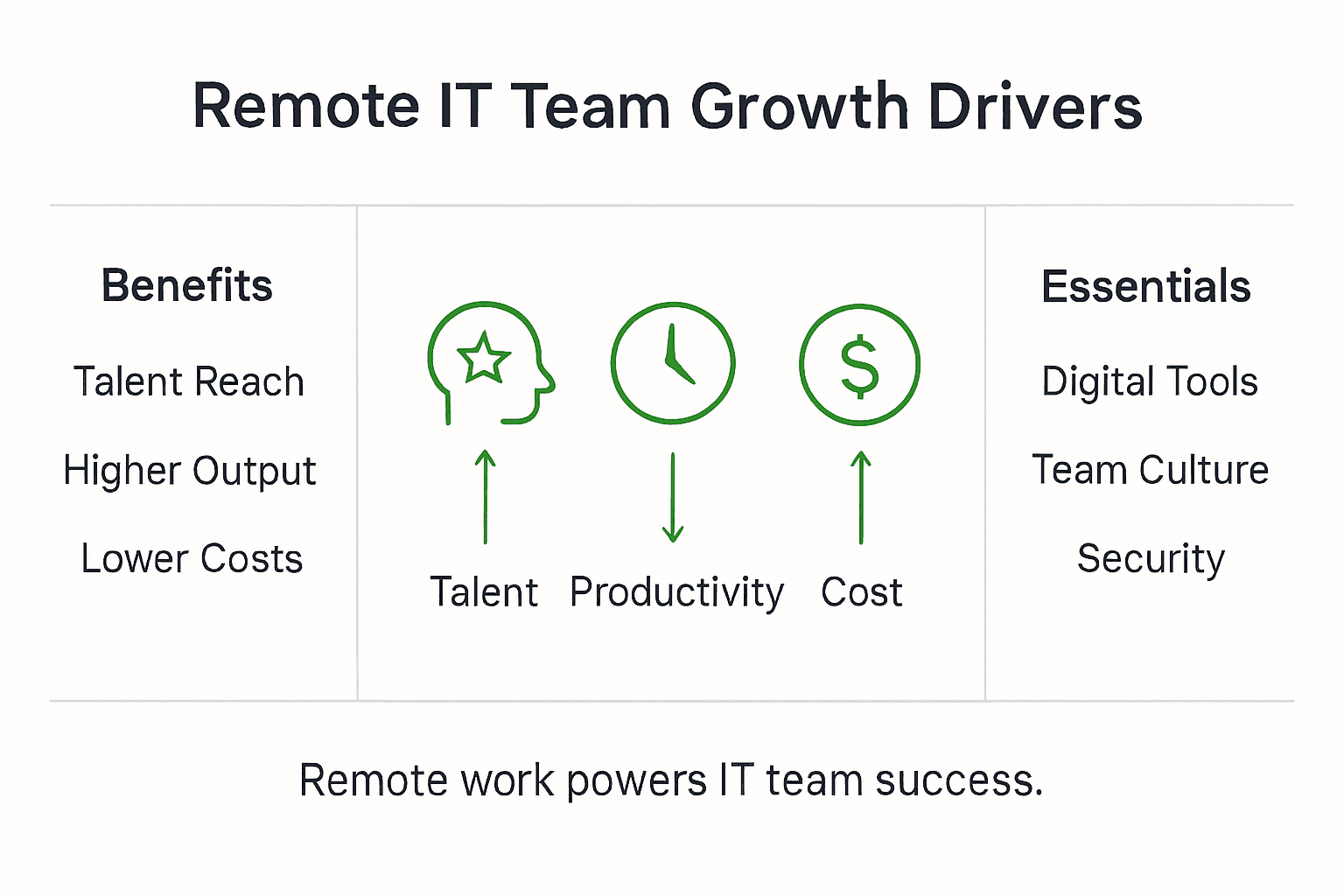
Productivity Gains emerge as a critical driver, with research demonstrating that remote IT teams often demonstrate higher performance levels compared to traditional office-based models. Professionals working remotely typically experience reduced commute stress, greater autonomy, and more flexible work schedules, which translate into enhanced focus and improved output quality. Advanced digital collaboration tools, cloud-based project management platforms, and sophisticated communication technologies further amplify team productivity by enabling seamless information exchange and real-time collaborative capabilities across diverse geographic regions.
The Cost Savings dimension of remote work represents a substantial strategic advantage for organizations. By minimizing physical office infrastructure requirements, companies can dramatically reduce real estate expenses, utility costs, and associated overhead. These financial efficiencies extend beyond immediate operational expenses, encompassing long-term savings in recruitment, employee retention, and workforce management. Remote work models allow businesses to optimize their financial resources, redirecting investments toward technological innovation, talent development, and core business growth strategies.
Pro tip: Implement comprehensive performance tracking mechanisms and invest in robust digital collaboration tools to maximize the potential of your remote IT team’s productivity and talent potential.
Challenges and Best Practices for Success
Remote IT teams encounter multifaceted challenges that require strategic management and innovative solutions. The 7 Essential Outsourcing Best Practices guide outlines comprehensive strategies for navigating these complexities. Communication Barriers represent the most significant hurdle, with distributed teams struggling to maintain seamless collaboration, interpersonal connections, and consistent information exchange across different geographic and technological environments.
Technological Infrastructure plays a critical role in overcoming remote work challenges. Successful IT teams invest in robust digital platforms that enable real-time collaboration, secure data sharing, and comprehensive project management. Key technological solutions include advanced video conferencing tools, cloud-based communication systems, integrated project tracking software, and cybersecurity protocols that protect sensitive information while facilitating transparent workflows. Organizations must develop comprehensive digital ecosystems that replicate the collaborative dynamics of traditional office environments, focusing on creating intuitive, user-friendly technological interfaces that support seamless team interactions.
Effective Leadership and Cultural Management emerge as pivotal factors in remote team success. Managers must develop specialized skills in remote team leadership, including creating inclusive digital communication strategies, establishing clear performance metrics, and maintaining team cohesion despite physical separation. This involves implementing regular virtual team-building activities, developing transparent performance evaluation frameworks, and creating opportunities for informal digital interactions that build trust and team solidarity. Successful remote IT teams prioritize continuous learning, professional development, and creating a sense of shared organizational purpose that transcends physical workplace boundaries.
Pro tip: Implement quarterly virtual team assessments and invest in comprehensive digital collaboration training to continuously optimize your remote IT team’s performance and engagement.
Comparing Remote Work to Traditional Models
The landscape of work organization has fundamentally transformed, with remote and traditional models representing two distinct paradigms of technological collaboration. The Understanding Outsourcing Challenges guide provides critical insights into these divergent approaches. Productivity Dynamics reveal significant differences between remote and traditional work environments, with each model presenting unique strengths and inherent challenges that impact organizational performance and employee engagement.
Structural Differences emerge most prominently in communication patterns, team dynamics, and operational flexibility. Traditional office models rely on physical proximity to facilitate spontaneous interactions, immediate problem-solving, and organic knowledge transfer. Conversely, remote work models leverage advanced digital technologies to create structured, intentional communication channels that often provide more documented and trackable interactions. These technological platforms enable precise performance monitoring, real-time collaboration across global time zones, and enhanced flexibility in work scheduling that traditional models cannot easily replicate.
The comparative analysis extends beyond mere operational mechanics to encompass broader organizational implications. Remote work models significantly reduce overhead costs, eliminate geographical talent recruitment barriers, and provide employees with unprecedented work flexibility. Traditional models, while offering more direct social interactions and easier cultural alignment, often struggle with higher operational expenses, limited talent pools, and reduced employee autonomy. The emerging hybrid models represent a strategic compromise, attempting to synthesize the most effective elements from both approaches by balancing structured office interactions with the flexibility of remote work technologies.
Below is a summary of key remote vs. traditional IT work model differences:
| Factor | Remote Work Model | Traditional Work Model |
|---|---|---|
| Communication | Digital, structured, documented | In-person, spontaneous |
| Talent Pool | Global, scalable | Local, more limited |
| Operational Costs | Lower, minimal office needs | Higher, extensive office expenses |
| Work Flexibility | High, adjustable schedules | Fixed, limited flexibility |
Pro tip: Develop a comprehensive organizational assessment framework that objectively evaluates your team’s performance across remote and traditional work models to identify the most effective collaborative strategy.
Unlock the Full Potential of Remote IT Teams with NineArchs
The article highlights key challenges in managing remote IT teams such as maintaining seamless communication, leveraging global talent, and ensuring productivity through advanced digital tools. If your organization is striving to overcome communication barriers, build resilient technological infrastructure, or efficiently scale your remote workforce to drive growth, NineArchs LLC provides proven solutions designed to meet those needs. By embracing tailored outsourcing models and comprehensive digital collaboration strategies, you can transform operational challenges into growth opportunities.
Take the next step toward elevating your IT team’s remote work success. Explore how our expertise in custom software development, virtual assistance, and skills outsourcing can streamline your operations and maximize productivity. Don’t wait to harness the power of a scalable, reliable, and innovative remote workforce. Contact us today to discuss your unique requirements at NineArchs Contact and start turning remote work drivers into your competitive advantage.
Frequently Asked Questions
What are the main benefits of remote work for IT teams?
Remote work for IT teams drives growth through enhanced talent acquisition, improved productivity, and significant cost savings. Organizations can access a global talent pool, leverage advanced digital collaboration tools, and minimize overhead costs associated with physical office space.
How does remote work impact productivity in IT teams?
Research shows that remote IT teams often demonstrate higher performance levels due to reduced commute stress, greater autonomy, and flexible work schedules. Advanced collaboration technologies further enhance productivity by facilitating seamless information exchange.
What types of remote work models are available for IT teams?
IT teams typically operate under fully remote, hybrid, and distributed models. Fully remote teams work entirely outside traditional offices, hybrid models blend onsite and remote work, and distributed models span multiple geographic locations, allowing for 24-hour operations.
What challenges do remote IT teams face?
Remote IT teams encounter challenges such as communication barriers, reliance on robust technological infrastructure, and the need for effective leadership and cultural management. Strategies for success include investing in collaboration tools and establishing clear communication protocols.
Recommended
- What Is Remote Workforce? Complete Business Guide | NineArchs
- Understanding IT Outsourcing Trends in 2025 | NineArchs
- 7 Key Reasons to Outsource IT for Business Growth | NineArchs
- Understanding What is Outsourced IT for Businesses | NineArchs
- Understanding Remote Teamwork Tips for Effective Collaboration – Optio Station: Best Project Management App for Prioritization
- Ventajas de las herramientas informáticas en la nube