



Most American companies underestimate how much time is lost to repetitive tasks every day. Reports show that workers spend an average of three hours daily on manual processes that automation could streamline. This matters because wasted time quickly adds up, affecting profit and staff morale. Understanding what business process automation truly is, and clearing up common misconceptions, can help organizations save money, increase efficiency, and empower their teams to focus on meaningful work.
Defining Business Process Automation and Misconceptions
Business process automation represents a strategic approach to transforming organizational workflows by leveraging software technologies to replicate and enhance human actions. At its core, business process automation enables companies to streamline complex, repetitive tasks across multiple systems without constant manual intervention. By implementing intelligent software solutions, organizations can capture data, trigger responses, and execute multistep actions with unprecedented efficiency.
The fundamental mechanism of business process automation involves creating digital workflows that connect fragmented systems and eliminate traditional bottlenecks. Organizations achieve this through specialized software platforms that can mimic human decision-making processes while maintaining consistent accuracy. Business process documentation plays a critical role in mapping out these workflows, ensuring each automated step follows precise organizational guidelines.
Common misconceptions often prevent businesses from fully embracing process automation. Many leaders mistakenly believe automation is exclusively reactive – useful only when significant operational problems emerge. However, proactive organizations understand that process improvement strategies can prevent future challenges and maintain competitive advantages. Automation is not about replacing human workers but empowering them to focus on higher-value strategic tasks that require creativity, emotional intelligence, and complex problem solving.
Key characteristics of effective business process automation include:
- Seamless system integration
- Reduction of manual data entry
- Consistent performance across multiple departments
- Real-time tracking and reporting capabilities
- Scalability to support organizational growth
By understanding automation as a strategic enabler rather than a technical replacement, businesses can unlock significant operational potential and create more agile, responsive organizational structures.
Main Types of Business Process Automation Solutions
Business process automation encompasses several sophisticated technology solutions designed to transform organizational workflows and enhance operational efficiency. Robotic Process Automation (RPA) stands at the forefront of these technologies, enabling organizations to create software robots that mimic human interactions with digital systems, executing repetitive tasks with remarkable precision and speed. By outsourcing repetitive tasks, companies can redirect human talent toward more strategic and creative endeavors.
Intelligent process automation solutions can be categorized into three primary interaction models. Attended automation involves software robots collaborating directly with human workers, providing real-time assistance and augmenting human capabilities. Unattended automation allows robots to operate independently, handling complete workflows without human intervention. The hybrid automation approach combines both models, creating flexible systems that adapt to complex organizational requirements and dynamic business environments.
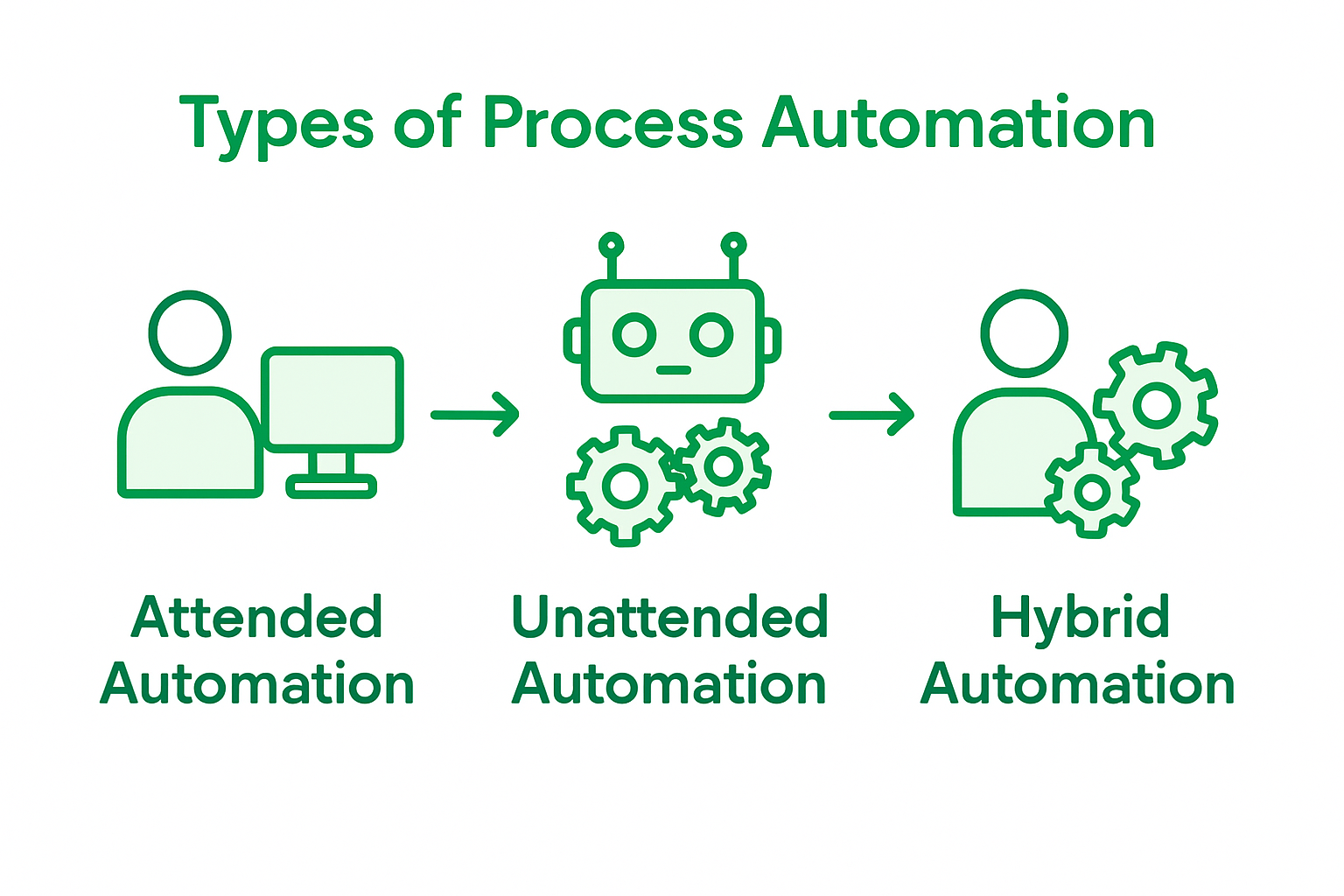
Beyond RPA, organizations leverage additional advanced automation technologies to streamline operations. Enterprise Resource Planning (ERP) systems integrate multiple business processes across departments, creating centralized data management platforms. Workflow Management Systems (WfMS) provide structured frameworks for designing, executing, and monitoring business processes. Cognitive-Robotic Process Automation (C-RPA) represents the cutting edge, incorporating artificial intelligence and machine learning capabilities to enable more sophisticated, adaptive automation strategies.
Key characteristics of modern business process automation solutions include:
- Seamless system integration
- Intelligent decision-making capabilities
- Scalability across organizational structures
- Enhanced accuracy and consistency
- Reduced operational costs
- Real-time performance tracking
By strategically implementing these diverse automation technologies, businesses can create more agile, responsive operational frameworks that drive sustainable growth and competitive advantage.
Key Benefits for Operations and Cost Efficiency
Business process automation delivers transformative operational benefits that extend far beyond simple cost reduction. Operational efficiency emerges as the primary advantage, with an impressive 84% of organizations reporting significant improvements in process performance through strategic automation technologies. By understanding outsourcing benefits, businesses can unlock unprecedented levels of productivity and strategic resource allocation.

The financial implications of process automation are substantial and multifaceted. Organizations experience dramatic reductions in operational expenses by eliminating manual labor requirements, minimizing human error, and accelerating workflow completion times. Automated systems enable consistent performance across complex business functions, reducing variability and creating predictable operational frameworks that support strategic decision making. This approach transforms fixed labor costs into flexible, scalable operational capabilities that adapt quickly to changing business environments.
Beyond direct cost savings, process automation generates profound organizational improvements. Automated workflows create granular performance tracking capabilities, providing real-time insights into operational bottlenecks and efficiency opportunities. Teams can redirect human capital toward higher-value strategic initiatives, fostering innovation and creating competitive advantages. Intelligent automation technologies enable businesses to respond more rapidly to market changes, customer demands, and emerging technological opportunities.
Key operational and cost efficiency benefits include:
- 40-70% reduction in processing time
- Dramatic decrease in human error rates
- Enhanced compliance and standardization
- Improved resource allocation
- Accelerated decision-making processes
- Increased organizational agility
By embracing comprehensive process automation strategies, organizations can transform operational constraints into dynamic opportunities for growth, innovation, and sustainable competitive advantage.
Common Risks and Challenges in Automation Projects
Business process automation presents complex implementation challenges that require strategic planning and nuanced understanding. Digital transformation demands more than simple technological deployment, necessitating comprehensive organizational alignment and careful change management. Organizations frequently underestimate the complexity of integrating automated systems, mistakenly believing that technological solutions alone can resolve intricate operational inefficiencies.
The human element represents a critical risk factor in automation initiatives. Employees often experience significant anxiety about technological changes, fearing potential job displacement or skill obsolescence. Understanding IT outsourcing challenges becomes crucial in managing workforce transitions and maintaining team morale during technological implementation. Successful automation requires transparent communication, robust training programs, and a strategic approach to workforce reskilling and role redefinition.
Technical challenges can derail automation projects if not carefully managed. Integration complexities, data quality issues, and legacy system constraints frequently emerge as significant obstacles. Organizations must invest in comprehensive system assessments, conduct thorough compatibility analyses, and develop flexible implementation strategies that allow incremental improvements. Contrary to common misconceptions, businesses do not need complete process redesigns to achieve meaningful efficiency gains; strategic, targeted interventions can produce substantial operational improvements.
Key risks and challenges in automation projects include:
- Resistance to technological change
- Inadequate employee training
- Complex system integration barriers
- Data migration and quality challenges
- Unexpected implementation costs
- Potential security and compliance risks
By anticipating these challenges and developing proactive mitigation strategies, organizations can transform potential obstacles into opportunities for technological innovation and operational excellence.
Selecting and Implementing Automation for Growth
Successful business process automation requires a strategic, measured approach that aligns technological capabilities with specific organizational objectives. Strategic implementation demands careful assessment of existing workflows, identifying precise opportunities where automation can deliver measurable improvements. Organizations must conduct comprehensive process mapping, analyzing each workflow’s complexity, repetitiveness, and potential for efficiency gains before selecting appropriate automation technologies.
The initial phase of automation should prioritize pilot projects with clear, achievable goals. Implementing business automation requires organizations to start small, targeting specific processes that offer immediate, tangible benefits. This approach allows teams to build confidence, develop technical expertise, and generate internal momentum for broader digital transformation initiatives. Successful pilot projects serve as powerful demonstrations of automation’s potential, helping overcome organizational resistance and creating compelling evidence for broader technological investments.
Selecting the right automation technologies involves evaluating multiple critical factors beyond immediate cost considerations. Organizations must assess solution scalability, integration capabilities, compliance requirements, and long-term adaptability. Technical compatibility with existing systems, vendor support quality, and potential for future enhancements become crucial decision-making criteria. Advanced organizations develop robust evaluation frameworks that consider not just technological specifications, but also alignment with broader strategic objectives, potential return on investment, and capacity for continuous improvement.
Key considerations for selecting automation solutions include:
- Alignment with strategic business goals
- Scalability and future-proofing capabilities
- Ease of system integration
- Comprehensive vendor support
- Compliance and security features
- Potential for rapid deployment
- Measurable performance metrics
By adopting a methodical, strategic approach to automation selection and implementation, organizations can transform technological investments into powerful drivers of operational excellence and sustainable competitive advantage.
Unlock Scalable Growth with Strategic Business Process Automation
The article highlights key challenges such as integrating complex automated workflows, overcoming resistance to change, and achieving measurable operational efficiency. If your business struggles with these pain points or seeks to expand using intelligent process automation, NineArchs LLC offers tailored solutions designed to empower your workforce while reducing costs. We specialize in outsourcing repetitive tasks, providing virtual assistance, and delivering custom software development—all designed to accelerate your digital transformation journey with minimal disruption.

Discover how flexible remote workforce solutions can seamlessly integrate with your current systems to enhance productivity and reduce human error. Act now to leverage our expertise in business process outsourcing and skills outsourcing that help companies overcome implementation challenges and unlock true scalability. Connect with us today at Contact NineArchs to start building smarter, more agile operations that drive sustainable competitive advantage.
Frequently Asked Questions
What is business process automation?
Business process automation (BPA) is a strategic approach that uses software technologies to replicate and enhance human actions in organizational workflows, streamlining complex tasks and reducing manual intervention.
What are the key benefits of automating business processes?
The key benefits include increased operational efficiency, reduced processing times (by 40-70%), decreased human error rates, enhanced compliance, improved resource allocation, and increased organizational agility.
What types of automation solutions are available for businesses?
Common automation solutions include Robotic Process Automation (RPA), Intelligent Process Automation, Enterprise Resource Planning (ERP) systems, Workflow Management Systems (WfMS), and Cognitive-Robotic Process Automation (C-RPA).
What are the common challenges in implementing business process automation?
Common challenges include resistance to technological change, inadequate employee training, complex system integration, data quality issues, unexpected implementation costs, and potential security risks.