

Over 60 percent of american companies now outsource part or all of their IT service desk operations to contain costs and improve response times. For IT managers at global enterprises, understanding service desk roles and structures is crucial for making informed decisions. This guide highlights key functions, technology trends, and common mistakes behind successful outsourcing, helping you avoid setbacks and maximize your business’s operational efficiency.
Defining IT Service Desk Roles and Concepts
The IT Service Desk represents a critical operational hub where technology meets strategic business support. Modern organizations increasingly recognize this function as more than a technical troubleshooting center, but as a core strategic enabler that connects technological infrastructure with business performance. Systematic support services have transformed from reactive problem-solving to proactive business optimization.
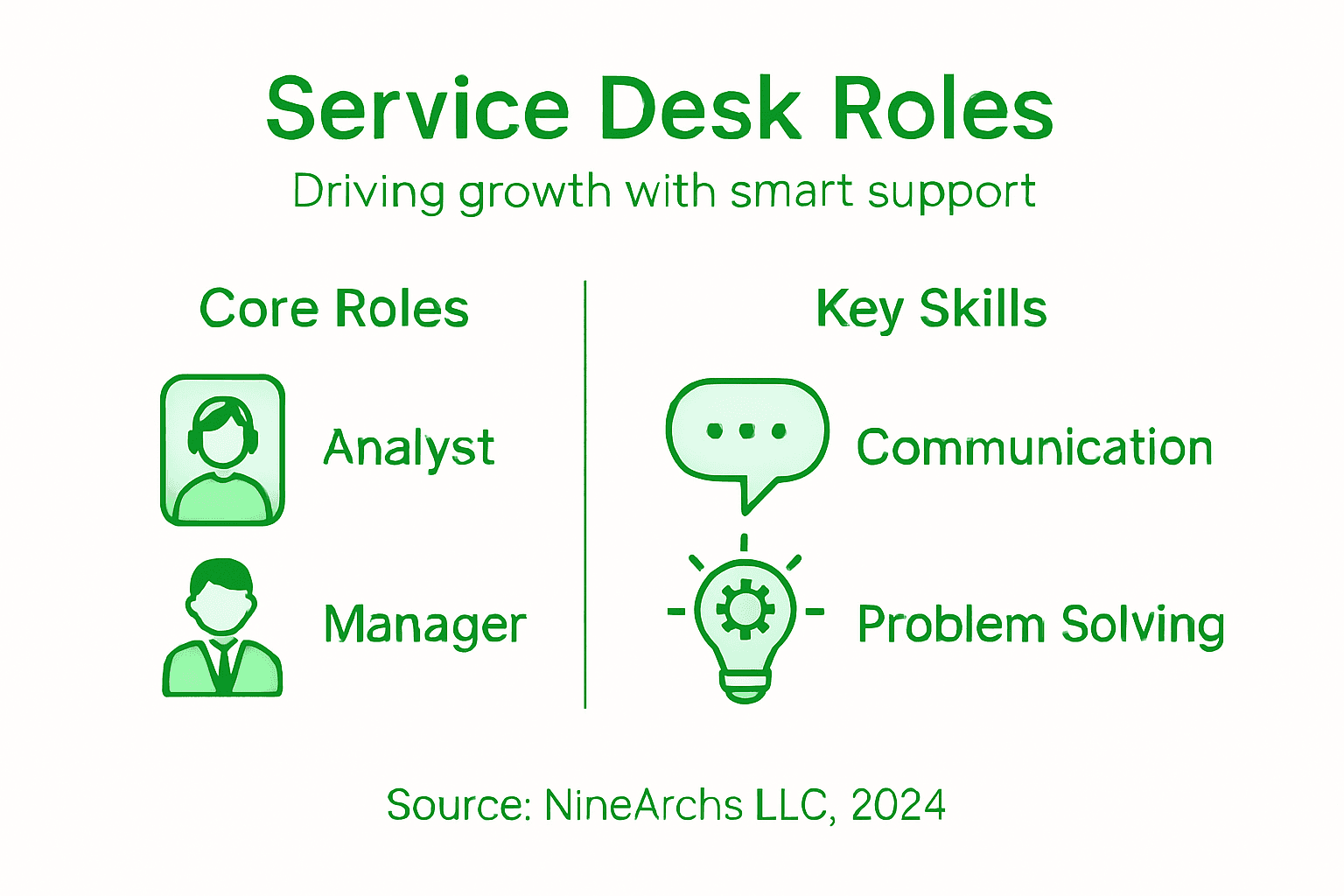
At its core, an IT Service Desk encompasses multiple specialized roles designed to manage technological ecosystems efficiently. Key positions typically include:
- Service Desk Analysts: First-line responders handling direct user queries and incidents
- Incident Management Specialists: Professionals tracking and resolving complex technical problems
- Service Desk Supervisors: Managers overseeing team performance and workflow optimization
- Technical Support Representatives: Experts providing specialized technological guidance
These roles collaborate to create a comprehensive support infrastructure that addresses both immediate technical needs and long-term operational strategies. The modern service desk goes beyond simple technical assistance, functioning as a strategic partner that enables business continuity, improves user experience, and drives technological efficiency.
Pro tip: Implement a skills matrix that tracks your service desk team’s technical capabilities to ensure comprehensive coverage and identify potential training needs.
Types of Service Desk Structures Explained
Organizations design IT service desk structures strategically to match their unique operational requirements and technological landscapes. Comprehensive support models have evolved to provide flexible, responsive technological assistance across diverse business environments.
Traditionally, service desk structures are categorized into four primary configurations:
- Local Service Desk: Dedicated support teams serving specific geographical locations or departments
- Centralized Service Desk: Single, consolidated support hub managing enterprise-wide technological requests
- Virtual Service Desk: Geographically distributed teams providing 24/7 remote support across multiple time zones
- Multi-Level Service Desk: Hierarchical structure with specialized support tiers handling increasing complexity of technical issues
Each service desk structure offers unique advantages based on organizational size, complexity, and technological infrastructure. Local desks provide intimate, proximity-based support, while centralized models ensure standardized processes and consistent user experiences. Virtual desks leverage global talent pools, enabling round-the-clock technological assistance, and multi-level structures allow sophisticated problem escalation mechanisms.
Here is a comparison of different IT service desk structures and their business impact:
| Structure Type | Main Focus | Scalability | Typical Use Case |
|---|---|---|---|
| Local Service Desk | Department/region support | Limited growth | Single office/branch |
| Centralized Service Desk | Organization-wide consistency | High scalability | Large enterprises |
| Virtual Service Desk | Remote, location-agnostic | Flexible expansion | Multi-time-zone companies |
| Multi-Level Service Desk | Complex issue escalation | Tiered scalability | Businesses with complex IT needs |
Pro tip: Conduct a comprehensive organizational audit to determine which service desk structure aligns most closely with your company’s operational dynamics and technological ecosystem.
Core Responsibilities of Service Desk Teams
The service desk team plays a pivotal role in maintaining technological infrastructure and ensuring smooth organizational operations. Strategic support services have transformed these teams from simple troubleshooters to critical business enablers that drive operational efficiency and user satisfaction.
Core responsibilities of service desk teams encompass multiple crucial functions:
- Incident Management: Rapidly identifying, diagnosing, and resolving technical issues to minimize business disruption
- Request Fulfillment: Processing and addressing user technology requests efficiently and systematically
- Problem Management: Conducting root cause analysis to prevent recurring technical challenges
- Communication Management: Providing timely, clear updates and maintaining transparent communication channels
- Knowledge Management: Documenting solutions, creating internal knowledge bases, and sharing critical technological insights
Beyond traditional support functions, modern service desk teams act as strategic partners. They leverage advanced technologies like automation and predictive analytics to transform reactive support models into proactive technological management systems. These teams not only resolve immediate technical challenges but also contribute to broader organizational efficiency by identifying systemic improvements and streamlining technological workflows.

Pro tip: Implement a continuous learning program that requires service desk team members to update their technical skills quarterly and cross-train in emerging technological domains.
Technology, Automation, and Integration Trends
The rapidly evolving landscape of IT service desk technologies is fundamentally reshaping how organizations approach technological support and operational efficiency. Business automation strategies are driving transformative changes that enable more intelligent, responsive, and proactive technological ecosystems.
Key technological trends revolutionizing service desk operations include:
- Artificial Intelligence Integration: Advanced AI algorithms enabling predictive issue resolution and intelligent ticket routing
- Omnichannel Support Platforms: Seamless communication across multiple technological interfaces and communication channels
- Automated Workflow Management: Intelligent systems that streamline repetitive tasks and reduce human intervention
- Augmented Reality Support: Interactive guidance tools providing immersive troubleshooting experiences
- Cybersecurity-Integrated Support: Comprehensive security monitoring and threat detection within support infrastructures
These technological innovations are not merely incremental improvements but represent fundamental shifts in how organizations conceptualize technological support. By leveraging machine learning, predictive analytics, and intelligent automation, service desk teams can transition from reactive problem solvers to strategic technological partners who anticipate and prevent potential disruptions before they impact business operations.
This summary shows how emerging technology trends shape service desk performance:
| Technology Trend | Key Benefit | Example Use Case |
|---|---|---|
| AI Integration | Faster issue diagnosis | Automated ticket prioritization |
| Omnichannel Platforms | Improved user access | Support across chat, email, voice |
| Workflow Automation | Reduced human workload | Auto-resolving password resets |
| AR Support | Enhanced troubleshooting | Interactive hardware guidance |
| Cybersecurity Integration | Threat reduction | Real-time security alerts |
Pro tip: Develop a comprehensive technology roadmap that integrates emerging automation technologies and regularly reassess your service desk’s technological capabilities to maintain competitive advantage.
Cost Implications and Outsourcing Risks
Outsourcing IT service desk operations presents a complex landscape of potential financial benefits and strategic challenges for organizations seeking to optimize their technological support infrastructure. Comprehensive outsourcing strategies require meticulous evaluation of both economic and operational implications.
Critical cost considerations and potential risks include:
- Direct Cost Savings: Reduced infrastructure, recruitment, and training expenses
- Hidden Transition Costs: Onboarding expenses and potential operational disruptions
- Quality Variability: Potential inconsistencies in service delivery and technical expertise
- Communication Barriers: Challenges arising from cultural and linguistic differences
- Security and Compliance Risks: Potential vulnerabilities in data protection and regulatory adherence
Successful outsourcing demands a strategic approach that balances financial optimization with robust risk management. Organizations must develop comprehensive service level agreements, implement rigorous vendor selection processes, and maintain ongoing oversight to mitigate potential operational and financial risks. This approach transforms outsourcing from a simple cost-cutting measure into a sophisticated strategy for technological capability enhancement.
Pro tip: Conduct a comprehensive cost-benefit analysis that includes both quantitative financial metrics and qualitative operational impact assessments before finalizing any outsourcing decision.
Common Mistakes and Alternatives to Avoid
Navigating the complex landscape of IT service desk management requires strategic awareness and proactive problem prevention. Comprehensive outsourcing guides reveal critical pitfalls that can undermine technological support effectiveness and organizational performance.
Common mistakes organizations frequently encounter include:
- Tool Overemphasis: Prioritizing technological solutions over human expertise and team development
- Undefined Service Boundaries: Lack of clear service level agreements and operational scope
- Inadequate Knowledge Management: Failing to develop and maintain comprehensive internal knowledge bases
- Poor Communication Protocols: Inconsistent response strategies and ineffective customer interaction frameworks
- Neglecting Team Development: Underinvesting in continuous training and professional growth opportunities
Successful service desk management demands a holistic approach that balances technological capabilities with human-centric strategies. Organizations must cultivate adaptive frameworks that encourage continuous learning, promote transparent communication, and create robust knowledge sharing mechanisms. By addressing systemic vulnerabilities and implementing proactive improvement strategies, companies can transform potential limitations into opportunities for operational excellence.
Pro tip: Develop a quarterly skills assessment and training program that maps individual team member capabilities against emerging technological trends and organizational requirements.
Elevate Your IT Service Desk to Drive Real Business Growth
The article highlights the crucial roles and evolving responsibilities of IT Service Desk teams in boosting operational efficiency and enhancing user experience. Many organizations struggle to align their service desk structures with strategic business goals while managing challenges like incident management, knowledge sharing, and integrating emerging technologies. You need a partner who understands these pain points and can help streamline your IT support with scalable, reliable solutions.
NineArchs LLC specializes in offering comprehensive remote workforce solutions that complement your internal IT Service Desk efforts. Whether you seek to augment your team’s technical capabilities, automate routine workflows, or optimize knowledge outsourcing for better problem resolution, our skilled professionals apply industry best practices tailored to your unique needs. Explore how our services in skills outsourcing, virtual assistance, and business process outsourcing can power your technology support with innovation and agility while controlling costs.
Unlock the full potential of your IT Service Desk with trusted support designed for growth and continuity. Connect with us today and experience how strategic outsourcing can transform your service operations into a strategic growth engine. Visit NineArchs Contact now to take the first step.
Enhance your IT Service Desk capabilities with expertise that drives measurable outcomes. Check out our offerings and reach out for a personalized consultation.
Contact NineArchs
Frequently Asked Questions
What are the main roles within an IT service desk?
The main roles within an IT service desk typically include Service Desk Analysts, Incident Management Specialists, Service Desk Supervisors, and Technical Support Representatives. These positions work together to manage technological ecosystems efficiently and enhance user experience.
How do different service desk structures impact business operations?
Service desk structures, such as Local, Centralized, Virtual, and Multi-Level, each have unique advantages that affect scalability, response times, and user experiences. Organizations should choose a structure based on their specific operational needs and technological complexity.
What are the core responsibilities of service desk teams?
Core responsibilities of service desk teams include Incident Management, Request Fulfillment, Problem Management, Communication Management, and Knowledge Management. These functions are essential for maintaining technological infrastructure and ensuring smooth operations.
What technologies are transforming IT service desk operations?
Key technologies transforming IT service desk operations include Artificial Intelligence for predictive resolution, Omnichannel support for seamless communication, Automated Workflow Management for efficiency, Augmented Reality for enhanced support, and cybersecurity integration for robust protection.