



Managing constant email streams and complex schedules often leaves Operations Managers searching for practical ways to reclaim hours in their workday. For American technology companies, balancing productivity with lean budgets drives the need for adaptable solutions beyond traditional hiring. Discover how virtual assistants—independent contractors leveraging cloud-based collaboration and specialized skills—can deliver reliable support, scalable efficiency, and improved workflow for teams handling non-core business functions.
Defining Virtual Assistants and Core Functions
Virtual assistants represent a dynamic workforce solution designed to provide remote professional support across multiple business functions. These skilled professionals deliver critical administrative and technical services from external locations, offering organizations unprecedented flexibility and operational efficiency. Unlike traditional employees, virtual assistants are independent contractors who leverage digital technologies to collaborate seamlessly with businesses worldwide.
In the technology sector, virtual assistants perform diverse functions that extend well beyond basic administrative tasks. Their core responsibilities typically include managing complex communication workflows, handling research and data compilation, scheduling, document preparation, and providing specialized technical support. Tech teams frequently utilize these professionals for tasks such as:
- Project coordination and documentation management
- Email and communication screening
- Calendar and meeting scheduling
- Data entry and database maintenance
- Basic technical support and customer interaction
- Research and competitive intelligence gathering
The modern virtual assistant represents a strategic resource that bridges technological capabilities with human expertise. Unlike automated AI systems, these professionals bring nuanced understanding, adaptability, and contextual intelligence to complex business challenges. They operate using cloud-based collaboration tools, enabling real-time communication and seamless integration with existing team structures.

Pro tip: When onboarding a virtual assistant, invest initial time in creating comprehensive standard operating procedures and communication protocols to ensure smooth collaboration and maximum productivity.
Types of Virtual Assistants for Tech Workflows
Virtual assistants for technology teams represent a specialized ecosystem with diverse skill profiles designed to address specific operational needs. These professionals are not a monolithic group but rather a nuanced workforce with distinct capabilities tailored to different technological domains. Organizations can strategically select virtual assistants based on their specialized expertise and project requirements.
Technology-focused virtual assistants typically fall into several key categories, each bringing unique capabilities to tech workflows. Understanding these specialized roles enables more strategic team augmentation across different operational contexts:
- Technical Support Virtual Assistants
- Provide first-tier troubleshooting
- Manage customer support tickets
- Handle basic software configuration issues
- Research and Development Virtual Assistants
- Conduct competitive intelligence gathering
- Perform literature reviews and technical research
- Compile and summarize technical documentation
- Software Development Support Virtual Assistants
- Assist with project documentation
- Manage code repositories
- Track development milestones and sprint progress
- Digital Marketing Technology Virtual Assistants
- Manage analytics platforms
- Implement digital marketing tracking
- Create technical performance reports
Beyond categorization, these virtual assistants operate with remarkable flexibility, leveraging cloud-based collaboration tools and advanced communication platforms. Their ability to integrate seamlessly into existing technological ecosystems makes them invaluable resources for scaling operations without substantial overhead. Modern virtual assistants bring not just task completion, but strategic insight and adaptable problem-solving capabilities that transcend traditional administrative support.
Here’s how technology-focused virtual assistants differ by specialization:
| Assistant Type | Main Focus | Typical Tools Used | Value to Tech Teams |
|---|---|---|---|
| Technical Support | Troubleshooting, customer care | Helpdesk, ticketing systems | Resolves common tech issues |
| Research & Development | Competitive intelligence, analysis | Research databases, spreadsheets | Identifies growth opportunities |
| Software Development Support | Project tracking, repo management | Code repositories, trackers | Boosts dev workflow efficiency |
| Digital Marketing Tech Support | Analytics, reporting | Analytics platforms, dashboards | Enhances marketing technology ROI |
Pro tip: When selecting a virtual assistant for your tech workflow, prioritize professionals with demonstrated technical certifications and proven experience in your specific technological domain.
Key Benefits for Operations and Scalability
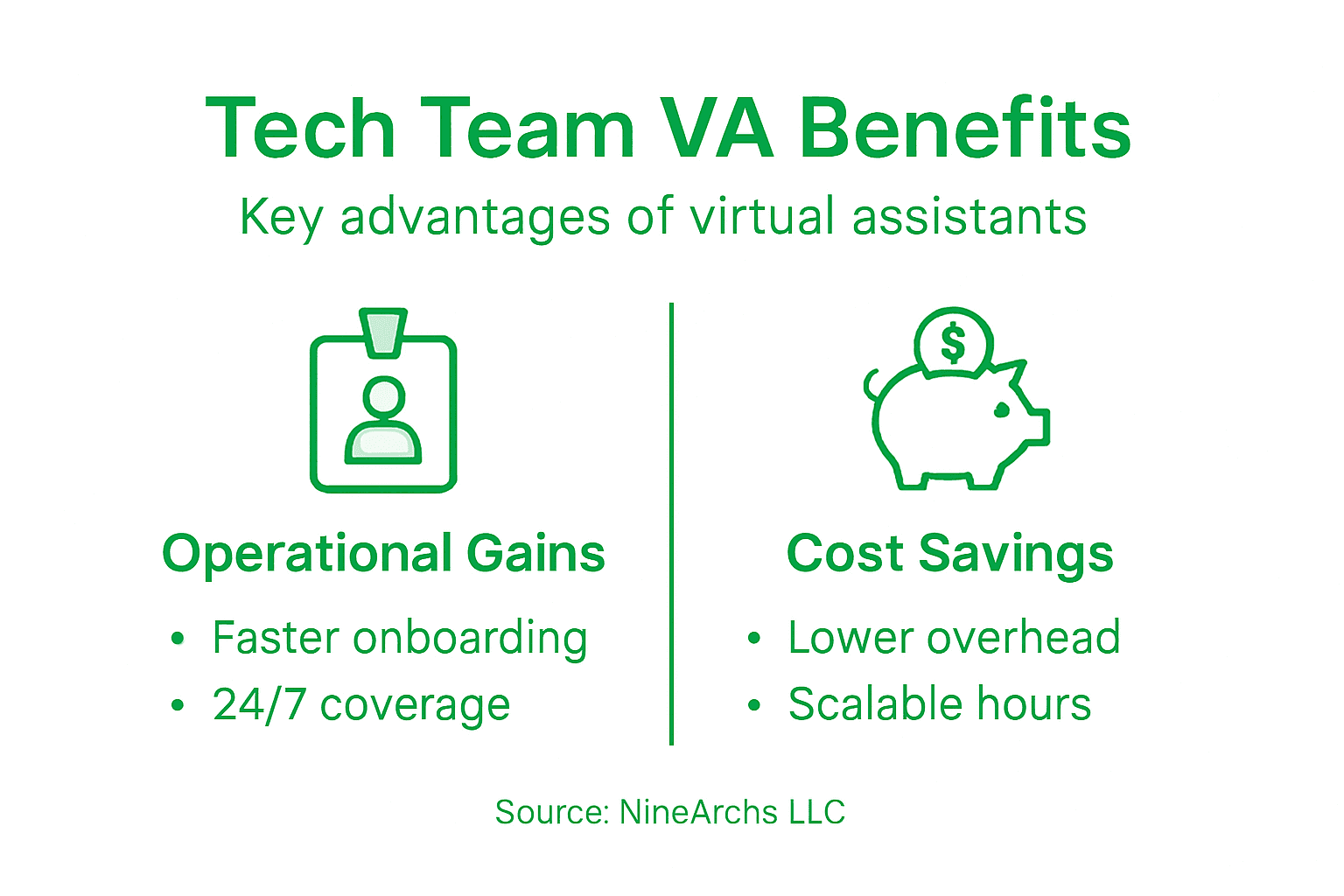
Operational scalability represents the critical advantage that virtual assistants bring to modern technology teams. By strategically integrating these flexible professionals, organizations can dramatically transform their workflow efficiency and resource allocation. Business process optimization through virtual assistants enables companies to rapidly adjust workforce capabilities without the traditional constraints of full-time hiring and extensive onboarding processes.
The key operational benefits of virtual assistants for tech teams can be categorized into several transformative dimensions:
- Cost Efficiency
- Reduce overhead expenses
- Eliminate full-time employee infrastructure costs
- Pay only for actual work performed
- Operational Flexibility
- Scale workforce up or down quickly
- Access global talent pools
- Adapt to project-specific skill requirements
- Productivity Enhancement
- Offload repetitive administrative tasks
- Free core team members for strategic work
- Maintain continuous operational momentum
- Risk Mitigation
- Minimize long-term employment commitments
- Reduce recruitment and training expenses
- Access specialized skills without permanent investment
Technology organizations particularly benefit from this model of workforce engagement. Virtual assistants bring specialized expertise without the substantial overhead associated with traditional hiring. They represent a dynamic solution that allows tech teams to remain agile, responsive, and strategically focused. By leveraging these professionals, companies can simultaneously reduce operational costs and increase organizational adaptability.
Pro tip: Develop clear, comprehensive standard operating procedures before onboarding virtual assistants to ensure seamless integration and maximum productivity.
Financial Impact and Cost Efficiency Factors
Understanding the financial dynamics of virtual assistant integration reveals substantial economic advantages for technology teams. By strategically managing outsourced talent costs, organizations can dramatically reduce operational expenses while maintaining high-performance capabilities. The financial model of virtual assistants represents a revolutionary approach to workforce management that directly impacts bottom-line performance.
The cost efficiency factors for virtual assistants can be comprehensively broken down into several key financial dimensions:
- Direct Labor Cost Reduction
- Eliminate full-time salary expenses
- Remove healthcare and insurance overhead
- Avoid paid vacation and sick leave costs
- Indirect Operational Savings
- Minimize office infrastructure expenses
- Reduce technology and equipment investments
- Lower administrative management costs
- Scalable Expense Management
- Pay only for actual hours worked
- Adjust workforce expenses with project demands
- Eliminate fixed labor cost commitments
- Tax and Compliance Benefits
- Reduce payroll tax obligations
- Minimize worker classification complexities
- Streamline international talent acquisition
Technology organizations gain significant financial flexibility through this model. Virtual assistants provide a variable cost structure that allows precise alignment of workforce expenses with actual business requirements. By converting fixed labor costs into flexible, project-based expenditures, companies can optimize their financial resources and reinvest savings into core technological innovation and strategic growth initiatives.
Below is a comparison of virtual assistants’ financial impact versus traditional hiring:
| Expense Category | Virtual Assistants | Traditional Employees | Financial Impact |
|---|---|---|---|
| Fixed Salaries | None (pay per project) | Required monthly payments | Greater cost flexibility |
| Benefits/Insurance | Not required | Mandatory costs | Reduces overhead significantly |
| Office Needs | Remote, no workspace | Physical office required | Saves infrastructure expenses |
| Tax/Compliance | Simplified for contractors | Complex HR requirements | Less administrative burden |
Pro tip: Develop a comprehensive cost-comparison spreadsheet that includes both direct and indirect expenses to accurately evaluate the financial impact of virtual assistants against traditional hiring models.
Risks, Pitfalls, and Best Practice Solutions
Navigating the complex landscape of virtual assistant integration requires a strategic and informed approach. Implementing robust security and management protocols helps technology teams mitigate potential risks while maximizing the benefits of this flexible workforce model. Understanding the potential challenges is crucial for developing effective mitigation strategies.
Key risks and corresponding best practice solutions include:
- Communication Barriers
- Risk: Misaligned expectations
- Solution: Develop clear communication protocols
- Implement detailed onboarding documentation
- Use collaborative project management tools
- Data Security Concerns
- Risk: Potential confidentiality breaches
- Solution: Require comprehensive non-disclosure agreements
- Establish strict access control mechanisms
- Implement robust cybersecurity training
- Quality Control Challenges
- Risk: Inconsistent work performance
- Solution: Create detailed performance metrics
- Develop comprehensive standard operating procedures
- Implement regular performance reviews
- Cultural and Time Zone Complexities
- Risk: Miscommunication and workflow disruptions
- Solution: Use asynchronous communication tools
- Establish clear overlap working hours
- Develop cultural sensitivity training
Successful virtual assistant integration demands a proactive approach to risk management. Technology teams must view these professionals as strategic partners, investing time in comprehensive onboarding, clear expectations, and ongoing performance management. The goal is creating a seamless, secure, and productive working relationship that transcends traditional outsourcing limitations.
Pro tip: Conduct monthly comprehensive reviews of virtual assistant performance, including communication effectiveness, quality of work, and alignment with organizational objectives.
Unlock Tech Team Potential with Expert Virtual Assistants
Struggling with managing complex workflows or scaling your technology operations while keeping costs under control is a common challenge highlighted in the article “Why Hire Virtual Assistants for Tech Teams”. Key pain points such as communication barriers, quality control, and the need for operational flexibility require strategic solutions. Leveraging virtual assistants who excel in tasks like project coordination, technical support, and research can free your core team to focus on innovation and growth while reducing financial risks.
NineArchs LLC offers tailored remote workforce solutions designed exactly for technology teams facing these hurdles. With a professional outsourcing approach, we provide experienced virtual assistants who integrate seamlessly into your existing tech ecosystem, improving productivity and enhancing operational scalability. Our expertise in knowledge outsourcing, business process outsourcing, and technical support ensures your virtual assistant partnership is reliable, secure, and cost-efficient.
Experience the difference of collaborating with a partner who understands your need for clarity, control, and continuous momentum in tech operations.
Explore how strategic virtual assistance can transform your tech workflows at NineArchs.
Take the next step to streamline your technology operations and boost productivity by connecting with NineArchs today. Contact us now to discover custom virtual assistant services that align perfectly with your goals and budget at NineArchs Contact. Your scalable, flexible, and secure solution for tech workforce challenges is just a click away.
Frequently Asked Questions
What are the main benefits of hiring virtual assistants for tech teams?
Hiring virtual assistants for tech teams enhances operational flexibility, reduces overhead costs, and improves productivity by allowing core team members to focus on strategic work while routine tasks are handled externally.
How do virtual assistants differ from traditional employees?
Virtual assistants are independent contractors who offer specialized skills for specific tasks, providing flexibility and scalability without the long-term commitments and costs associated with full-time employees.
What types of tasks can virtual assistants perform for tech teams?
Virtual assistants can handle a variety of tasks for tech teams, including project coordination, email screening, data entry, technical support, and more specialized roles like digital marketing analytics or software development support.
What should organizations consider when onboarding a virtual assistant?
When onboarding a virtual assistant, organizations should focus on creating comprehensive standard operating procedures, clear communication protocols, and provide detailed onboarding documentation to ensure smooth collaboration.