



Most international tech firms lose nearly twenty percent of productivity to inefficient back office processes each year, even when adopting solutions popular among American companies. For operations managers searching for ways to keep costs in check and workflows reliable, understanding what truly drives back office excellence matters more than ever. This guide unpacks the core support functions and their impact on organizational success, offering practical strategies to protect performance and maintain a competitive edge.
Defining Back Office Support Functions
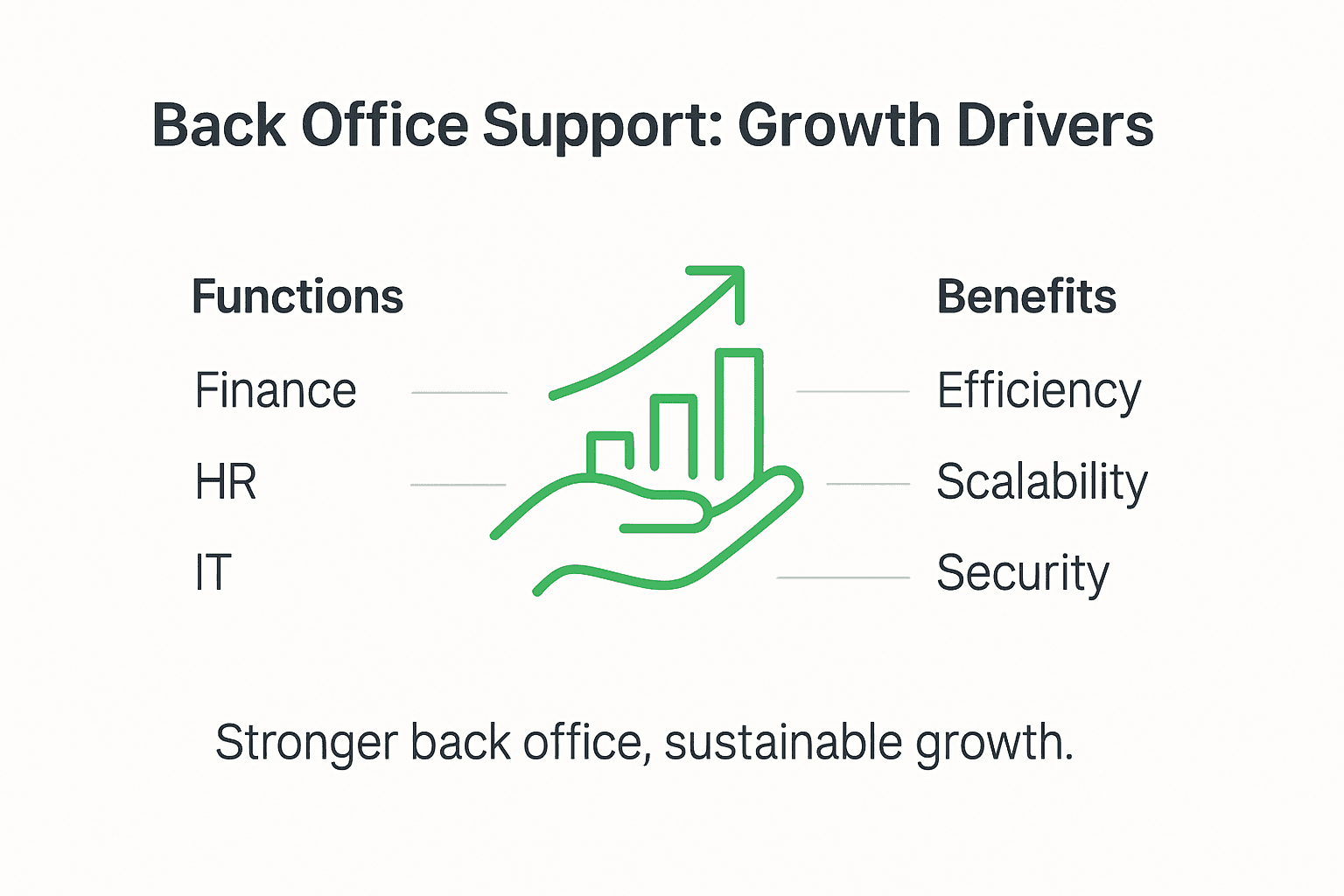
Back office support functions are the critical behind-the-scenes operations that power organizational success without direct customer interaction. These administrative and operational processes form the foundational infrastructure enabling businesses to run smoothly and efficiently. While often overlooked, back office functions are the hidden engines driving strategic growth and operational reliability.
Technically, back office support encompasses a wide range of essential business activities, including:
- Accounting and Financial Management
- Bookkeeping and financial reporting
- Payroll processing
- Budget planning and analysis
- Human Resources Operations
- Employee recruitment and onboarding
- Performance management
- Benefits administration
- Logistics and Supply Chain Management
- Inventory tracking
- Procurement
- Vendor relationship management
- Data Management and Administrative Support
- Record keeping
- Document processing
- Information systems maintenance
Businesses increasingly recognize that efficient back office support services are not merely administrative tasks but strategic capabilities that directly impact organizational performance. These functions create the operational stability necessary for front-facing teams to focus on core business objectives, customer engagement, and revenue generation.

Modern organizations are transforming back office operations through technological integration, outsourcing, and process optimization. By streamlining these critical support functions, companies can reduce operational costs, minimize errors, and allocate resources more strategically across their business ecosystem.
Pro Tip: Implement quarterly workflow audits to identify inefficiencies and bottlenecks in your back office processes, ensuring continuous improvement and operational excellence.
Types of Back Office Services for Tech Firms
Tech firms require specialized back office services that go beyond traditional administrative support, focusing on technology-driven solutions that enable scalable and efficient business operations. These services are critical for maintaining technological infrastructure, managing complex data ecosystems, and supporting rapid organizational growth.
Key back office service categories for technology companies include:
- IT Infrastructure Management
- Network maintenance and monitoring
- Cloud service configuration
- Hardware and software asset tracking
- Technical Support Services
- Internal helpdesk operations
- User access and permission management
- Technology troubleshooting and resolution
- Data Management and Analytics
- Database administration
- Data quality assurance
- Business intelligence reporting
- Cybersecurity and Compliance
- Security protocol implementation
- Risk assessment and management
- Regulatory compliance tracking
Technical support services represent a critical component of back office operations, enabling technology companies to maintain seamless internal workflows and rapidly address potential operational disruptions. These services ensure that technical infrastructure remains stable, allowing core business teams to focus on innovation and strategic objectives.
Modern tech firms are increasingly leveraging outsourced back office solutions to optimize operational efficiency, reduce overhead costs, and access specialized talent pools. By strategically selecting service providers with deep technological expertise, organizations can transform back office functions from traditional cost centers into strategic enablers of business growth and technological advancement.
Pro Tip: Conduct annual technology infrastructure audits to identify potential service gaps, optimize resource allocation, and ensure your back office support remains aligned with evolving business requirements.
How Outsourcing Enhances Efficiency and Flexibility
Back office outsourcing represents a strategic approach for businesses to transform operational capabilities, enabling organizations to optimize resource allocation, reduce costs, and access specialized expertise without maintaining extensive internal infrastructure. By delegating non-core administrative functions to specialized service providers, companies can redirect critical internal resources toward core business objectives and innovation strategies.
The primary efficiency advantages of back office outsourcing include:
- Cost Optimization
- Reduced overhead expenses
- Elimination of recruitment and training costs
- Flexible staffing models
- Talent Access
- Immediate access to specialized skills
- Global talent pool engagement
- Expertise across multiple technological domains
- Operational Scalability
- Quick resource ramping
- Reduced time-to-deployment
- Adaptable workforce capabilities
- Risk Mitigation
- Standardized compliance processes
- Enhanced data security protocols
- Reduced operational vulnerabilities
Understanding back office outsourcing strategies allows businesses to design more agile and responsive operational frameworks. Modern organizations recognize that outsourcing is not merely a cost-cutting measure but a sophisticated approach to building competitive technological capabilities and maintaining strategic flexibility.
Technological advancements have dramatically transformed outsourcing from a transactional service to a strategic partnership. Advanced communication technologies, robust security frameworks, and sophisticated project management tools enable seamless collaboration between internal teams and external service providers, breaking down traditional geographical and organizational barriers.
Here’s a summary of how back office outsourcing boosts business value:
| Key Benefit | Organizational Impact | Example Scenario |
|---|---|---|
| Cost Reduction | Frees up budget for innovation | Shifting payroll to an external firm |
| Enhanced Scalability | Quickly matches workforce needs | Expanding support during peak projects |
| Specialized Expertise | Improves process quality and speed | Accessing IT security specialists |
| Risk Mitigation | Reduces compliance violations | Using a provider with compliance certifications |
Pro Tip: Develop comprehensive service level agreements that clearly define performance metrics, communication protocols, and quality standards before initiating any back office outsourcing partnership.
Cost, Security, and Talent Considerations
Businesses contemplating back office outsourcing must carefully evaluate three critical dimensions: financial implications, data security protocols, and talent acquisition strategies. These interconnected considerations form the foundation of successful external workforce partnerships, requiring nuanced understanding and strategic planning beyond simple cost calculations.
Key strategic considerations include:
- Cost Management
- Direct salary reduction
- Elimination of infrastructure expenses
- Predictable monthly operational expenditures
- Security Frameworks
- Advanced encryption protocols
- Multi-factor authentication systems
- Comprehensive compliance monitoring
- Talent Acquisition
- Global skill diversity
- Specialized expertise access
- Rapid workforce scalability
- Risk Mitigation
- Contractual performance guarantees
- Continuous quality assurance
- Transparent reporting mechanisms
Advanced security protocols in IT outsourcing represent a critical consideration for organizations seeking to protect sensitive operational data while maintaining flexible workforce strategies. Sophisticated outsourcing partners implement robust technological safeguards that often exceed internal security capabilities of smaller organizations.
Modern talent acquisition through outsourcing transcends traditional recruitment models, enabling businesses to access specialized skills without extensive hiring processes. By leveraging global talent networks, companies can rapidly deploy expert resources, reduce time-to-market for critical projects, and maintain competitive technological capabilities.
Pro Tip: Conduct comprehensive vendor security assessments and establish clear data protection contractual clauses before finalizing any back office outsourcing partnership.
Risks of Inadequate Back Office Support
Back office inefficiencies represent significant operational vulnerabilities that can undermine an organization’s entire performance ecosystem. When core administrative functions fail to operate with precision and reliability, businesses experience cascading challenges that extend far beyond simple administrative inconveniences, potentially threatening long-term strategic objectives and competitive positioning.
Critical risks associated with inadequate back office support include:
- Operational Disruptions
- Increased processing errors
- Delayed financial reporting
- Inconsistent workflow management
- Compliance Vulnerabilities
- Regulatory violation risks
- Inadequate documentation
- Poor audit trail maintenance
- Financial Performance Impacts
- Unnecessary operational expenses
- Revenue leakage
- Inefficient resource allocation
- Technological Limitations
- Outdated system integrations
- Limited technological scalability
- Reduced digital transformation potential
Administrative support strategies play a crucial role in mitigating organizational risks by establishing robust operational frameworks that minimize potential systemic failures. Proactive back office management ensures that businesses can maintain strategic agility and respond quickly to emerging market challenges.
Modern organizations increasingly recognize that back office inefficiencies are not merely administrative problems but strategic risks that can compromise competitive positioning. Unaddressed operational vulnerabilities can lead to decreased employee productivity, increased operational costs, and diminished capacity to respond effectively to dynamic business environments.
Compare top back office risks and their business consequences:
| Risk Area | Potential Consequence | Business Impact |
|---|---|---|
| Data Inconsistency | Incorrect reporting and planning | Loss of management trust |
| Delayed Processing | Missed deadlines and penalties | Damaged reputation |
| Security Lapses | Data breaches and legal issues | Financial and legal loss |
| Poor Documentation | Audit failures and compliance gaps | Increased regulatory scrutiny |
Pro Tip: Implement quarterly comprehensive back office audits to identify potential operational vulnerabilities and develop targeted improvement strategies before they escalate into significant organizational challenges.
Unlock Your Business Growth with Expert Back Office Support
Struggling with back office inefficiencies that drain resources and stall your company’s growth No need to worry because targeted solutions exist to streamline operations and empower your core teams. By addressing critical pain points like costly errors, compliance risks, and operational disruptions businesses can improve productivity and refocus on innovation. At NineArchs LLC, we specialize in comprehensive back office outsourcing services tailored to your unique needs including finance, data management, and IT support.
Our proven approach offers
- Access to specialized global talent
- Scalable support to match your growth trajectory
- Enhanced security and compliance controls
Ready to transform your back office from a hidden risk to a strategic asset Explore how our solutions deliver reliability, cost-efficiency, and technological innovation exactly where you need them. Visit NineArchs Contact to connect with our team and learn more about back office support services. Take the first step toward operational excellence and sustained growth today.
Discover how our virtual assistance, business process outsourcing, and custom IT solutions can elevate your business Don’t let back office challenges hold you back any longer Reach out to us now at NineArchs Contact and start your journey to scalable success.
Frequently Asked Questions
What is back office support?
Back office support refers to the essential administrative and operational processes that help businesses run smoothly, including functions like accounting, human resources, logistics, and data management, without direct customer interaction.
How does back office support contribute to business growth?
Back office support enables operational stability, allowing front-facing teams to focus on customer engagement and core business objectives, which ultimately drives revenue generation and strategic growth.
Why should companies consider outsourcing back office functions?
Outsourcing back office functions allows companies to reduce operational costs, access specialized expertise, enhance scalability, and mitigate risks without needing to maintain extensive internal resources.
What are the risks of inadequate back office support?
Inadequate back office support can lead to operational disruptions, compliance vulnerabilities, poor financial performance, and technological limitations, which can compromise a business’s competitive positioning and overall success.