

Most american technology companies underestimate the true power of a business support desk. While over 60 percent of operations managers still see these platforms as mere cost centers, they actually drive major gains in productivity and long-term operational savings. As global competition rises, understanding the essentials and common misconceptions around support desks is crucial for any firm aiming for efficient growth and smarter resource allocation.
Business support desk essentials and misconceptions
A business support desk represents far more than a simple problem resolution center—it serves as a strategic platform for organizational growth and operational excellence. While many organizations mistakenly view support desks as tactical cost centers, they actually function as critical infrastructure for scalable business performance. Efficient support desk services transform customer interactions from transactional exchanges into opportunities for strategic engagement.
The fundamental misconception surrounding business support desks is that they primarily exist to resolve technical issues. In reality, modern support desks operate as sophisticated communication hubs that integrate multiple dimensions of organizational responsiveness. They synthesize customer feedback, track operational trends, and provide actionable insights that drive strategic decision making. Research indicates that top-performing support desks do not merely react to problems but proactively identify systemic improvements across business processes.
Key essentials for an effective business support desk include:
- Structured ticket management systems
- Clear escalation protocols
- Comprehensive knowledge base development
- Continuous staff training and skill enhancement
- Integrated performance tracking metrics
Technological integration plays a crucial role in transforming support desks from reactive units to proactive business intelligence centers. Advanced support desks leverage artificial intelligence, machine learning algorithms, and predictive analytics to anticipate customer needs and streamline resolution pathways.
Pro tip: Implement a quarterly review process that analyzes support desk performance metrics to identify emerging trends and potential systemic improvements across your organization.
Types of business support desks for tech firms
Tech firms require specialized support desk configurations that go beyond traditional customer service models. Support desk services can be strategically classified into multiple specialized categories designed to address unique technological challenges and organizational needs.
The primary types of business support desks for technology companies include:
- Technical Support Desks: Focus on resolving specific hardware and software issues
- IT Service Management Desks: Manage comprehensive technological infrastructure and system integrations
- Software Development Support Desks: Handle product-specific technical queries and development-related challenges
- Cloud Services Support Desks: Address complex cloud infrastructure and migration challenges
- Cybersecurity Support Desks: Manage security incident response and threat mitigation strategies
Each support desk type represents a unique approach to technological problem solving, with specialized skill sets and operational protocols tailored to specific technological domains. Technical support desks typically operate with shorter resolution windows and more immediate response requirements, while IT service management desks engage in more strategic, long-term technological planning and optimization.
Advanced technology organizations are increasingly adopting hybrid support desk models that integrate multiple service types, enabling more flexible and comprehensive technological support strategies. These integrated approaches leverage cross-functional expertise and advanced technological tools to provide more nuanced, adaptive support solutions.
Here is a summary of how different business support desk types serve technology firms:
| Support Desk Type | Main Focus Area | Typical Users |
|---|---|---|
| Technical Support Desk | Hardware/software troubleshooting | End users, customers |
| IT Service Management Desk | Infrastructure and system oversight | IT staff, management |
| Software Development Desk | Developer-related product support | Developers, QA teams |
| Cloud Services Desk | Cloud infrastructure and migration | Cloud admins, engineers |
| Cybersecurity Support Desk | Threat detection and mitigation | Security teams, CIOs |
Pro tip: Design your support desk infrastructure with clear inter-departmental communication protocols to ensure seamless knowledge transfer and rapid problem resolution.
How support desks improve productivity and efficiency
Modern businesses recognize that support desks are far more than problem resolution centers—they are strategic productivity engines that transform organizational performance. Workflow optimization strategies enable companies to convert traditional support functions into powerful efficiency drivers that streamline operational processes and reduce time-consuming manual interventions.
Support desks improve productivity through several critical mechanisms:
- Automated Ticket Routing: Rapidly directs issues to most appropriate team members
- Knowledge Management Systems: Capture and centralize institutional problem-solving expertise
- Performance Analytics: Track resolution times, identify bottlenecks, and measure support team effectiveness
- Standardized Response Protocols: Create consistent, repeatable problem-solving approaches
- Integrated Communication Channels: Enable seamless collaboration across departments
The quantitative impact of well-designed support desks extends beyond immediate issue resolution. By implementing intelligent routing algorithms and comprehensive tracking systems, organizations can dramatically reduce response times, minimize operational disruptions, and create data-driven insights that continuously improve internal processes. Advanced support desks leverage machine learning and predictive analytics to anticipate potential issues before they escalate, transforming reactive support models into proactive strategic assets.
Technology-driven support desks fundamentally reshape organizational efficiency by creating transparent, accountable, and interconnected problem-solving ecosystems. These systems not only resolve individual technical challenges but also generate valuable organizational intelligence that drives continuous improvement and strategic decision making.

Pro tip: Implement quarterly performance reviews of your support desk metrics to identify systemic improvement opportunities and track tangible productivity gains.
Key features: ticketing, automation, reporting
A comprehensive business support desk relies on three fundamental technological pillars that transform operational efficiency: ticketing systems, intelligent automation, and strategic reporting mechanisms. Support desk services integrate these components to create powerful, responsive organizational problem-solving platforms.
Ticketing systems serve as the critical infrastructure for managing support interactions:
- Centralized Request Tracking: Log and monitor all incoming support requests
- Priority Classification: Automatically assign urgency levels based on predefined rules
- Multi-Channel Integration: Accept requests from email, chat, phone, and web platforms
- Customizable Workflow Management: Create specific routing paths for different issue types
- Real-Time Status Updates: Provide transparent communication about request progress
Automation technologies dramatically enhance support desk capabilities by reducing manual intervention and accelerating problem resolution. Intelligent routing algorithms can automatically assign tickets to the most appropriate support specialist, while machine learning systems predict potential bottlenecks and proactively suggest optimization strategies. These technologies transform support desks from reactive problem-solving centers into predictive, strategic organizational assets.
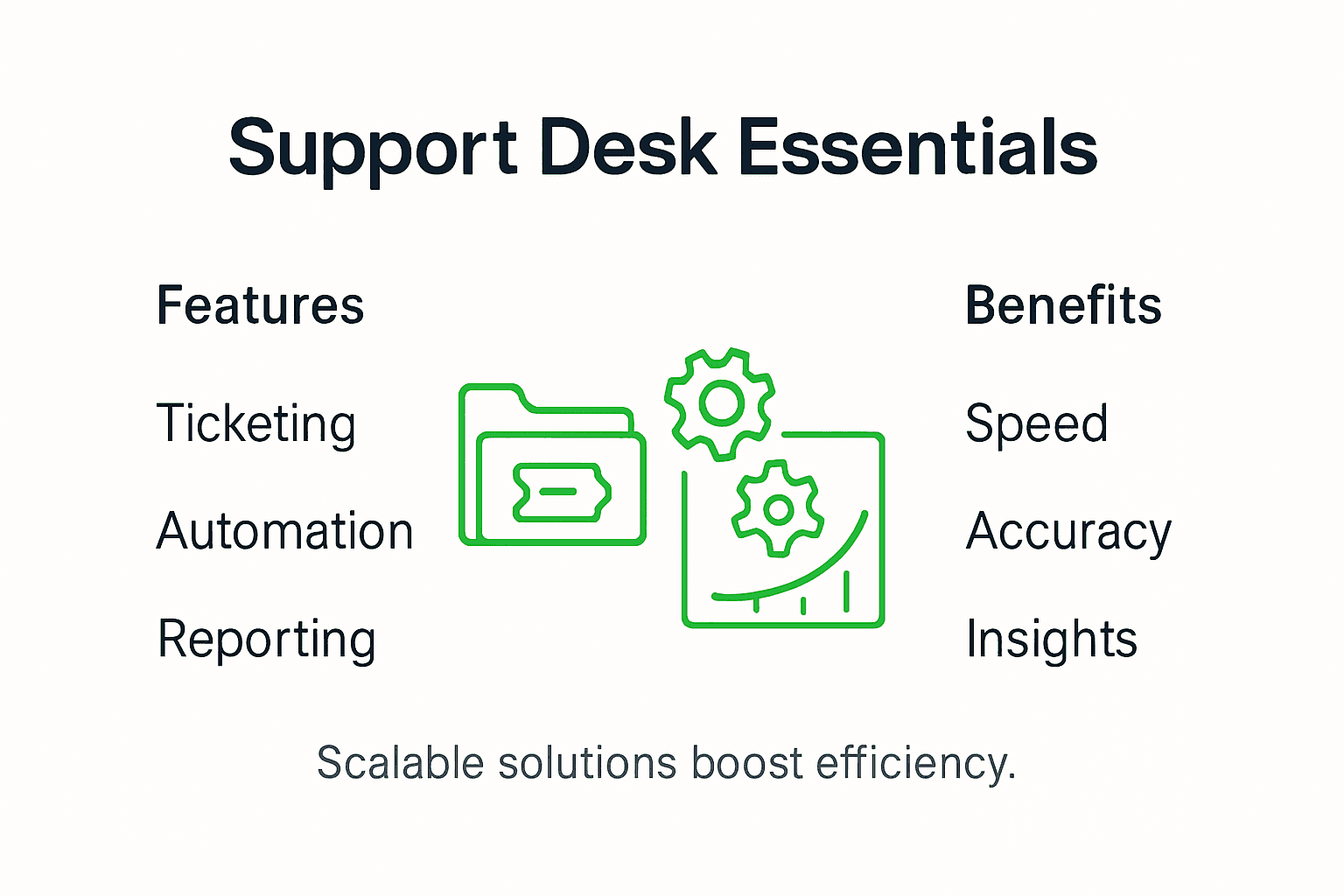
Reporting and analytics represent the strategic intelligence layer of modern support desks. By generating comprehensive performance metrics, organizations can track critical indicators such as average resolution time, first-contact resolution rates, and customer satisfaction scores. These insights enable continuous process improvement, identify training opportunities, and provide data-driven strategies for enhancing overall operational efficiency.
The table below highlights the business impact of key support desk features:
| Feature | Function | Business Impact |
|---|---|---|
| Ticketing System | Centralizes and tracks support requests | Enhances accountability, reduces errors |
| Intelligent Automation | Routes and resolves issues automatically | Cuts response times, saves labor costs |
| Reporting Tools | Analyzes performance metrics and trends | Drives continuous improvement |
Pro tip: Develop a standardized reporting framework that tracks not just quantitative metrics, but also qualitative feedback to create a holistic view of support desk performance.
Financial impact and cost efficiency explained
Businesses increasingly recognize support desks as strategic financial investments that drive substantial operational cost savings and revenue optimization. Support desk services transform traditional cost centers into powerful economic engines that generate measurable financial benefits across multiple organizational dimensions.
The primary financial advantages of implementing a sophisticated support desk include:
- Reduced Labor Costs: Automate repetitive tasks and minimize manual intervention
- Decreased Operational Downtime: Quickly resolve technical issues that interrupt productivity
- Enhanced Resource Allocation: Strategically deploy human capital more effectively
- Predictive Cost Management: Identify and mitigate potential expensive system failures
- Improved Customer Retention: Minimize revenue loss through superior support experiences
Advanced support desks generate financial value through intelligent cost optimization strategies. By leveraging data analytics and machine learning, organizations can predict potential system failures, streamline resource deployment, and create more accurate budgeting models. These technological platforms transform support from a reactive expense into a proactive value generation mechanism that directly contributes to bottom-line performance.
The economic impact extends beyond immediate cost savings. Support desks generate comprehensive performance data that enables leadership to make informed strategic decisions, optimize workforce productivity, and identify potential revenue streams. By converting support interactions into actionable business intelligence, companies can continuously refine their operational efficiency and create sustainable competitive advantages.
Pro tip: Implement a quarterly financial analysis of your support desk performance to quantify direct and indirect cost savings and justify ongoing technological investments.
Risks, pitfalls, and mistakes to avoid
Implementing a business support desk requires strategic planning and awareness of potential operational challenges. Support desk services must be carefully designed to avoid common implementation mistakes that can compromise organizational effectiveness and user experience.
Critical risks and potential pitfalls include:
- Inadequate Training: Insufficient staff preparation leads to poor ticket management
- Overcomplicated Workflows: Complex routing systems create resolution bottlenecks
- Lack of Performance Metrics: Failing to track key support desk performance indicators
- Inconsistent Communication Protocols: Unclear escalation and response guidelines
- Technology Integration Failures: Poor synchronization between support platforms
Many organizations underestimate the complexity of creating a robust support desk infrastructure. Common mistakes often stem from viewing support desks as simple technical troubleshooting centers rather than strategic organizational tools. Ineffective implementation can result in increased operational costs, decreased user satisfaction, and diminished team productivity. Successful support desks require continuous refinement, leveraging data-driven insights and maintaining flexible technological ecosystems.
Technological risks extend beyond immediate operational challenges. Support desks that fail to integrate comprehensive security protocols can expose organizations to significant data privacy vulnerabilities. Advanced support desk strategies must incorporate robust cybersecurity measures, ensuring that ticket management systems protect sensitive information while maintaining seamless communication channels.
Pro tip: Conduct comprehensive scenario testing and establish clear performance benchmarks before fully deploying your support desk infrastructure to identify and mitigate potential systemic weaknesses.
Elevate Your Business Growth with Scalable Support Desk Solutions
Many businesses struggle with inefficient support desk systems that hinder scalability and operational efficiency. This article highlights crucial challenges such as inadequate ticket management, lack of automation, and poor performance tracking that slow down your response times and drain resources. If your goal is to transform your support desk from a reactive cost center into a proactive driver of productivity and growth your business needs reliable, scalable, and technology-driven outsourcing solutions.
At NineArchs LLC we specialize in delivering tailored remote workforce and IT support services that directly address these pain points. Our expertise in business support services explained ensures your support desk implements intelligent automation, comprehensive reporting, and expert staffing to reduce downtime and improve customer satisfaction. By partnering with us you gain not only cost-efficiency but also a flexible and innovative support infrastructure designed to grow with your organization.
Get started today by connecting with our team at NineArchs contact to discover how our remote workforce solutions can optimize your support desk performance and accelerate your scalable growth.
Take charge of your business support strategy now and experience the impact of professional, reliable, and scalable support services crafted to maximize your operational success.
Frequently Asked Questions
What are the primary functions of a business support desk?
A business support desk not only resolves technical issues but also acts as a communication hub, synthesizing customer feedback, tracking operational trends, and offering insights that drive strategic decision-making.
How can a business support desk improve organizational efficiency?
A business support desk enhances efficiency through automated ticket routing, knowledge management systems, performance analytics, standardized response protocols, and integrated communication channels.
What key features should I look for in a support desk system?
Key features to consider include ticketing systems for tracking requests, intelligent automation to streamline operations, and strategic reporting tools to analyze performance metrics and improve processes.
How does a business support desk contribute to financial savings?
A business support desk contributes to financial savings by reducing labor costs through automation, minimizing operational downtime with quick issue resolution, and enhancing customer retention through effective support experiences.
Recommended
- 7 Examples of Support Desk Services for Scaling Businesses | NineArchs
- Business Support Services Explained: Complete Guide | NineArchs
- Master the IT Support Delegation Process for Streamlined Results | NineArchs
- Why Outsource Support Desk: Complete Guide for 2025 | NineArchs
- IT Support Benefits Explained: Value for Brisbane SMEs – IT Start